
Artificial intelligence and machine learning are core emerging technologies that enable systems to learn from data, automate decisions, and adapt over time. They matter today because they improve efficiency, accuracy, and scale across industries. Their future impact will focus on responsible integration, workforce transformation, and intelligent infrastructure.
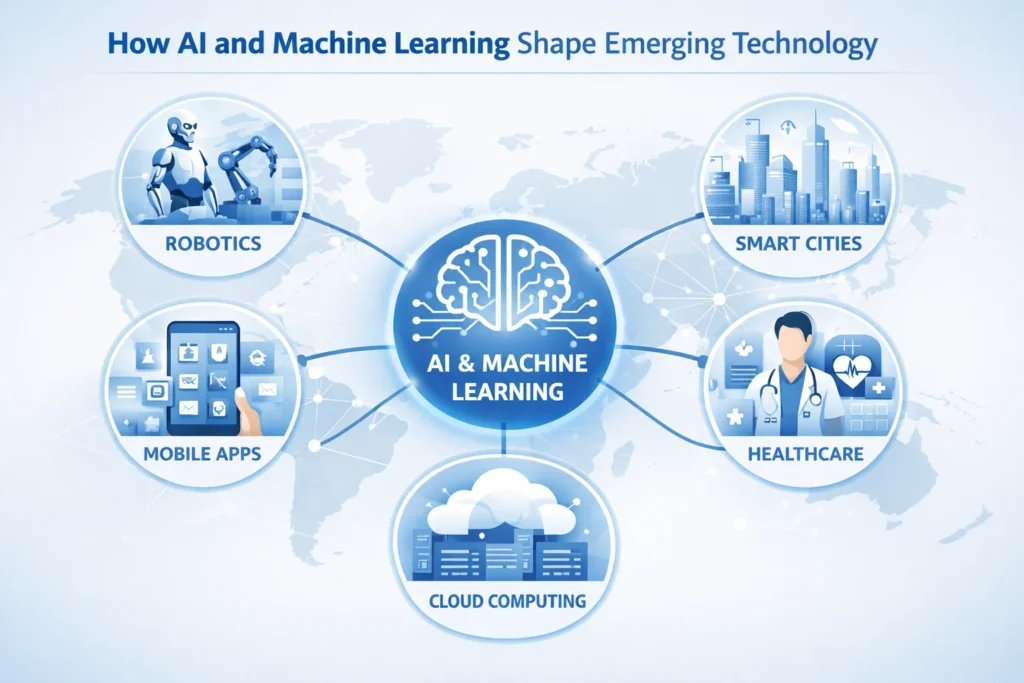
Quick Facts about AI and Machine Learning
| Fact | Detail |
|---|---|
| What AI is | Technology that enables machines to perform intelligent tasks |
| Role of machine learning | Allows AI systems to learn from data and improve automatically |
| Where AI is used | Mobile apps, healthcare, finance, smart cities, workplaces |
| Key advantage | Faster, more accurate decision-making at scale |
| Career impact | Shifts jobs toward analysis, oversight, and AI collaboration |
| Current leaders | United States and China |
| Future direction | Embedded, regulated, and efficiency-focused AI systems |
Why this matters right now
AI stopped being a lab experiment. It now sits inside phones, apps, offices, hospitals, and factories. According to multiple industry reports, AI investment keeps climbing because it solves real problems at scale. Faster decisions. Better predictions. Lower costs. This is not about hype. It’s about capability.
Machine learning is the engine behind that capability. Together, AI and ML form the backbone of what we call emerging technology. If you want to understand where tech is going, you start here.
What artificial intelligence actually is, in plain terms
Artificial intelligence is the ability of machines to perform tasks that normally require human intelligence. That includes recognizing patterns, understanding language, making decisions, and learning from experience.
AI becomes “emerging” when it shifts from theory to impact. That shift already happened. Recommendation systems, voice assistants, fraud detection, and image recognition all rely on AI today. What’s new is how fast these systems learn and how widely they’re deployed.
Machine learning is the reason.
How machine learning powers modern AI
Machine learning allows systems to learn from data instead of following rigid rules. Feed the system examples. Let it detect patterns. Improve the results over time.
Here’s the simple loop that runs almost every ML system:
Data comes in → patterns are learned → predictions are made → feedback improves accuracy.
That loop scales. The more data, the smarter the system becomes. This is why AI thrives in areas like mobile apps, cloud platforms, and large networks where data flows constantly.
AI vs machine learning: the difference that actually matters
AI is the goal. Machine learning is the method.
AI refers to systems that act intelligently. Machine learning is one way to build those systems. Not all AI uses ML, but almost all modern AI does.
Think of AI as the destination and machine learning as the road that gets you there. 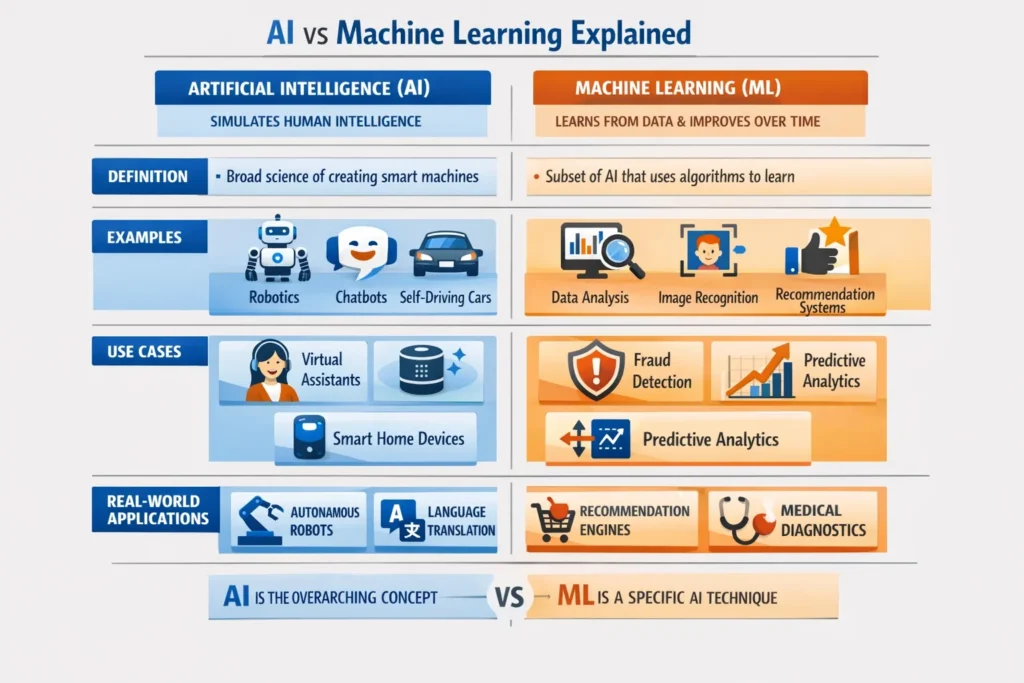
The four types of AI technology
Most real-world systems fall into these categories:
Reactive machines
They respond to input but don’t learn. Basic game AI fits here.
Limited memory systems
These learn from past data. Most modern AI, including recommendation engines, sits in this category.
Theory of mind
Still experimental. These systems aim to understand emotions and intent.
Self-aware AI
Purely theoretical. No real-world examples exist today.
What matters for emerging tech is limited-memory AI. That’s where progress happens now.
The seven common types of AI you see today
- Narrow AI
- Machine learning systems
- Deep learning models
- Natural language processing
- Computer vision
- Predictive analytics
- Generative AI
Each solves a specific problem well. None think like humans. That’s an important boundary to remember.
Is ChatGPT AI or machine learning?
ChatGPT is an AI system built using machine learning, specifically deep learning. It learns patterns from large datasets and generates responses based on probability, not understanding.
It feels intelligent because language patterns are complex. But it does not think, reason, or feel. It predicts what comes next based on what it has learned.
The system itself is developed by OpenAI, which focuses on building and researching advanced AI models.
How AI and machine learning are transforming emerging technologies
AI in mobile apps
Mobile apps now adapt to users in real time. Cameras auto-correct images. Keyboards predict text. Apps suggest content before you search.
Machine learning makes apps personal without manual setup. That’s why modern apps feel smarter with every update.
AI in healthcare, finance, and smart cities
Healthcare uses AI for early disease detection and imaging analysis. Finance uses it for fraud prevention and risk modeling. Cities use it to manage traffic, energy, and public safety.
The common thread is pattern recognition at scale. Humans can’t process that volume. Machines can.
AI in technical communication
AI now improves how instructions, documentation, and support systems work. It summarizes complex material, adapts language to skill level, and reduces misunderstandings.
That makes technology more usable, not more complex.
The role of AI in shaping the future of work
AI doesn’t replace work. It reshapes it.
Routine tasks shrink. Decision-making grows. New roles appear around data, oversight, and system design.
Jobs that combine human judgment with AI tools are expanding fastest. That includes healthcare professionals, analysts, designers, engineers, and educators.
The future belongs to people who know how to work with AI, not compete against it.

Five positive effects of AI on technology and society
- Faster and more accurate decisions
- Improved accessibility for users with disabilities
- Better use of resources and energy
- Scalable solutions to complex problems
- New industries and job categories
These gains show up when AI is used responsibly and transparently.
Five key advantages of AI for users and businesses
Efficiency improves first. Accuracy follows. Costs drop. Insights deepen. Systems scale.
Those five advantages explain why AI adoption continues even during economic uncertainty.
Who are the Big 4 driving AI forward?
The AI landscape is shaped largely by four players:
- Microsoft
- Amazon
- OpenAI
Each brings a different strength, from cloud infrastructure to research and consumer platforms.
Which country is number one in AI?
Leadership depends on the metric.
The United States leads in research, startups, and commercial deployment.
China leads in scale, data volume, and state-backed implementation.
Both shape the global AI direction in different ways.
The four major emerging technologies today
AI sits alongside three others:
- Artificial intelligence and machine learning
- Internet of Things
- Biotechnology
- Advanced renewable energy systems
AI connects to all of them. That makes it the central force, not just another trend.
The future of AI and machine learning
Expect narrower, more reliable systems. Less magic. More precision.
AI will move closer to infrastructure, embedded quietly into tools people already use. Regulation will increase. Efficiency will matter more than novelty.
Progress will be steady, not explosive. That’s a sign of maturity.
How AI can help shape your future career
You don’t need to be a data scientist.
Understanding how AI tools work, where they fail, and how to guide them responsibly is enough to stay relevant. Communication, ethics, and system thinking matter as much as coding.
AI rewards adaptable thinkers.
Challenges and limits you should not ignore
AI depends on data quality. Bias travels with bad data. Energy use remains a concern. Transparency is still uneven.
These limits don’t stop progress. They shape it.
Practical checklist to understand AI clearly
- Know what the system learns from
- Ask what decisions it automates
- Check where humans stay in control
- Understand the limits before trusting outputs
- Focus on use cases, not promises
Final thoughts before you think about the future
AI and machine learning are not replacing human intelligence. They extend it.
Emerging technology is shaped by tools that learn, adapt, and scale. Understanding that shift puts you ahead, whether you’re a student, a business owner, or a future builder.
Frequently Asked Questions
What is artificial intelligence, in simple words?
Artificial intelligence is technology that allows machines to perform tasks that normally need human intelligence. This includes recognizing patterns, understanding language, making decisions, and learning from experience.
How is artificial intelligence shaping the future of technology?
AI is shaping the future by automating complex tasks, improving accuracy, and enabling systems to learn from data. It drives smarter apps, faster business decisions, better healthcare tools, and more efficient digital services.
Why is AI considered an emerging technology?
AI is considered emerging because its capabilities are still expanding rapidly. New models, better data processing, and wider real-world adoption continue to unlock uses that were not possible a few years ago.
How do AI and machine learning improve mobile apps?
AI and machine learning personalize mobile apps by learning user behavior. They power features like smart recommendations, voice assistants, predictive text, camera enhancement, and fraud detection.
What are the four main types of AI technology?
The four types are reactive machines, limited memory systems, theory of mind AI, and self-aware AI. Today, most real-world systems use limited memory AI.
What are the seven common types of AI used today?
Common types include narrow AI, machine learning, deep learning, natural language processing, computer vision, predictive analytics, and generative AI.
Is ChatGPT artificial intelligence or machine learning?
ChatGPT is an artificial intelligence system built using machine learning. It uses deep learning models trained on large datasets to generate human-like text responses.
What is the future of AI and machine learning?
The future of AI and machine learning focuses on more accurate, efficient, and responsible systems. AI will become part of everyday infrastructure rather than stand-alone tools.
What are five advantages of artificial intelligence?
AI improves efficiency, reduces errors, processes large amounts of data, supports better decision-making, and scales solutions across industries.
How does AI affect the future of work?
AI reshapes work by reducing repetitive tasks and increasing demand for analytical, creative, and oversight roles. Jobs evolve rather than disappear.
Which country is leading the world in AI?
Leadership depends on the measure used. The United States leads in research and innovation, while China leads in large-scale deployment and data-driven implementation.
How can AI help in your future career?
AI can support your career by automating routine work, improving productivity, and opening new roles that combine human judgment with intelligent tools