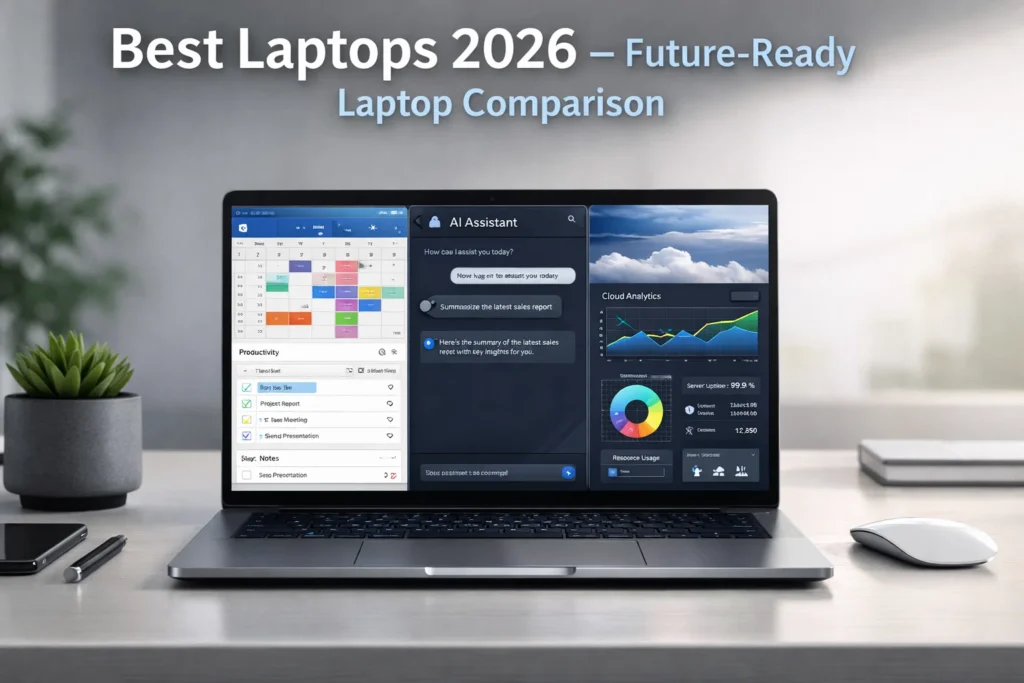
A 2026 laptop must balance performance, efficiency, and long-term support. Modern processors integrate AI features, RAM needs have increased, and brand reliability matters more than raw specs. Choosing a future-ready laptop means focusing on real usage, not marketing claims.
Quick Facts:
| Fact | Details |
|---|---|
| Ideal RAM in 2026 | 16GB for most users |
| Best processor choice | i5-class or equivalent for general use |
| Intel vs Ryzen | Both excellent, efficiency and use case matter |
| Best storage type | NVMe SSD |
| Laptop lifespan | 4–6 years with proper specs |
| Key buying focus | Balance, support, efficiency |
Buying a laptop in 2026 feels harder than it used to. Specs look impressive on paper, marketing is louder than ever, and prices keep climbing. At the same time, laptops now sit at the center of how we study, work, build businesses, and use AI tools. Choosing the wrong one can cost you years of frustration.
Here’s what matters. A good laptop in 2026 is not just fast today. It stays relevant for the next four to six years. It handles AI features without slowing down. It balances performance, battery life, and long-term software support. This guide breaks all of that down, without hype, without brand bias, and without confusing jargon.
Why Choosing the Right Laptop in 2026 Matters
Laptop usage has changed more in the last five years than in the decade before it. Cloud apps replaced heavy local software. AI assistants now run in the background. Browsers use more memory than entire operating systems once did. At the same time, people expect thinner devices, longer battery life, and quieter machines.
In 2026, most users keep a laptop longer than before. Prices are higher, and upgrade cycles are slower. That makes buying decisions more permanent. A weak processor or low RAM that felt “fine” at purchase can become a bottleneck within a year.
There’s also the future-proofing problem. New operating systems rely more on AI acceleration. Video conferencing, creative tools, and even basic productivity apps now use machine learning. A laptop that cannot support these features smoothly will age fast.
This is why specs alone do not tell the full story anymore. You need to understand how hardware, software, and real-world usage connect. That’s what this guide focuses on.
What Makes a Laptop “Future-Ready” in 2026?
A future-ready laptop is not the most expensive one. It’s the one that matches how technology is evolving.
Performance Beyond Basic Specs
Raw clock speeds matter less than architecture. Modern processors spread work across efficiency cores, performance cores, and AI engines. This allows laptops to stay responsive while saving battery.
AI acceleration is now part of everyday tasks. Noise cancellation, image upscaling, background blur, smart search, and local AI tools rely on dedicated processing units. Laptops without this hardware depend on slower software processing.
Graphics also matter more than before. Even non-gamers rely on GPU power for video editing, 3D rendering in browsers, and AI-assisted visuals.
Battery, Thermals, and Efficiency
A powerful laptop that overheats or drains quickly is not future-ready. In 2026, efficiency defines quality. Better thermal design means consistent performance over time. Better efficiency means fewer battery cycles lost each year.
Software Compatibility and Support
Long OS support is critical. Some brands update drivers and firmware for years. Others stop early. This affects security, stability, and compatibility with future apps.
Laptop Processors Explained for 2026 Buyers
Intel vs Ryzen in 2026 — What Actually Matters
Intel and AMD Ryzen both offer excellent processors in 2026. The difference is not about which one is “better.” It’s about how they behave.
Intel processors often excel in single-core performance and compatibility with legacy software. They also integrate AI acceleration deeply into newer chips.
Ryzen processors focus heavily on efficiency and multi-core performance. They often deliver better sustained performance at lower power levels.
In everyday use, both handle office work, browsing, and streaming easily. The choice matters more for heavy multitasking, creative work, and long battery life.
Should You Buy i5 or i7 in 2026?
This is one of the most searched questions, and the answer is simpler than it sounds.
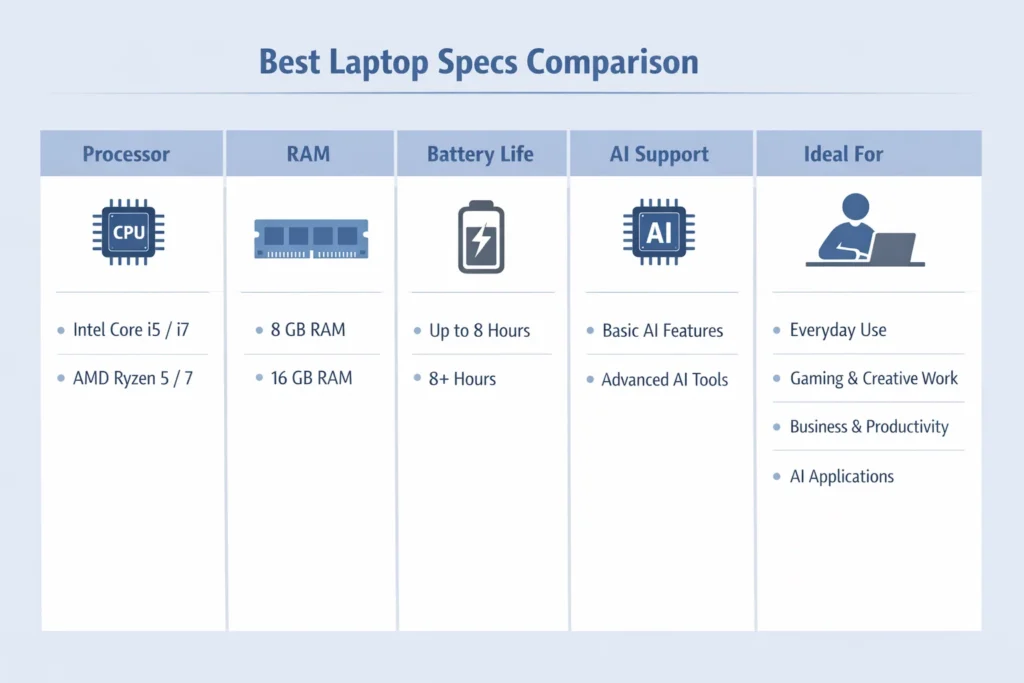
An i5-class processor is enough for most users. Students, office workers, and casual creators rarely push beyond what modern i5 chips can handle.
An i7 makes sense if you edit video regularly, compile large projects, or use demanding AI tools locally. It also makes sense if you plan to keep the laptop for many years and want extra headroom.
Buying an i7 just for the label usually wastes money.
Apple Silicon and ARM-Based Laptops
ARM-based laptops continue to grow in 2026. They offer excellent efficiency and battery life. Performance is strong for creative and productivity tasks. Compatibility is much better than it was a few years ago, but some specialized software still favors traditional architectures.
How Much RAM and Storage Do You Really Need?
How Much RAM Is Enough in 2026?
RAM needs have increased steadily. Browsers alone can use several gigabytes.
- 8GB RAM is the minimum, not the recommendation.
- 16GB RAM is the safe choice for most users.
- 32GB RAM is for heavy multitasking, creators, and professionals.
AI tools running locally make RAM even more important. Once RAM fills up, performance drops sharply.
Storage Types and Sizes
Fast storage matters more than large storage. NVMe SSDs improve boot times, app loading, and overall responsiveness.
- 512GB is the practical minimum.
- 1TB is ideal for creators and long-term use.
- Avoid laptops with slow storage, even if the capacity looks attractive.
Best Laptop Brands in 2026: Honest Comparison
HP vs Dell — Which Is Better Today?
HP and Dell both offer wide product ranges. Dell often focuses on business reliability and consistent support. HP offers strong designs and competitive pricing.
Dell laptops tend to have better long-term firmware support. HP often provides better value at mid-range prices. Neither is universally better. Model selection matters more than brand name.
Is Lenovo Better Than HP?
Lenovo’s ThinkPad line remains one of the most reliable options in 2026. Keyboards, durability, and enterprise support are strong. HP often competes better in consumer and design-focused models.
For work-focused users, Lenovo often wins. For home and mixed use, HP can offer better value.
Apple, ASUS, Acer, and Others
Apple dominates efficiency and ecosystem integration. ASUS leads in performance-focused designs. Acer competes aggressively on price. Each brand has strengths and weaknesses. There is no single king of laptops anymore.
Top Laptop Picks for Different Users in 2026
Best Laptop for Students
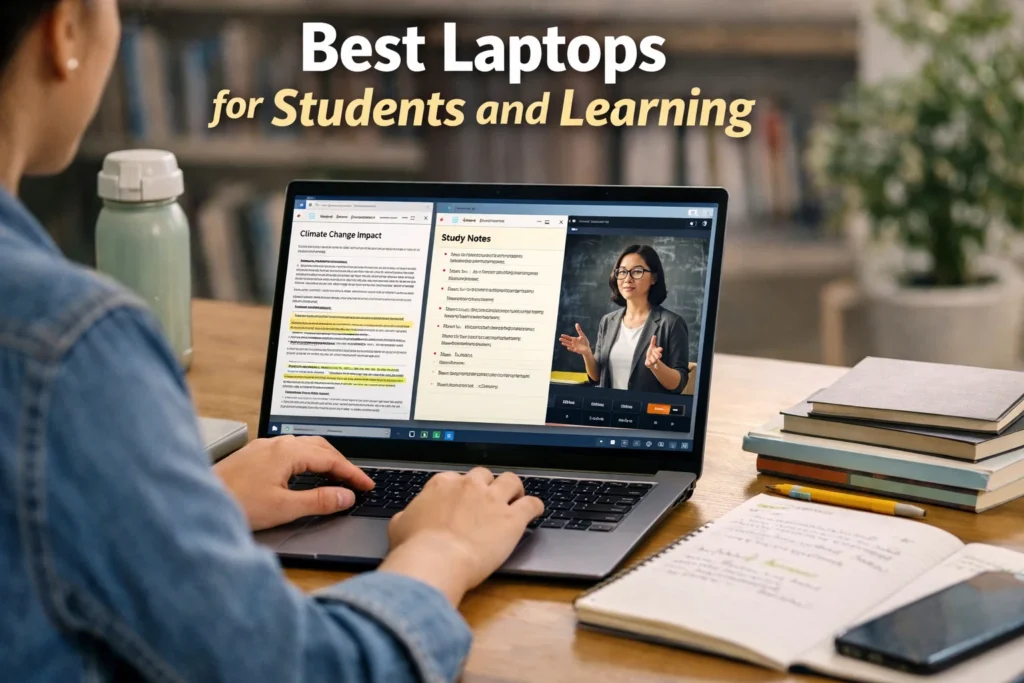
Students need balance. Good battery life, solid performance, and durability matter more than raw power. A mid-range processor with 16GB RAM works well for most academic needs.
Best Laptop for Professionals
Professionals should prioritize reliability, keyboard comfort, display quality, and ports. Performance matters, but stability matters more.
Best Laptop for Creators and Power Users
Creators need strong CPUs, capable GPUs, fast storage, and good thermal design. These laptops cost more, but cutting corners hurts productivity.
Best Budget Laptop That Still Makes Sense
Budget laptops can still be good in 2026 if they meet minimum standards. Avoid low RAM, outdated processors, and poor displays. Compromise on design, not performance basics.
Common Laptop Buying Mistakes to Avoid in 2026
Many buyers chase high numbers instead of balanced systems. A powerful CPU paired with weak cooling underperforms. Too little RAM makes fast processors feel slow. Buying last-generation chips to save money often shortens lifespan.
Another mistake is ignoring support. Firmware updates, driver stability, and warranty quality matter more than many people realize.
Step-by-Step Guide to Choosing the Best Laptop
First, define how you actually use your laptop. Not how you imagine using it.
Next, choose a processor tier that fits that use. Then lock in RAM and storage minimums. After that, compare brands by model, not reputation. Finally, review long-term support and upgrade options.
This process avoids impulse decisions and marketing traps.
Are Laptops Still Worth Buying in 2026?
Yes. Tablets are better than before, but laptops remain unmatched for flexibility. Desktops offer power, but laptops offer freedom. In 2026, laptops continue to be the most versatile personal computing devices.
Expert Insights on the Future of Laptops
Industry research shows AI features becoming standard across all price tiers. Performance gains will slow, but efficiency gains will continue. Buyers should focus less on peak benchmarks and more on sustained performance and support.
Quick Laptop Buying Checklist
- Modern processor with AI support
- At least 16GB RAM
- Fast NVMe SSD
- Good thermal design
- Reliable brand support
- Clear upgrade path
Final Thoughts Before You Choose Your Laptop
There is no perfect laptop for everyone in 2026. But there is a right laptop for you. Ignore hype. Focus on how technology is changing and how long you plan to keep your device. A thoughtful choice now saves money, time, and frustration later.
FAQ’s:
Which laptop is best for the future?
A future-ready laptop in 2026 should have a modern processor with AI support, at least 16GB RAM, fast NVMe storage, and long software update support. The best choice depends on how long you plan to keep it and whether you use AI, creative, or professional tools.
Which brand of laptop is very best in 2026?
There is no single best brand for everyone. Apple leads in efficiency and ecosystem integration, Lenovo excels in durability and keyboards, Dell focuses on reliability, and HP offers strong value in mid-range models. The model matters more than the brand name.
Which is the most recommended laptop to buy right now?
The most recommended laptops in 2026 are those with current-generation processors, 16GB RAM, and solid thermal design. Mid-range models often offer the best balance between price, performance, and longevity.
How do I choose the best laptop processor in 2026?
Choose a processor based on your real workload. For general use, a modern i5-class or equivalent processor is enough. Power users, creators, and developers benefit from higher-tier processors with better multi-core and AI performance.
Which is better in 2026, Intel or Ryzen?
Both Intel and Ryzen processors perform very well in 2026. Intel often leads in single-core performance and compatibility, while Ryzen excels in efficiency and multi-core workloads. The better option depends on your usage, not the brand.
Should I buy an i5 or i7 laptop in 2026?
Most users should buy an i5-class laptop in 2026. It handles everyday work, study, and multitasking smoothly. An i7 makes sense only if you run heavy software, edit videos, or want extra performance headroom for long-term use.
How much RAM is needed for a good laptop in 2026?
Sixteen gigabytes of RAM is the ideal amount for most users in 2026. It ensures smooth multitasking, better browser performance, and proper support for AI-based features. Eight gigabytes is now the minimum, not the ideal.
Which is better, HP or Dell?
HP and Dell are both strong brands. Dell is often preferred for business reliability and long-term support. HP usually offers better value in consumer models. Comparing specific models is more important than choosing by brand alone.
Is Lenovo better than HP?
Lenovo is often better for business and professional users due to strong build quality and keyboards. HP may be a better choice for home users and students looking for design and value. Neither brand is universally better.
What are the top computer brands in 2026?
The top computer brands in 2026 include Apple, Lenovo, Dell, HP, and ASUS. Each brand focuses on different strengths such as efficiency, durability, performance, or pricing.
Who is considered the king of laptops?
There is no single “king” of laptops in 2026. Different brands lead in different areas. Apple leads in efficiency, Lenovo in durability, Dell in enterprise reliability, and ASUS in performance-focused designs.

Digital innovation analyst with a focus on AI, IoT, and connectivity. Maria’s articles combine data-driven research, industry statistics, and tested solutions, helping global readers stay informed, confident, and future-ready in technology.