
 Artificial intelligence once symbolized raw computing power. In 2025, it stands for something deeper efficiency, responsibility, and environmental renewal. AI now drives the systems that run our cities, optimize factories, predict climate patterns, and even design cleaner energy networks.
The global shift is clear. According to the International Energy Agency’s 2025 review, AI-powered optimization has already cut industrial energy waste by more than 15 percent worldwide. That isn’t theory it’s progress measured in megawatts and tons of carbon avoided.
Let’s unpack how AI fuels the green-tech movement, where it’s working today, what hurdles remain, and how developers, businesses, and governments can build a truly sustainable digital future.
Why AI and Sustainability Matter Today
We live in a paradox. Every year, AI models grow larger and more capable yet the data centers that power them consume more electricity than some countries. Training one large-language model can emit up to 50 tons of CO₂, equivalent to driving a car across the United States five times.
That’s why “Green AI” has emerged: a movement focused on creating algorithms and infrastructure that use less energy while producing more useful outcomes. As Gartner’s 2025 Sustainability Trends Report notes, “Organizations that align AI growth with environmental design principles will outperform competitors in both cost and compliance.”
In short, smart technology must also be clean technology.
Understanding Green AI
What Is Green AI?
Green AI refers to artificial-intelligence methods, tools, and infrastructures optimized for environmental efficiency. It’s not just about building new models it’s about lowering carbon costs across the entire AI lifecycle, from data training to deployment.
The Environmental Cost of AI Models
Every query you send to an AI chatbot triggers computations across servers cooled by vast amounts of water and electricity. Researchers at the University of Massachusetts found that training a large transformer model can consume over 600 megawatt-hours as much as 100 American homes use in a year.
Why Efficiency Is the Future
In response, major players are rewriting the rules. Microsoft’s 2025 Sustainability Report highlights a 25 percent reduction in data-center energy per AI operation, achieved through advanced liquid cooling and adaptive workloads. As Microsoft Chief Sustainability Officer Melanie Nakagawa put it, “Our goal is to make intelligence itself sustainable so every computation gives back more than it takes.”
Real-World Examples of Sustainable AI
1. Smart Grids and Energy Optimization
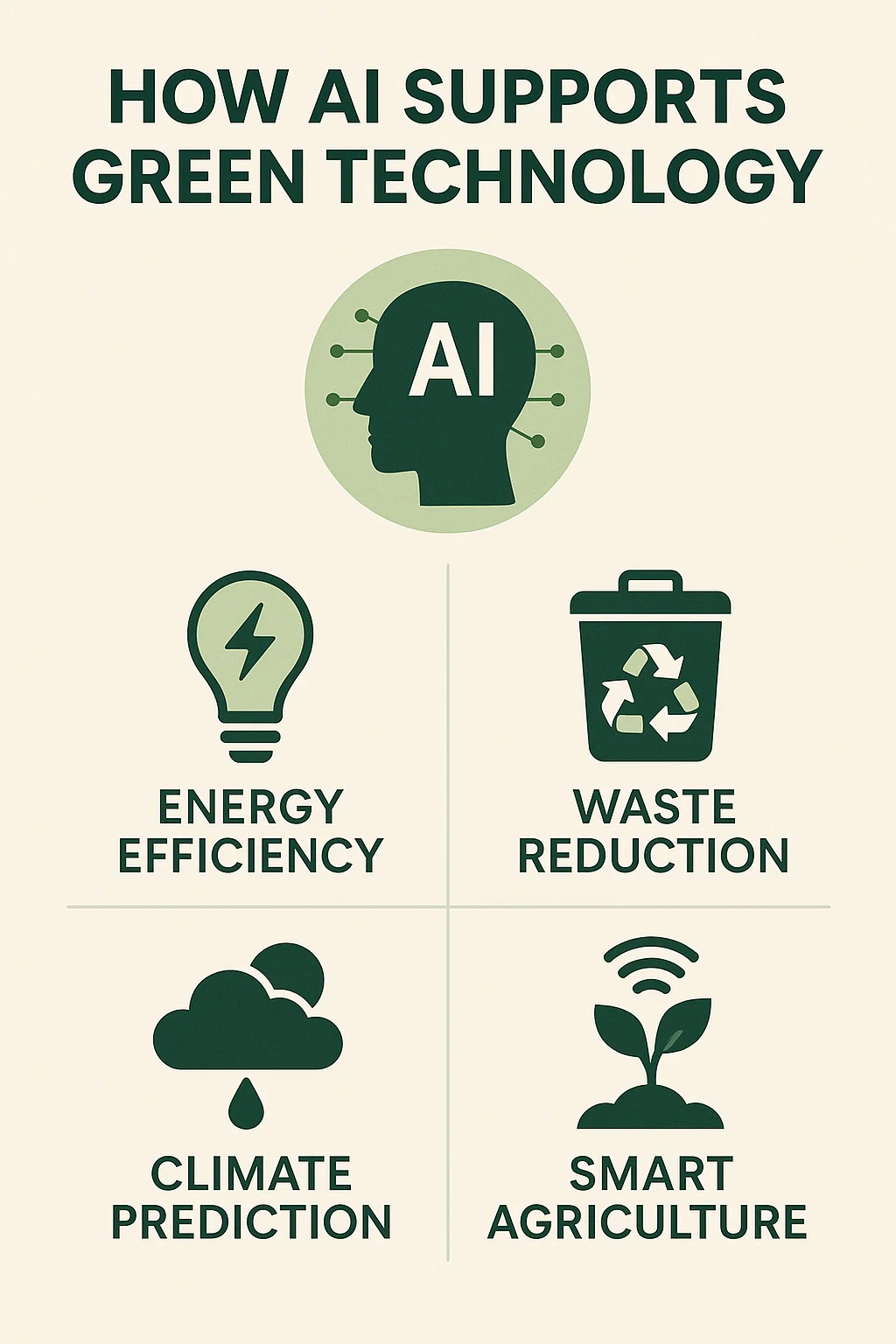
Electric utilities are using AI to balance supply and demand in real time. In Germany, Siemens’ MindSphere platform leverages machine learning to predict peak usage hours and shift renewable resources accordingly. The result: up to 12 percent less grid loss.
2. Agriculture and Water Conservation
AI drones in India and Kenya monitor crop health through infrared imaging, recommending irrigation only where needed. The FAO reports that such precision-farming tools can cut water waste by 40 percent while maintaining yields.
3. Climate Prediction and Disaster Prevention
Models like IBM’s Environmental Intelligence Suite analyze satellite data to forecast floods and wildfires. These systems now power early-warning networks in over 20 countries, turning raw data into life-saving action.
4. Waste Management and Recycling
Startups such as Greyparrot AI deploy camera-based neural networks to sort recyclables. Their software identifies materials on conveyor belts at 99 percent accuracy, helping recycling plants recover more plastic and metal.
Each of these sustainable-AI examples proves that intelligent code can reduce emissions without slowing innovation.
How AI Empowers Green Technology Industries
Renewable Energy
AI predicts wind and solar output hours ahead, allowing utilities to store or sell energy more efficiently. Google DeepMind’s wind-farm forecasting boosted turbine value by 20 percent, turning unpredictable weather into dependable power.
Transportation and Electric Vehicles
AI systems manage traffic flows and charging stations. In Oslo, predictive models reduced EV charging queues by 30 percent and cut idle-time emissions from cars waiting to plug in.
Construction and Smart Cities
Sensors in “green buildings” use AI to adjust lighting, HVAC, and water use. Cisco’s Smart+Connected Communities program shows that automating building management can reduce energy bills by 35 percent across large campuses.
Sustainable Manufacturing
Robotics guided by computer vision minimize material waste. Toyota’s AI paint-optimization project, for instance, decreased solvent use by 18 percent per vehicle proof that sustainability and profit can share the same assembly line.

Leading Green AI Projects and Companies to Watch
| Company | Initiative | Result |
|---|---|---|
| Google DeepMind | AI cooling for data centers | 40 % reduction in cooling energy |
| Microsoft Azure | Carbon-negative AI infrastructure | 100 % renewable power by 2025 |
| IBM | Environmental Intelligence Suite | Real-time climate risk analysis |
| NVIDIA | Energy-efficient GPUs (Hopper architecture) | 30 % performance per watt gain |
| Climatiq AI (startup) | API for carbon-footprint tracking | Helps SaaS apps calculate emissions |
These green-AI companies lead not only in computing power but in environmental accountability.
Key Challenges in Implementing Green AI
1. Energy Demand
Even efficient chips draw vast power. As IEEE Spectrum’s 2025 analysis warns, “Hardware gains alone can’t offset exponential model growth.” Without moderation, AI’s carbon curve could outpace its benefits.
2. Lack of Standard Metrics
There’s no universal “green score” for AI efficiency. Different labs measure carbon output differently, making comparison difficult. IEEE researchers are now drafting a Green AI Benchmark to standardize assessments across models.
3. Hardware and Cloud Limitations
Renewable-powered data centers remain rare in developing regions. This creates inequity AI innovations born in wealthy nations may rely on fossil-fueled grids elsewhere.
4. Balancing Innovation and Responsibility
Cutting computational budgets too aggressively can hinder model accuracy. The challenge, says Dr. Ravi Iyer of Stanford’s AI Sustainability Lab, is “to design algorithms that do more with less, not less with less.”
The Role of Ethical AI in Sustainability
AI ethics isn’t limited to bias or privacy. Environmental transparency is part of responsible design.
Transparent Algorithms
Projects such as Open AI Carbon Tracker disclose the energy used per model run. This encourages developers to consider environmental impact early in the design cycle.
Green Algorithms
Researchers now publish green AI papers emphasizing efficiency over raw performance. The movement started with Allen Institute’s 2020 call for transparency and has matured into mainstream practice by 2025.
Lifecycle Impact
Beyond servers, sustainability includes supply chains: chip manufacturing, rare-earth mining, and e-waste. Companies like HP Enterprise now offer “circular-computing” programs to recycle AI hardware responsibly.
How Small Businesses and Developers Can Go Green with AI
Even without billion-dollar budgets, small teams can make a difference.
1. Choose Cloud Providers Powered by Renewables
Platforms such as Google Cloud Carbon-Free Regions or Microsoft Azure Green Compute allow developers to select low-carbon zones for training and deployment.
2. Optimize Code and Workloads
Smaller models can be surprisingly powerful. Techniques like knowledge distillation and quantization shrink model size by 70 percent with minimal accuracy loss a win for cost and the planet.
3. Use Energy-Aware APIs
Services like Climatiq API integrate carbon tracking into business software, giving companies visibility into emissions per transaction or per user query.
4. Partner with Green AI Initiatives
Non-profits such as AI for Earth and SustainAI offer grants, datasets, and mentorship for sustainability projects. Developers gain both credibility and community.
Cisco 2025 Sustainability Outlook:
“The next wave of digital transformation will hinge on visibility seeing energy, emissions, and impact in real time. AI is the lens that makes that visibility possible.”
Expert Insights and Future Outlook
By 2030, AI could account for 10 percent of global electricity demand if unchecked, or cut it by half if optimized the outcome depends on our choices today.
Gartner’s 2025 briefing forecasts that “75 percent of enterprises will use AI-driven sustainability metrics as a primary reporting factor by 2027.” That shift means sustainability is no longer a side note it’s a performance metric.
Meanwhile, Microsoft has pledged to be carbon-negative by 2030, aiming to remove all historical emissions since 1975. Its AI efficiency breakthroughs are expected to set the standard for other hyperscalers.
IEEE’s Green Computing Task Force (2025) adds perspective: “We are entering an era where computational ethics equals environmental ethics. To build intelligent systems, we must first build sustainable ones.”
The Future: Human Ethics + Machine Intelligence
AI isn’t the enemy of the planet it’s the tool that might save it. Predictive maintenance cuts waste. Smart logistics reduce fuel. Data-driven policy helps nations plan greener cities.
But every benefit depends on conscious design. The future will belong to developers and leaders who understand that sustainability is not a feature it’s the foundation.
If AI is the brain of modern civilization, then sustainability is its conscience.
Practical Checklist Your Green AI Roadmap
| Step | Action | Benefit |
|---|---|---|
| 1 | Audit your AI workloads | Identify high-energy tasks |
| 2 | Select renewable-powered cloud zones | Lower emissions instantly |
| 3 | Use model compression (distillation / pruning) | Reduce compute cost |
| 4 | Log and publish energy metrics | Improve transparency |
| 5 | Implement lifecycle recycling | Manage e-waste responsibly |
| 6 | Partner with Green AI alliances | Access funding & visibility |
Pin this list beside your workstation it’s the new to-do list for responsible innovation.
Further Reading
- Microsoft Sustainability Report 2025 – corporate-responsibility.microsoft.com
- Gartner: 5 Trends Shaping Sustainability Strategies in 2025
- IEEE Green Computing Initiative – research.ieee.org/green-ai
- Cisco 2025 Digital Sustainability Outlook – cisco.com
- World Economic Forum – AI for Earth Partnerships
Final Thoughts Before You Try It Yourself
Technology’s greatest promise has always been human progress. In 2025, that promise expands to include the planet itself.
Artificial intelligence can either accelerate environmental collapse or engineer its reversal. The difference lies in intention how we code, train, and deploy it.
As engineers, entrepreneurs, and citizens, our mission is simple: build systems that learn wisely and live lightly.
Because a smarter world is only truly smart when it’s also sustainable.