
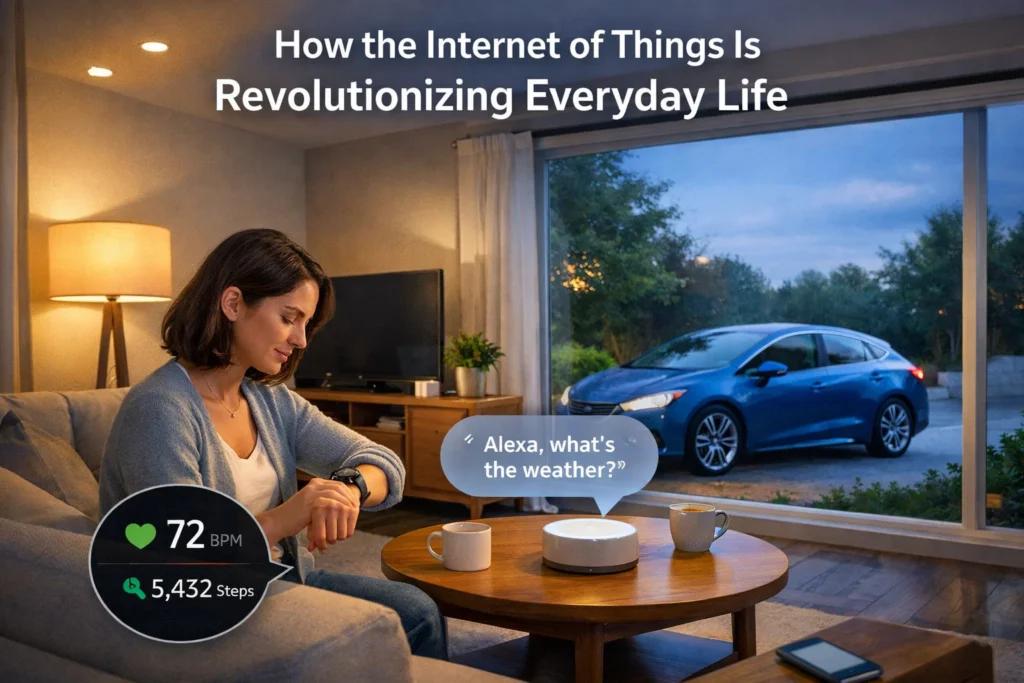
 Walk through a normal day and you’re already surrounded by the Internet of Things. Your phone unlocks with your face. Your watch nudges you to stand. Your home adjusts the lights before you think about it. None of this feels futuristic anymore. It feels normal.
That’s the real shift. IoT didn’t arrive with fireworks. It slipped into daily routines and stayed.
Here’s what matters. IoT isn’t about gadgets. It’s about systems quietly working together to save time, reduce waste, and make decisions faster than humans can. When it works well, you don’t notice it at all.
Let me explain how this actually plays out in real life, where it helps, where it causes friction, and where it’s headed next.
Why IoT Matters in Everyday Life Today
The number of connected devices crossed tens of billions worldwide, and that growth keeps accelerating. Homes, offices, hospitals, and cities now rely on sensors feeding constant data into software systems. This isn’t hype. It’s infrastructure.
What changed is cost and simplicity. Sensors got cheaper. Wireless networks got faster. Cloud platforms made data useful instead of overwhelming. Suddenly, everyday objects could sense, decide, and act.
For regular people, this means less manual work. For businesses, fewer blind spots. For cities, better planning. The impact shows up in small wins: lower energy bills, fewer breakdowns, quicker medical alerts.
IoT matters because it turns information into action without waiting for human input.
What Is the Internet of Things in Simple Terms
The Internet of Things is a network of physical objects that collect data and share it over the internet.
That’s it.
A smart thermostat measures temperature and adjusts heating. A fitness tracker monitors heart rate and syncs it to an app. A traffic sensor counts cars and adjusts signals.
Each device does three things:
- senses something
- sends data
- responds based on rules or intelligence
Individually, they’re useful. Together, they change how environments behave.
How IoT Affects Our Daily Life
IoT reshapes daily life in quiet but persistent ways.
At home, devices anticipate needs instead of waiting for commands. Lights turn off when rooms are empty. Washing machines choose efficient cycles. Doorbells show who’s outside without opening the door.
In health, wearables track sleep, movement, and heart patterns continuously. This turns healthcare from reactive to preventive. Doctors don’t just treat problems. They spot trends early.
On the road, navigation apps pull real-time data from millions of vehicles. Traffic lights adapt. Cars warn drivers before systems fail.
At work, IoT monitors equipment health, indoor air quality, and energy use. Offices become measurable systems, not guesswork.
Life becomes more data-informed, even when you’re not thinking about data.
Real Examples of IoT in Daily Life
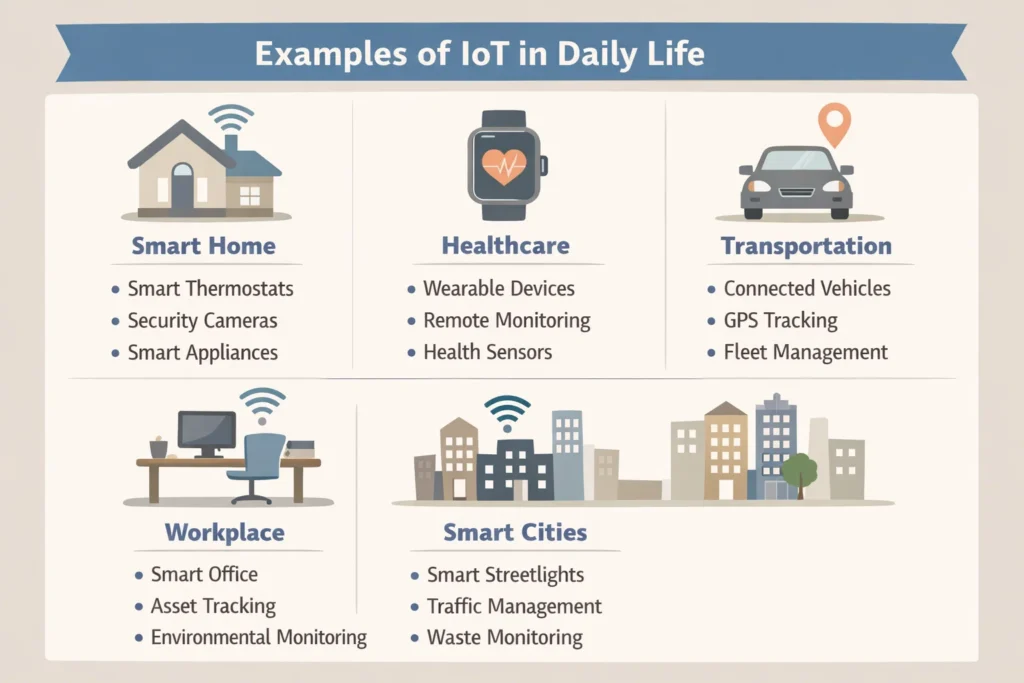
Some everyday examples you’ve likely used:
Smart homes
Thermostats, lights, plugs, and security cameras respond automatically to presence, schedules, and weather.
Wearables
Smartwatches and fitness bands track steps, heart rate, sleep, and even blood oxygen.
Connected cars
Vehicles monitor tire pressure, engine health, and driving behavior while syncing with navigation systems.
Smart appliances
Refrigerators track usage patterns. Washing machines optimize water and power.
Smart cities
Sensors manage parking, traffic, waste collection, and street lighting.
These aren’t experiments. They’re already standard in many places.
10 Common Uses of the Internet in Everyday Life
The internet powers IoT, but it also serves broader daily needs. Together, they shape modern routines.
- Communication through messaging and video calls
- Education via online learning platforms
- Entertainment through streaming services
- Navigation using real-time maps
- Shopping and payments
- Remote work and collaboration
- Health tracking and telemedicine
- Smart home automation
- News and real-time alerts
- Cloud storage and backups
IoT builds on this foundation by letting physical objects join the conversation.
The Four Types of IoT
Understanding IoT gets easier when you group it by use.
Consumer IoT
Devices for personal use like smart speakers, wearables, and home automation.
Commercial IoT
Systems used by businesses such as retail sensors, office energy management, and logistics tracking.
Industrial IoT
Heavy-duty systems in factories, utilities, and energy grids that monitor machinery and infrastructure.
Infrastructure IoT
City-wide systems managing traffic, water, power, and public services.
Each type solves different problems, but all rely on the same core idea: continuous data flow.
How IoT Is Changing the Way We Work
Workplaces are becoming measurable environments.
IoT tracks how spaces are used, not just how they’re designed. Offices adjust heating based on occupancy. Meeting rooms free themselves when unused. Equipment schedules maintenance before breaking.
In manufacturing, sensors monitor vibration, temperature, and output. This reduces downtime and waste. Maintenance becomes predictive instead of reactive.
Remote work benefits too. Employees monitor home office conditions. Managers track system performance instead of micromanaging people.
The shift is subtle but important. Work becomes outcome-focused, not presence-focused.
Why IoT Is Important in Modern Life
Five reasons stand out.
Efficiency
Automation removes repetitive tasks and optimizes resource use.
Safety
Sensors detect fires, leaks, and health anomalies early.
Cost savings
Preventive maintenance costs less than emergency repairs.
Convenience
Systems adapt without constant input.
Sustainability
Energy and water usage drops when measured precisely.
IoT matters because it scales good decisions across millions of moments.
How Big Companies Use IoT
Coca-Cola offers a clear real-world case.
Coca-Cola uses IoT sensors in vending machines and coolers to track inventory, temperature, and performance. Machines alert technicians before failures. Stocking routes adapt based on demand patterns. Energy use drops through optimized cooling cycles.
The result is fewer outages, better customer experience, and lower operational costs.
This same logic applies to retail, logistics, and healthcare. Measure reality continuously, then act on it.
How IoT Improves Quality of Life
Quality of life improves when friction disappears.
For older adults, health monitors provide independence with safety. Alerts go out only when something’s wrong.
For families, smart homes reduce energy waste and improve security without constant attention.
For commuters, traffic systems shave minutes off daily travel. That adds up over years.
For patients, chronic conditions get monitored daily instead of during rare clinic visits.
IoT doesn’t replace human care. It supports it with constant awareness.
Challenges of IoT in Everyday Use
IoT isn’t perfect. The risks are real.
Security
More devices mean more entry points. Weak passwords and outdated firmware cause problems.
Privacy
Data collection raises questions about who owns and controls personal information.
Reliability
Internet outages can disrupt connected systems.
Complexity
Too many apps and standards frustrate users.
The fix isn’t avoiding IoT. It’s using it responsibly with updates, strong security practices, and transparent data policies.
What the Future of the Internet of Things Looks Like
The next phase combines IoT with AI.
Devices won’t just report data. They’ll interpret it. Homes will understand routines. Cities will predict congestion. Healthcare systems will flag risks before symptoms appear.
Edge computing will reduce delays by processing data closer to devices. Energy systems will balance loads dynamically. Agriculture will use precision data to reduce water and fertilizer use.
IoT fades into the background as intelligence rises to the surface.
Practical Checklist: Using IoT Safely at Home and Work
- Change default passwords on every device
- Keep firmware updated
- Use a separate network for smart devices
- Review app permissions regularly
- Buy devices from reputable brands
Small steps prevent most problems.
Final Thoughts Before You Live With IoT Every Day
IoT already shapes daily life whether you think about it or not. The question isn’t whether to use it. It’s how deliberately you do.
Used well, it saves time, reduces waste, and improves safety. Used carelessly, it adds noise and risk.
Bottom line: IoT works best when it stays invisible, quietly supporting better decisions in the background. That’s not the future. That’s now.
FAQ’s:
How does the Internet of Things affect our everyday life?
IoT affects daily life by automating routine tasks and providing real-time information without constant human input. Smart homes adjust lighting and temperature automatically. Wearables monitor health continuously. Traffic systems respond to live road conditions. The result is less manual effort, better decisions, and more efficient use of time and resources.
What are some examples of IoT in daily life?
Common IoT examples include smart thermostats, fitness trackers, smart TVs, connected cars, security cameras, and voice assistants. Outside the home, IoT appears in traffic sensors, smart parking systems, digital health monitors, and energy meters. Many people use IoT every day without labeling it as such.
What are 10 uses of the internet in our daily life?
The internet supports communication, online education, entertainment streaming, navigation, shopping, digital payments, remote work, health services, cloud storage, and smart device connectivity. IoT builds on these uses by connecting physical objects to the internet so they can sense and respond automatically.
How is IoT changing lives?
IoT changes lives by shifting systems from reactive to proactive. Health issues get flagged earlier. Machines get repaired before breaking. Homes waste less energy. Cities manage resources more efficiently. These changes may seem small individually, but together they improve comfort, safety, and long-term quality of life.
What are the four types of IoT?
The four main types are consumer IoT for personal devices, commercial IoT for business operations, industrial IoT for factories and utilities, and infrastructure IoT for cities and public services. Each type serves a different purpose but relies on connected sensors and data sharing.
What are the main ways technology is changing how we work?
Technology is enabling remote work, automating repetitive tasks, improving collaboration, monitoring equipment health, and measuring productivity through outcomes rather than hours. IoT plays a role by tracking workspace usage, machine performance, and environmental conditions in real time.
What is the main use of the Internet of Things?
The main use of IoT is to collect real-time data from physical objects and turn it into automated or informed actions. This helps reduce manual work, prevent failures, and improve efficiency across homes, businesses, healthcare, and cities.
Why is IoT important in modern life?
IoT is important because it helps manage complexity at scale. As systems grow larger, humans can’t monitor everything manually. IoT fills that gap by providing constant awareness, faster responses, and better use of resources while lowering long-term costs.
How does Coca-Cola use IoT?
Coca-Cola uses IoT sensors in vending machines and coolers to track temperature, stock levels, and machine performance. This allows faster restocking, fewer breakdowns, and more energy-efficient operations across thousands of locations.
What is the future of the Internet of Things?
The future of IoT involves deeper integration with artificial intelligence, edge computing, and smart infrastructure. Devices will not just report data but interpret it, predict outcomes, and act independently. IoT will become less visible while becoming more influential in daily decision-making.
How does IoT improve quality of life?
IoT improves quality of life by reducing friction in daily tasks, improving safety, supporting healthcare monitoring, and saving time and energy. When systems respond automatically and intelligently, people can focus more on meaningful work and personal well-being