IT auditing has also changed. An auditor can no longer focus only on servers, passwords, and software installations. Modern audits may examine Microsoft 365 or Google Workspace access, cloud infrastructure, SaaS vendors, AI systems, automated business processes, remote workers, data privacy, disaster recovery, and cybersecurity monitoring. ISACA reflected that change in February 2026 when it released the fifth edition of its IT Audit Framework, or ITAF. The updated framework expands its attention to cloud computing, AI and machine learning, data analytics, automation, digital trust, continuous assurance, and AI governance.
Here’s what matters: a good IT audit does not simply create a long list of technical problems. It connects technology weaknesses to business risk and gives management a practical path for fixing them.
What Is an Information Technology Audit?
An information technology audit is a structured review of an organization’s technology risks and the controls used to manage those risks. ISACA describes IT auditing as identifying risk and assessing whether controls reduce that risk to an acceptable level. An auditor may inspect software applications, networks, user accounts, servers, databases, cloud platforms, cybersecurity systems, backup procedures, IT policies, and third-party services. The auditor then compares the organization’s actual practices with internal policies, regulatory requirements, contractual obligations, accepted frameworks, or other defined audit criteria.
Consider a simple example. A company may have a written rule requiring multi-factor authentication for administrator accounts. The IT auditor does not stop after reading the policy. The auditor checks actual administrator accounts, collects evidence, and verifies whether MFA is enabled. If three administrators can still sign in with passwords alone, the organization has a control gap. The auditor evaluates how serious that gap is, records evidence, considers the possible business impact, and recommends corrective action.
An IT audit differs from a traditional financial audit, although the two can overlap. Financial auditors focus mainly on financial statements and the controls that support reliable financial reporting. IT auditors focus on the technology that stores, processes, transmits, and protects information. A cybersecurity assessment also overlaps with IT auditing, but cybersecurity usually concentrates more heavily on threats, vulnerabilities, security defenses, and incident readiness. A broader IT audit can also examine governance, change management, operations, application controls, vendor management, business continuity, data quality, and compliance.
Common IT Problems, Their Causes, and Their Impact
IT auditors work from risk rather than simply hunting for mistakes. A weak control matters because it can affect confidentiality, system availability, financial accuracy, regulatory compliance, or normal business operations.
| Problem | Common Cause | Possible Business Impact |
|---|---|---|
| Excessive user access | Poor account reviews | Unauthorized access or fraud |
| Weak passwords | Outdated security policy | Account compromise |
| Inactive employee accounts | Weak offboarding | Former staff retain access |
| Missing backups | Poor recovery planning | Permanent data loss |
| Untested backups | Backup assumed to work | Recovery fails during an emergency |
| Unpatched software | Weak update process | Attackers exploit known flaws |
| Uncontrolled software changes | Missing approvals or testing | Downtime and data errors |
| Cloud misconfiguration | Poor cloud governance | Sensitive information exposure |
| Shared accounts | Convenience or poor design | No individual accountability |
| Unsupported software | Legacy systems | Security and reliability problems |
| Weak vendor controls | Limited third-party oversight | Supply-chain or data risk |
| Missing logs | Poor monitoring | Attacks remain undetected |
This table also shows why buying more security software does not automatically solve the problem. A company could have a modern firewall but fail to review who can change its configuration. It could back up data every night without ever testing whether those backups restore correctly. IT audit services look beyond whether a tool exists. They test whether the organization designed the control correctly, uses it consistently, and can prove that it works.
What Are Information Technology Audit Services?
Information technology audit services can cover a narrow system or the organization’s entire IT environment. The exact scope should depend on business risk. A small retailer using cloud accounting, Wi-Fi, email, payment systems, and a handful of laptops needs a different audit from a bank operating hundreds of applications across several data centers.
IT General Controls Audit
IT general controls, often shortened to ITGCs, support the reliability and security of multiple systems. Auditors commonly examine user access, privileged accounts, software changes, IT operations, system development, backup procedures, and separation of incompatible duties. ISACA notes that IT auditors support risk assessments and audits of IT general controls and perform independent, risk-based reviews of application and technology controls.
For example, an auditor may select a sample of employees who left the company and check how quickly IT disabled their accounts. The auditor might also review administrator access and ask whether developers can directly change production systems without independent approval.
Cybersecurity and Network Audits
A cybersecurity audit looks at how well an organization protects technology from attacks and unauthorized access. Auditors can review firewalls, endpoint security, vulnerability management, authentication, remote access, network segmentation, incident response, logging, security monitoring, and patching.
A network security audit may go deeper into routers, switches, wireless networks, VPNs, firewall rules, and how traffic moves between sensitive and less-sensitive systems.
Cloud and SaaS Audits
Many businesses now store critical data outside their own buildings. An audit may therefore examine Microsoft 365, Google Workspace, AWS, Azure, cloud storage, online accounting systems, CRM platforms, or other SaaS services. The auditor checks administrator rights, MFA, sharing settings, audit logs, data retention, backup arrangements, and vendor responsibilities.
Application and Data Audits
Application audits focus on the controls inside business software. Auditors may test whether transactions require approval, calculations work correctly, sensitive fields stay protected, and users can perform only authorized tasks.
Data-related audits examine how an organization collects, stores, shares, retains, and deletes information. That becomes especially important when a company handles customer records, financial details, health data, employee information, or confidential intellectual property.
Business Continuity and Disaster Recovery Audits
A backup is useful only when the business can recover from it. Auditors review recovery plans, backup frequency, off-site protection, recovery responsibilities, emergency communications, and restoration testing. They may also examine recovery time objectives and determine whether the organization can bring critical operations back within an acceptable period.
What Exactly Does an IT Auditor Do?
An IT auditor asks a simple question throughout an engagement: What could go wrong, and what control reduces that risk?
The work normally begins with understanding the organization. Auditors learn what the company does, which technology supports important operations, what information needs protection, and which legal or contractual requirements apply. They identify critical systems and determine which risks deserve the most attention.
The auditor then collects evidence. That can include policies, screenshots, configuration reports, system logs, user lists, backup records, change tickets, vendor contracts, security reports, training records, and interviews with employees. Evidence matters because an auditor cannot base a conclusion on assumptions.
Testing comes next. Suppose management says every employee receives access according to their job. The auditor may choose several employees and compare their actual permissions with approved access requests. If an accounts clerk has database administrator rights, the auditor investigates why.
ISACA describes an IT auditor as someone who supports risk assessments and ITGC reviews while examining controls in applications and the technology supporting business processes. IT auditors can work internally, work for an external firm, or specialize in areas such as cybersecurity, compliance, and AI.
The final job involves communication. Auditors explain what they found, how serious the risk is, what caused it, and what management can do. A technically correct finding has little value if the business cannot understand or act on it.
How Information Technology Audit Services Work Step by Step
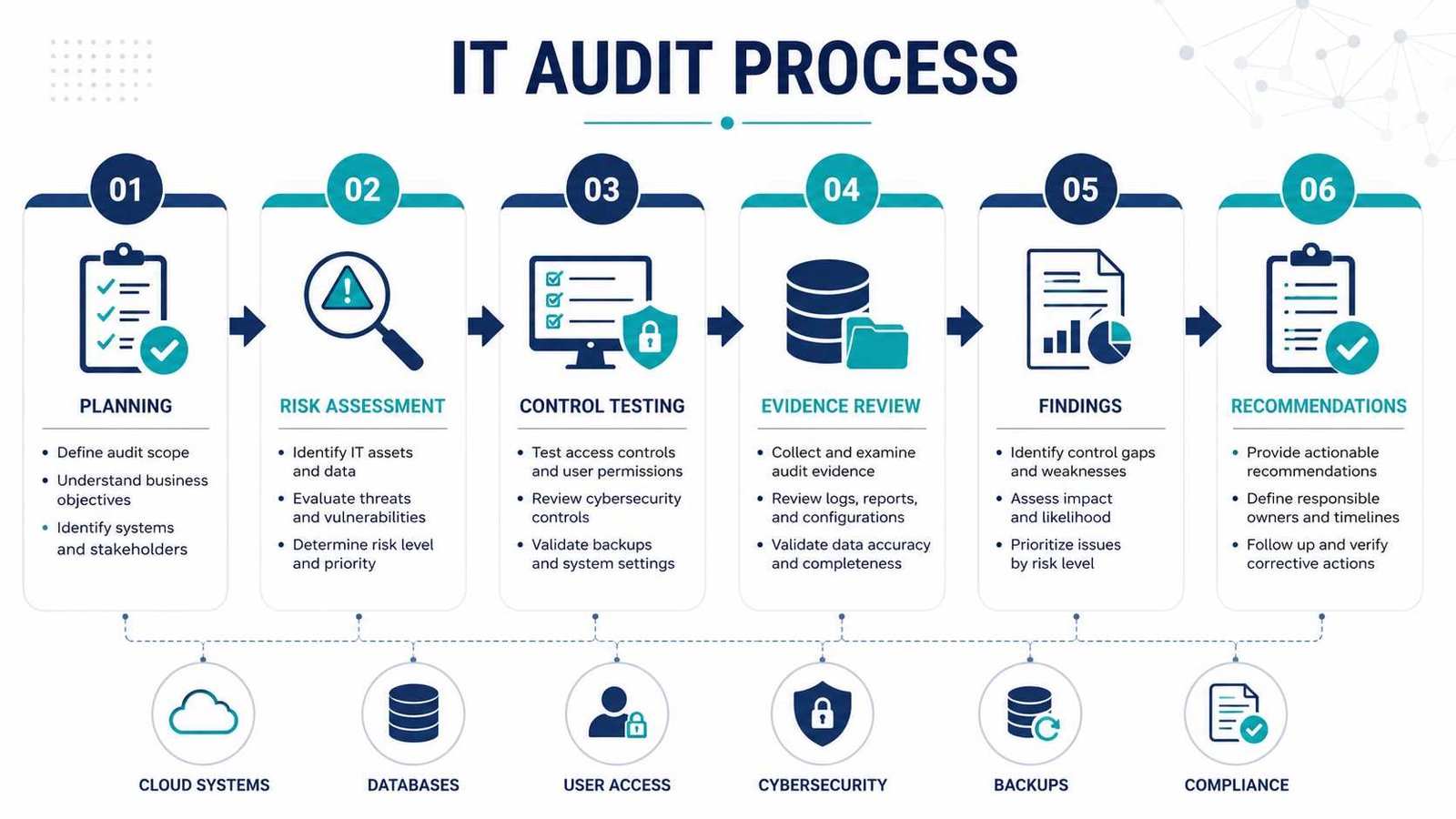
A professional IT audit usually follows a clear flow:
Scope → Risk assessment → Evidence → Testing → Findings → Recommendations → Remediation → Follow-up
1. Define the Scope
The auditor and management agree on what the engagement covers. It may include one application, the entire IT department, cybersecurity controls, cloud infrastructure, or controls supporting financial reporting.
2. Assess Risk
The auditor identifies important systems, sensitive information, threats, business dependencies, and previous incidents. High-risk areas receive more attention.
3. Request Evidence
The auditor asks for policies, system inventories, user lists, network diagrams, change records, backup reports, security logs, vendor information, and other relevant material.
4. Interview Key Staff
IT employees, business managers, system owners, security teams, and other staff explain how processes work in practice.
5. Test Controls
The auditor checks whether controls actually operate. Testing may include reviewing access, selecting transactions, inspecting configuration settings, examining change approvals, or testing backup evidence.
6. Record Findings
A finding normally explains the condition, risk, evidence, likely impact, and required improvement. Strong reports separate critical problems from lower-priority issues.
7. Agree on Corrective Actions
Management identifies who will fix each issue and when.
8. Follow Up
Auditors later verify whether management completed the promised work.
What Does an IT Auditor Check?
The answer depends on the engagement, but a full information technology audit can touch almost every part of a digital business.
An auditor may review employee and administrator accounts, password and MFA settings, firewall configuration, remote access, laptops, servers, cloud platforms, databases, backups, security logs, software updates, vulnerability reports, vendor access, data retention, disaster recovery, incident response, and software-development controls.
Now consider three examples.
Example 1: Former employee access. A sales employee leaves the company, but the Microsoft 365 account remains active for three months. That creates unnecessary exposure. An auditor checks whether HR and IT use a formal offboarding process and whether anyone reviews inactive accounts.
Example 2: Backup failure. A company performs automatic backups every night and assumes it can recover. The auditor asks for evidence of restoration tests. Nobody has performed one for two years. The company therefore knows that files are copied, but it does not know whether recovery will work when needed.
Example 3: Uncontrolled software changes. A developer fixes a production application directly without testing or approval. The change solves one issue but creates another. An audit can identify weak change-management controls before such mistakes cause major downtime.
The goal is not to blame employees. Good auditors determine why a control failed and recommend a realistic solution.
What Should an IT Audit Report Include?
The audit report turns technical evidence into business decisions. A useful report normally starts with an executive summary that gives senior management a quick view of the most important risks. It should define the audit scope and objectives so readers understand what the auditor did and did not examine.
Each finding should clearly state the problem, evidence, risk, and recommended action. Many auditors use ratings such as critical, high, medium, or low, although organizations can use different systems. The rating should reflect both likelihood and business impact rather than how complicated the technology looks.
A report should also assign responsibility. A recommendation such as improve access security is too vague. A better action might require the IT manager to review privileged accounts each quarter, remove unnecessary access, document approval, and retain evidence.
Management responses add accountability. The responsible owner can agree with the finding, describe planned corrective action, and provide a target completion date. Follow-up reviews then determine whether the control actually improved.
Mini Case Study: What a Small-Business IT Audit Can Find
Consider a 40-person professional services company. Employees use laptops, Microsoft 365, cloud accounting software, a shared office Wi-Fi network, and several SaaS tools. Management has never suffered a major cyberattack, so it assumes security works reasonably well.
An IT audit finds five issues.
First, four former employees still have active cloud accounts. Second, two administrator accounts do not use MFA. Third, the company backs up important files but has never performed a full restoration test. Fourth, staff and visitors use the same Wi-Fi network. Fifth, the company has no written incident-response process.
None of these problems requires a Hollywood-style hacker to become dangerous. A stolen administrator password could expose email and files. A former employee account could remain useful to someone who still knows the password. A ransomware incident could expose weaknesses in untested backups. Shared Wi-Fi can also create unnecessary network exposure.
The auditor recommends disabling inactive accounts, enforcing MFA, creating separate guest access, testing recovery, and documenting an incident-response plan.
The value of the audit comes from finding these gaps before a serious event forces management to discover them under pressure.
How Often Should a Business Conduct an IT Audit?
There is no single schedule that fits every company. Risk should drive frequency. Many organizations use annual audits for important technology areas, but high-risk systems may need more frequent reviews.
An organization should also consider a new or targeted audit after major changes. Examples include a cloud migration, ERP implementation, merger, acquisition, security incident, new office, major network redesign, regulatory change, or deployment of an important AI system.
Continuous monitoring can complement periodic audits. Modern platforms can flag unusual administrator access, configuration changes, failed backups, vulnerabilities, and other issues throughout the year. ISACA’s 2026 ITAF update recognizes this shift toward continuous assurance, data analytics, automation, and AI-supported audit work.
That does not mean software replaces professional judgment. Automated monitoring can tell an auditor that an account has administrator access. A human still needs to determine whether that access makes sense, whether management approved it, what risk it creates, and whether the control meets the organization’s objectives.
How Much Do Information Technology Audit Services Cost?
IT audit pricing varies too much to give one reliable global figure. A ten-person company with five cloud applications creates a very different workload from a manufacturer with several locations, industrial systems, hundreds of employees, and strict regulatory requirements.
Several factors drive cost. The first is scope. A focused access-control review usually requires less work than a complete cybersecurity and ITGC audit. Company size also matters because auditors must evaluate more users, systems, processes, locations, and evidence.
Complexity can increase effort. Cloud platforms, custom applications, ERP systems, legacy infrastructure, multiple vendors, and hybrid environments can require specialists. Compliance requirements can also change the work. An audit designed for internal improvement may need different documentation from an engagement supporting regulatory or customer assurance.
Businesses should therefore compare scope before price. Ask each provider what systems they will examine, what testing they will perform, how many interviews they expect, what report they will deliver, whether remediation support is included, and whether follow-up testing costs extra.
A cheap audit that checks boxes without testing meaningful controls can cost more in the long run because management may gain false confidence.
How to Choose an Information Technology Audit Firm
Start with competence and independence. Ask whether the auditors regularly review environments similar to yours. A firm that understands banks may not automatically understand industrial technology, and a general security consultancy may not have the audit experience needed for formal assurance work.
Review professional credentials, but do not choose a provider only because of letters after someone’s name. CISA certification has particular relevance to information systems auditing, but practical experience still matters. Ask who will actually perform fieldwork rather than focusing only on senior people shown in the proposal.
Next, review the methodology. The provider should be able to explain how it identifies risk, selects controls, tests evidence, rates findings, and follows up. Ask for a sample report with confidential information removed.
You should also discuss data security. Auditors may receive user lists, network diagrams, configuration details, security reports, contracts, and other sensitive evidence. Ask how they transfer, store, restrict, retain, and delete this material.
Finally, make sure the engagement produces action. A useful auditor does more than point out problems. The report should help management understand priority, ownership, and practical next steps.
What Are the Top 10 CA Firms in Pakistan?
There is no single official ICAP ranking of the top 10 chartered accountant firms, so businesses should be careful with websites that present a subjective list as an official ranking. The Institute of Chartered Accountants of Pakistan, or ICAP, maintains lists of CA firms and separately publishes firms with satisfactory Quality Control Review ratings. ICAP’s current QCR material lists firms whose ratings meet the framework’s stated requirements.
Ten prominent names appearing in ICAP’s current QCR-rated material include:
- A. F. Ferguson & Co.
- EY Ford Rhodes
- KPMG Taseer Hadi & Co.
- BDO Ebrahim & Co.
- Grant Thornton Anjum Rahman
- Crowe Hussain Chaudhury & Co.
- Baker Tilly Mehmood Idrees Qamar
- Yousuf Adil
- Riaz Ahmad & Co.
- Mazars M.F. & Co.
ICAP’s QCR list confirms names such as A. F. Ferguson & Co., BDO Ebrahim & Co., Crowe Hussain Chaudhury & Co., EY Ford Rhodes, KPMG Taseer Hadi & Co., Grant Thornton Anjum Rahman, Riaz Ahmad & Co., and Yousuf Adil among firms appearing in its current material.
This should not be read as a ranking from first to tenth. When choosing a Pakistan firm for information technology audit services, check the current ICAP status and then compare technology-risk expertise, audit team experience, industry knowledge, independence, cybersecurity capability, locations, and the exact services included in the proposal.
A CA firm can make sense when IT controls connect closely to financial reporting, internal audit, regulatory assurance, or enterprise risk. A specialist cybersecurity or IT-assurance provider may fit better when the work requires deep technical testing. Some organizations use both.
How Do I Become an IT Auditor?
You do not need one single educational path to become an IT auditor. Professionals enter the field from computer science, information systems, cybersecurity, accounting, finance, internal audit, networking, and risk management.
Start by learning how technology supports business processes. A technically skilled person who cannot understand business risk will struggle in auditing. Likewise, an accountant who does not understand access control, databases, networks, cloud systems, and cybersecurity will face limitations in modern IT environments.
ISACA’s career guidance lists auditing, risk analysis, information systems, internal controls, computer science, data analysis, and communication among important skills for IT-audit roles.
Build practical experience next. Learn how companies create accounts, approve access, deploy software changes, back up systems, manage incidents, monitor security events, and control vendors. Entry-level roles in IT support, cybersecurity, internal audit, compliance, risk, or systems administration can provide useful exposure.
Certification can support career growth. ISACA’s Certified Information Systems Auditor, or CISA, remains one of the best-known credentials for this field. ISACA currently requires at least five years of professional information systems auditing, control, or security experience for certification, subject to its applicable rules and experience provisions. Candidates also need to meet ongoing professional education and ethics requirements.
Do not ignore writing and communication. Senior managers may never read raw security logs. They will read your audit finding. An auditor must explain a technical weakness in terms of risk, evidence, impact, and action.
IT Audit Frameworks and Standards You Should Know
No single framework covers every audit situation. Experienced auditors select criteria that match the engagement.
ISACA ITAF
ISACA’s IT Audit Framework, 5th Edition provides standards and guidance for planning, performing, and reporting IT audit and assurance work. The 2026 edition adds stronger coverage of AI, cloud systems, automation, data analytics, agile methods, governance, and digital trust.
Mary Carmichael, lead developer for the fifth edition, described the update simply: “This new edition of ITAF meets this moment.” Her point matters because technology risk now changes faster than the traditional annual audit cycle.
NIST Cybersecurity Framework 2.0
The NIST Cybersecurity Framework 2.0 helps organizations understand and manage cybersecurity risk. It organizes cybersecurity outcomes around six functions: Govern, Identify, Protect, Detect, Respond, and Recover. NIST designed the framework so organizations of different sizes and industries can use it rather than limiting it to one technical environment.
For small businesses, this provides a useful audit lens. An auditor can ask whether management governs cybersecurity properly, knows its important assets, protects them, detects incidents, responds effectively, and can recover operations.
ISO/IEC 27001
ISO/IEC 27001:2022 defines requirements for an information security management system, or ISMS. ISO explains that the standard helps organizations establish, implement, maintain, and continually improve a structured system for managing information-security risks.
An IT audit may use ISO/IEC 27001 controls or related requirements when the organization’s audit objective calls for them.
COBIT and Other Control Models
COBIT can help organizations connect technology governance, risk, control, and business objectives. Auditors may also use regulatory requirements, internal policies, contractual obligations, industry-specific standards, and control criteria relevant to the systems under review.
The key is not collecting frameworks. The key is choosing appropriate criteria for the question the audit needs to answer.
Modern IT Audit Tools and Techniques
Modern auditors increasingly use tools to analyze larger amounts of evidence. Vulnerability scanners can identify known technical weaknesses. Identity platforms can report administrator access and inactive users. SIEM systems can help auditors review security events. Cloud security dashboards can reveal public storage, weak authentication, unusual permissions, and configuration problems.
Data analytics changes testing as well. Traditional auditors often selected a sample of transactions because examining every item took too much time. Modern analytics can sometimes examine an entire population and flag unusual records for deeper review.
AI can help summarize evidence, identify patterns, prepare working papers, or support continuous monitoring. ISACA’s fifth-edition ITAF specifically recognizes AI, automation, and data-driven audit techniques.
The limits matter. An automated tool can generate thousands of warnings without telling management which five problems deserve attention first. Auditors must verify results, understand business context, challenge assumptions, and protect confidential evidence.
Technology should make an auditor more effective, not less skeptical.
Advanced IT Audit Trends in 2026
AI governance has become one of the biggest changes in IT assurance. Organizations now need to know where employees use AI, what data enters those systems, how models make important decisions, whether humans review outputs, and whether third-party AI vendors create new privacy or security exposure.
Cloud risk also continues to reshape auditing. Businesses may own very little physical infrastructure while still operating hundreds of user accounts and dozens of SaaS applications. Auditors must therefore follow data and access rights across services rather than concentrating only on a local server room.
Continuous assurance is another important shift. ISACA notes that modern audit functions increasingly use full-population analytics, continuous monitoring, and AI-assisted workflows rather than relying only on periodic sampling.
IBM’s 2026 breach research reinforces why these changes matter. The company reported a 56% increase in AI-driven attacks and found that organizations making extensive use of AI and automation in security saved an average of about $1.93 million in breach costs compared with organizations using none.
The future of IT auditing will therefore involve more automation, but also more judgment. Auditors will need to understand technology deeply enough to challenge automated decisions rather than simply trusting them.
Frequently Asked Questions About Information Technology Audit Services
What is an information technology audit?
An information technology audit evaluates technology risks and determines whether an organization’s controls adequately protect systems, data, operations, and business processes.
What exactly does an IT auditor do?
An IT auditor identifies risks, reviews policies and systems, collects evidence, tests controls, documents weaknesses, evaluates their business impact, and recommends improvements.
Is an IT audit the same as a cybersecurity audit?
No. Cybersecurity can form part of an IT audit, but a broader IT audit can also examine change management, application controls, IT operations, governance, business continuity, data quality, vendors, and technology supporting financial reporting.
How long does an IT audit take?
It depends on scope, organization size, system complexity, evidence quality, locations, and the number of controls being tested. A focused review may take much less time than an enterprise-wide audit.
Can a small business benefit from an IT audit?
Yes. Small businesses often depend heavily on cloud applications, email, online payments, Wi-Fi, laptops, and customer information but may lack dedicated security staff. A focused audit can identify a small number of high-impact improvements.
How often should IT audits be performed?
Many organizations use annual reviews for important areas, but risk should determine frequency. Major system changes, incidents, cloud migrations, acquisitions, or regulatory changes can justify additional audits.
How do I become an IT auditor?
Build knowledge in technology, business processes, internal controls, cybersecurity, and risk. Gain practical experience, strengthen communication skills, study common audit frameworks, and consider professional credentials such as CISA.
Practical IT Audit Readiness Checklist
Before an external auditor arrives, an organization can complete this basic review:
- Maintain an up-to-date inventory of important systems and applications.
- Identify owners for critical systems.
- Review active employee accounts.
- Disable accounts belonging to former staff.
- Review administrator and privileged access.
- Enable MFA for sensitive accounts where appropriate.
- Verify software and operating-system patch status.
- Review firewall and remote-access rules.
- Check endpoint protection status.
- Confirm important data is backed up.
- Perform and document backup restoration tests.
- Document incident-response responsibilities.
- Review cloud administrator accounts.
- Review important third-party vendors.
- Collect previous audit and security reports.
- Document software-change approvals.
- Review security logs and monitoring procedures.
- Assign employees who can provide audit evidence.
- Track every audit recommendation to completion.
- Retest high-risk findings after remediation.
Further Reading and Professional Resources
Businesses and aspiring IT auditors should start with primary sources rather than relying only on blog summaries. ISACA’s IT Audit Framework, 5th Edition provides current audit and assurance guidance. NIST’s Cybersecurity Framework 2.0 gives organizations a practical structure for managing cybersecurity risk. ISO provides official information about ISO/IEC 27001:2022, while ICAP maintains directories and QCR information for chartered accountant firms operating in Pakistan. IBM’s annual Cost of a Data Breach Report provides useful current data for understanding the financial impact of security failures.
These resources serve different purposes. ITAF guides IT audit practice. NIST CSF helps organizations organize cybersecurity outcomes. ISO/IEC 27001 supports structured information-security management. ICAP helps organizations verify professional accounting firms in Pakistan. IBM provides current breach research.
Using the right source for the right question produces better audit decisions.
Final Thoughts Before You Choose an IT Audit Service
Information technology audit services give organizations something security software alone cannot provide: an independent view of whether technology controls actually work.
The strongest audits connect technical weaknesses to business consequences. They do not simply report that a setting looks wrong. They explain what could happen, how likely the problem is, what evidence supports the finding, who should fix it, and how management can verify that the risk has been reduced.
That matters even more in 2026. Cloud services distribute business data across more platforms. AI adds new systems, decisions, and data flows. Employees work from more locations. Third-party software handles critical operations. Attackers also use automation to move faster.
Businesses do not need to audit everything at once. Start with the technology that would hurt most if it failed, became unavailable, produced incorrect information, or exposed sensitive data. Review the controls around those systems first.
A useful IT audit should leave management with fewer unknowns, clearer priorities, and a practical plan. That is the real value of information technology audit services.

Technology journalist with 12+ years in networking and cybersecurity. Known for simplifying complex tech into everyday solutions, Alex combines research, industry insight, and hands-on testing to guide readers with authority and clarity.