
A solar power battery calculator answers a practical question: how much battery storage do you need to keep your chosen appliances running when solar production falls or the grid goes down? The answer is rarely as simple as adding appliance watts. Battery sizing depends on energy use, backup duration, battery depth of discharge, conversion losses, system voltage, reserve capacity, and the amount of solar energy available to recharge the battery.
That calculation matters more now because battery storage is expanding quickly. The International Energy Agency reports that 108 GW of new battery storage capacity was deployed worldwide in 2025, up 40% from 2024. Installed battery-storage capacity is now about eleven times its 2021 level. The IEA also reports that lithium iron phosphate, or LFP, accounts for around 90% of current battery-storage deployments.
“Battery storage is the fastest growing power technology today.” — International Energy Agency
Here’s what matters for a homeowner or small business: battery kWh determines how much energy you can store, while battery and inverter kW determine how much power you can deliver at one time. A calculator may tell you that 10 kWh of storage is enough for your evening consumption, but that does not guarantee the system can start a large air conditioner, water pump, refrigerator compressor, or other high-surge load.
This guide shows you how to calculate battery capacity in kWh and Ah, build a solar battery calculator in Excel, size a 12V system, compare different battery voltages, and avoid the mistakes that cause disappointing backup times.
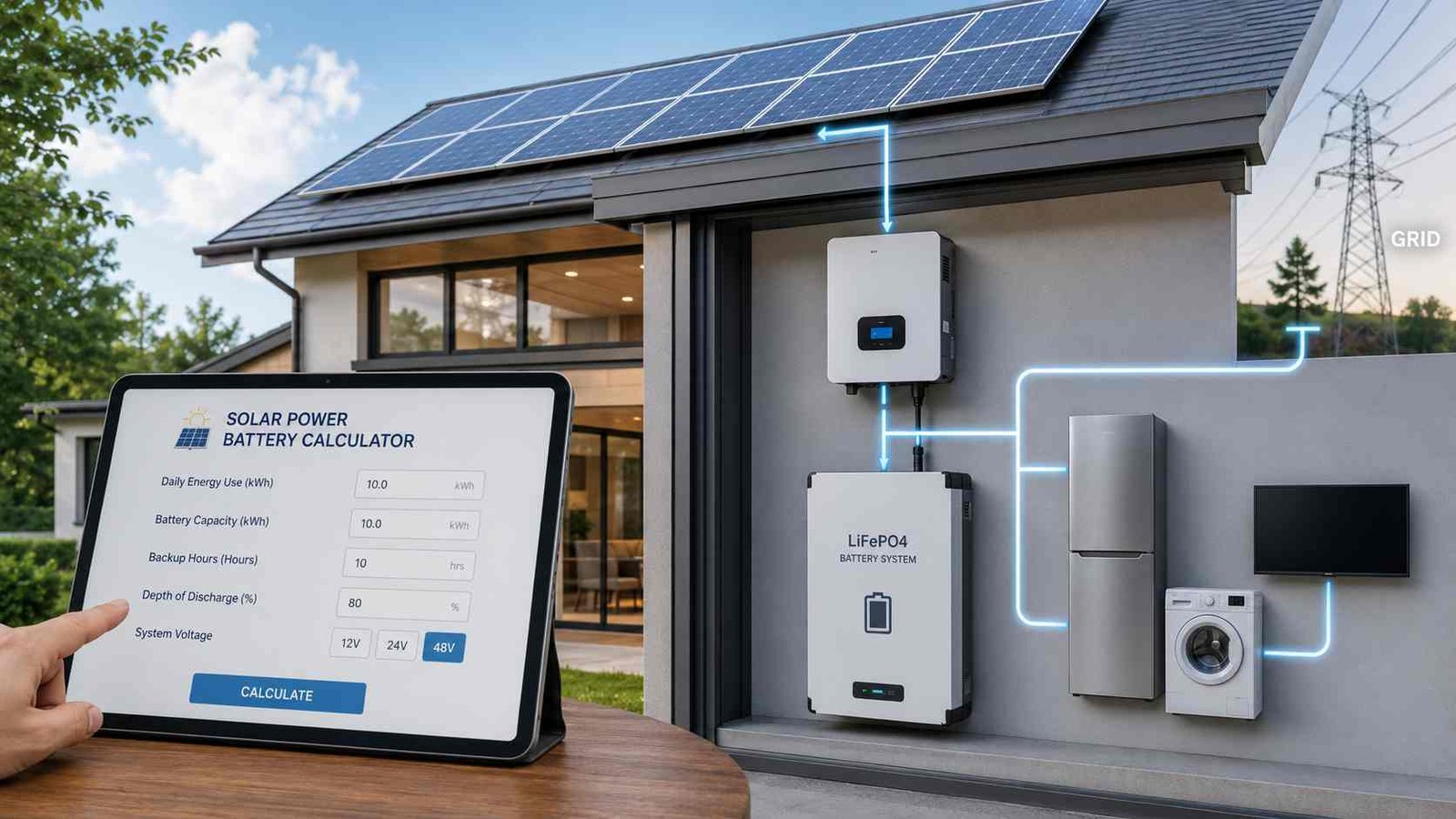
Solar Power Battery Calculator
A practical calculator should ask for the energy you actually want the battery to supply rather than the total electrical load of the entire property. For example, a home may consume 25 kWh each day, but the owner may only want the battery to support refrigerators, fans, lights, Wi-Fi, computers, and selected outlets during an outage. Those critical loads might consume only 8 or 10 kWh.
Current battery-sizing calculators use several variations of the same approach. Typical inputs include daily kWh, hours or days of autonomy, usable depth of discharge, system efficiency, reserve capacity, voltage, and sometimes peak load.
For a simple planning calculator, use:
Required nominal battery kWh = Required load energy × (1 + reserve) ÷ (usable DoD × discharge-path efficiency)
If you need a full day or several days without meaningful charging:
Required nominal battery kWh = Daily load kWh × autonomy days × (1 + reserve) ÷ (usable DoD × discharge-path efficiency)
Then convert battery energy into amp-hours:
Battery Ah = Battery kWh × 1,000 ÷ battery-bank voltage
For example, 4.8 kWh at 48V equals approximately:
4,800 Wh ÷ 48V = 100Ah
The same 4.8 kWh expressed at 12V is:
4,800 Wh ÷ 12V = 400Ah
This is why comparing battery banks by Ah alone can be misleading. A 100Ah battery bank at 48V contains roughly four times the nominal energy of a 100Ah bank at 12V.
What Does a Solar Power Battery Calculator Actually Calculate?
Battery calculations become easier when you separate power from energy. The U.S. Department of Energy explains that storage systems have an energy capacity, normally stated in kWh or MWh, and a power capacity, normally stated in kW or MW.
Storage systems differ in both “energy capacity” and “power capacity.” — U.S. Department of Energy
Think of kWh as the size of a fuel tank and kW as the rate at which the engine can draw fuel. Suppose your battery stores 10 kWh. A continuous 1 kW load could theoretically consume that energy over about ten hours before losses and operating limits. A 5 kW load could theoretically consume it in about two hours. Yet the battery must also support that 5 kW discharge rate.
Three battery figures therefore matter. Nominal capacity is the amount of energy printed on the battery specification. Usable capacity is the portion the manufacturer allows you to discharge under defined operating conditions. Power rating tells you how quickly the battery can deliver energy.
This distinction prevents a common mistake. A user may correctly calculate that an air conditioner, refrigerator, lights, and router require 6 kWh overnight, then choose a battery with more than 6 kWh of energy. But if those devices create a combined starting surge beyond the battery-management system or inverter limit, the system may shut down even while plenty of energy remains.
A useful solar power battery calculator therefore gives you a capacity target, not permission to ignore inverter specifications, BMS limits, wiring, protection devices, or manufacturer compatibility.
Information You Need Before Calculating Battery Size
Good calculations start with measured consumption. Electricity bills can help establish whole-home monthly or daily energy use, while a smart meter, plug-in energy meter, inverter monitoring portal, or appliance energy monitor can provide better information for selected backup loads. Manufacturer wattages can work as initial estimates, but refrigerators, pumps, air conditioners, and other cycling appliances rarely draw their rated power continuously.
You also need to decide how long you want backup. A four-hour evening outage creates a very different storage requirement from two full days of off-grid autonomy. Battery calculators commonly express this value as backup hours for short outages or days of autonomy for off-grid systems. Current calculators also commonly include depth of discharge and efficiency because a battery’s rated capacity is not the same as the energy ultimately delivered to AC appliances.
Depth of discharge should come from the battery manufacturer’s specifications rather than a generic internet rule. The same applies to charge and discharge limits. LFP batteries commonly permit a larger usable portion of their nameplate capacity than traditional lead-acid designs, but actual limits differ by product and warranty conditions.
Finally, include a reasonable reserve for uncertainty, changing loads, aging, or unusually poor solar conditions. A 10% to 20% planning margin is often used in online sizing tools, but it should remain an adjustable assumption rather than a fixed engineering rule.
Solar Battery Problems, Causes, and Impact
| Problem | Likely Cause | Practical Impact |
|---|---|---|
| Battery empties too early | Energy use underestimated | Backup ends before expected |
| Calculated Ah looks extremely high | Low battery-bank voltage | Higher current and larger Ah requirement |
| Runtime is shorter than calculated | Losses or usable capacity ignored | Less AC energy reaches appliances |
| Battery rarely reaches full charge | Solar array or charging window is inadequate | Large battery remains underused |
| Battery remains mostly full | Storage oversized for actual shifted energy | Higher cost with little extra benefit |
| System shuts down with energy remaining | Power or surge limit exceeded | Battery cannot support the load |
| Old battery gives poor runtime | Capacity has degraded | Nameplate capacity no longer reflects performance |
| Results change between calculators | Different DoD, efficiency, and reserve assumptions | Apparently conflicting recommendations |
The table explains why two solar battery calculators can give different answers without either one necessarily being mathematically wrong. One calculator might assume 80% usable depth of discharge and 90% efficiency. Another might use 90% DoD, separate inverter efficiency, a battery-efficiency factor, and a 20% reserve. Current online tools use several such methodologies.
The solution is not to search for the calculator with the largest number. Look at the assumptions behind the result.
Solar Battery Calculation Formula Explained
Start with the energy your backup loads need.
If appliances consume an average of 500 watts for six hours:
500W × 6 hours = 3,000Wh = 3kWh
That 3 kWh is the energy you want to deliver to the loads. It is not automatically the battery size.
Suppose the battery allows 90% usable depth of discharge, the discharge path from battery to AC loads is 94% efficient, and you want a 10% reserve.
The calculation becomes:
Battery capacity = 3 × 1.10 ÷ (0.90 × 0.94)
Battery capacity = 3.90kWh approximately
You would then compare that number with compatible commercial battery modules rather than trying to buy exactly 3.90 kWh.
This distinction also helps prevent double-counting losses. Some calculators use round-trip efficiency, which measures losses during a complete charge-and-discharge cycle. If your immediate question is how much stored energy is required to run AC appliances from an already charged battery, use appropriate discharge-side losses based on the equipment involved. If you are estimating how much solar generation is required to put that energy back into the battery, charging losses become relevant too.
Current sizing tools increasingly expose these assumptions rather than hiding them. One recently reviewed calculator, for example, labels its result as a planning model and separately asks for daily energy, autonomy, reserve, usable depth of discharge, efficiency, battery-module size, and peak simultaneous load.
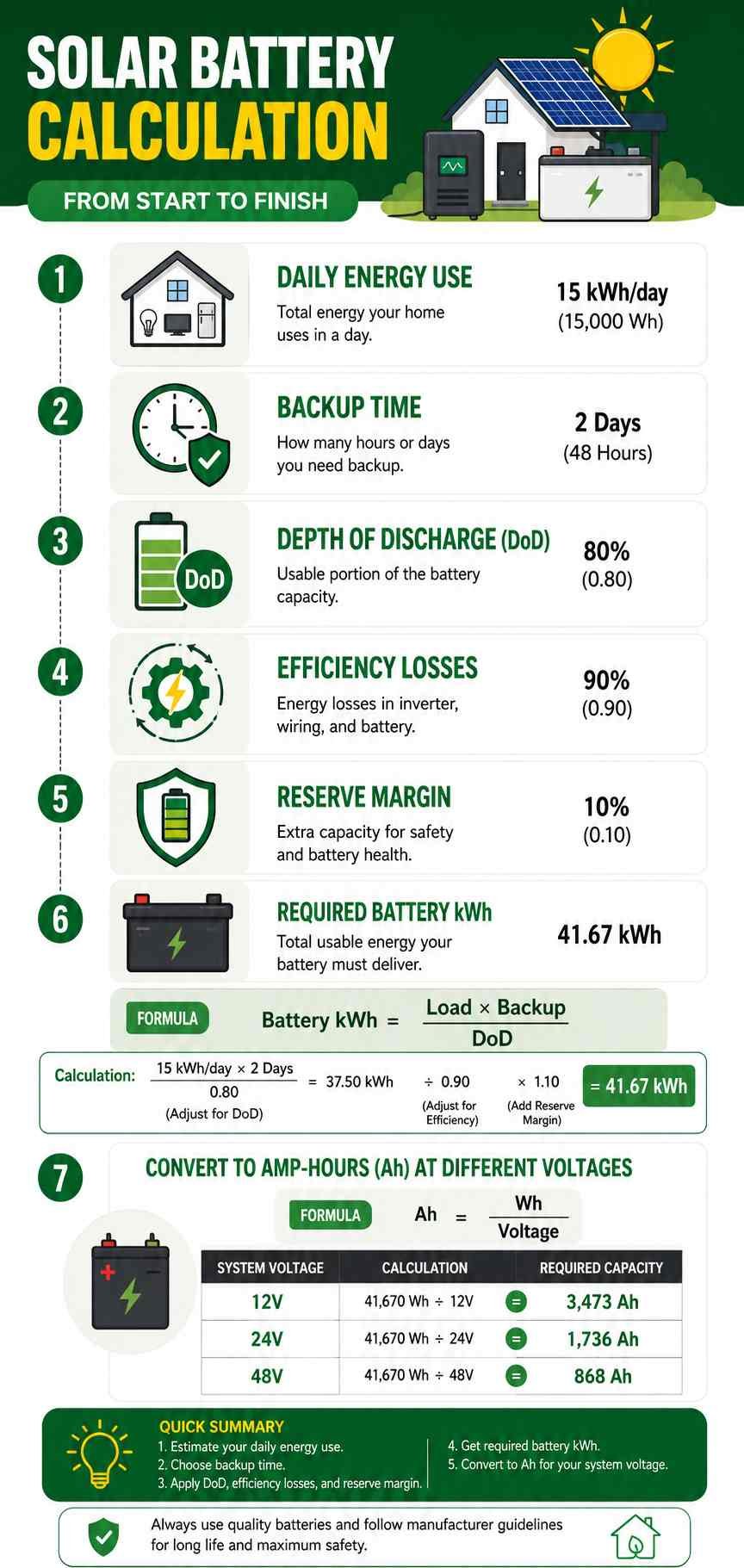
Solar Power Battery Calculator kWh Example
Consider a household that wants eight hours of backup for selected essential loads. During those eight hours, three efficient fans use 1.32 kWh, LED lighting uses about 0.48 kWh, a refrigerator consumes an estimated 0.64 kWh based on measured average operation, the router and network equipment use 0.16 kWh, and a television uses 0.40 kWh. Total estimated backup energy is roughly 3 kWh.
Now assume the chosen battery datasheet allows 90% usable depth of discharge, estimated discharge-path efficiency is 94%, and the homeowner wants 10% reserve capacity.
3kWh × 1.10 ÷ (0.90 × 0.94) = 3.90kWh
A nominal battery system around 4 kWh or the next compatible module size could therefore be a reasonable planning starting point.
But the calculation is only half of the design. The installer must still check the simultaneous load. If a refrigerator compressor starts while several fans and other appliances are operating, momentary power demand can be higher than the average energy calculation suggests.
This is also why measuring appliances is better than copying generic wattage tables. Refrigerators cycle. Variable-speed air conditioners change consumption as conditions change. Pumps have starting currents. Computers enter low-power states. An energy meter records what actually happens.
The best solar battery calculator uses your measured consumption whenever possible. SolarBazaar likewise tells calculator users that personal bills and measurements are more useful than broad averages.
Solar Battery Calculator for 12V Systems
The LSI search solar battery calculator 12v usually comes from users working with small backup systems, RVs, cabins, telecom equipment, or traditional inverter setups. The math is straightforward, but 12V systems can produce very large current and Ah numbers when the required energy increases.
Suppose you require 2 kWh of AC backup energy. You choose an 80% usable DoD assumption, 90% discharge-path efficiency, and 10% reserve.
2 × 1.10 ÷ (0.80 × 0.90) = 3.06kWh nominal
At a simplified 12V battery-bank voltage:
3,060Wh ÷ 12V = 255Ah approximately
At 24V:
3,060Wh ÷ 24V = 128Ah approximately
At 48V:
3,060Wh ÷ 48V = 64Ah approximately
| Nominal System Voltage | Capacity for 3.06 kWh |
|---|---|
| 12V | About 255Ah |
| 24V | About 128Ah |
| 48V | About 64Ah |
The energy requirement has not changed. The voltage and current relationship has.
For actual battery selection, use the manufacturer’s stated nominal voltage and rated energy. A product sold as a 12V-class lithium battery may use a nominal voltage such as 12.8V, so multiplying its documented voltage and Ah specification gives a more accurate energy figure than assuming exactly 12.0V.
Large residential storage systems commonly use higher DC voltages because delivering several kilowatts at very low voltage requires substantial current. Never redesign battery series or parallel connections solely from calculator results. Battery modules, BMS architecture, inverter voltage windows, cables, fuses, disconnects, and installation rules must all match.
Solar Battery Calculator Excel Method
You can build a solar battery calculator in Excel with only a few cells. This is useful when comparing several battery options or creating a repeatable sizing sheet for different homes.
| Cell | Input |
|---|---|
| B2 | Required load energy in kWh |
| B3 | Backup days |
| B4 | Reserve margin |
| B5 | Usable DoD |
| B6 | Discharge-path efficiency |
| B7 | Battery voltage |
| B8 | Required battery kWh |
| B9 | Required battery Ah |
If percentages are entered as decimals, such as 10% = 0.10, 90% = 0.90, the Excel battery-capacity formula is:
=B2*B3*(1+B4)/(B5*B6)
Then calculate Ah with:
=B8*1000/B7
For a short backup period rather than full days, calculate the required load energy first. Create appliance columns for wattage, quantity, operating hours, and watt-hours.
Appliance energy = Watts × Quantity × Hours
Then:
Total kWh = Total Wh ÷ 1,000
This spreadsheet approach has one major advantage over a simple web calculator: every assumption stays visible. You can instantly test what happens when backup drops from eight hours to four, the reserve changes from 20% to 10%, or a large appliance is removed.
It also makes comparison easier. Duplicate the sheet and create one scenario for essential loads, another for comfortable backup, and a third for near-whole-home operation. That usually produces a better buying decision than entering the entire electricity bill into one calculator and accepting the first result.
Three Real-World Solar Battery Sizing Examples
Home Essentials During an Outage
Suppose measured essential consumption is 3 kWh during the expected outage. With 90% usable DoD, 94% discharge efficiency, and 10% reserve, the calculated nominal storage requirement is about 3.9 kWh. The homeowner should then choose a compatible battery configuration at or above that target and check inverter power against the refrigerator, fans, entertainment equipment, and any other simultaneously operating loads.
Small Shop Backup
A small shop runs a POS system, router, lighting, security equipment, and two fans. Assume measurements show these devices consume 2.2 kWh over an eight-hour interruption. Using 90% DoD, 93% discharge efficiency, and 15% reserve:
2.2 × 1.15 ÷ (0.90 × 0.93) = about 3.02kWh
The business therefore needs roughly 3 kWh of nominal storage under those assumptions, before rounding to an available battery module.
Off-Grid Cabin
An off-grid cabin consumes 4 kWh per day and needs two days of autonomy. Assume 80% usable DoD, 90% discharge efficiency, and a 20% weather reserve.
4 × 2 × 1.20 ÷ (0.80 × 0.90) = 13.33kWh
This example shows how autonomy drives battery cost quickly. Reducing unnecessary loads may save more money than simply buying a larger battery.
Backup Sizing and Solar Self-Consumption Are Different
A battery intended for emergency backup is sized differently from a battery intended mainly to store excess midday solar for evening use.
For outage backup, begin with the energy needed by critical loads during the expected outage. For a remote off-grid system, increase the autonomy period to reflect how long the site must operate without enough solar input.
Grid-connected self-consumption needs another question: how much excess solar energy is actually available to store?
Suppose a home exports only 5 kWh of surplus solar on a normal sunny day and consumes about 5 kWh after sunset. Installing 20 kWh of battery storage does not automatically create 20 kWh of useful daily energy shifting. Much of that capacity may remain unused unless other charging sources, tariffs, backup objectives, or seasonal conditions justify it.
Researchers have studied this exact relationship between real solar-plus-storage behavior, discharge schedules, and battery size. Current solar-plus-storage work from the U.S. national laboratory uses tools such as SAM and REopt to analyze how battery dispatch and system size affect project performance.
Here’s what matters: battery sizing starts with demand, but good solar-battery sizing also checks the energy source that will recharge that battery.
How Solar Panel Production Changes the Answer
Battery capacity and solar-array capacity solve different parts of the problem. The battery stores energy. The solar array must produce enough energy to serve daytime loads and recharge storage within the available solar window.
A simple calculation might divide required charging energy by peak sun hours, but real solar production changes with location, season, orientation, temperature, shading, soiling, equipment losses, and weather.
PVWatts is useful at this stage. The current PVWatts platform estimates grid-connected PV energy production from location and system inputs. It also exposes loss categories such as soiling, shading, wiring, connections, age, and availability. Its expected production ranges use long-term historical weather information to show that output naturally varies from year to year.
PVWatts itself warns that its predictions contain assumptions and uncertainties. That makes it useful for planning, not a guarantee of daily production.
For more advanced projects, the System Advisor Model, or SAM, can model photovoltaic systems with batteries, including lithium-ion, lead-acid, and flow battery technologies. Its battery model can also account for dispatch strategy, voltage behavior, temperature, degradation, and battery replacement over time.
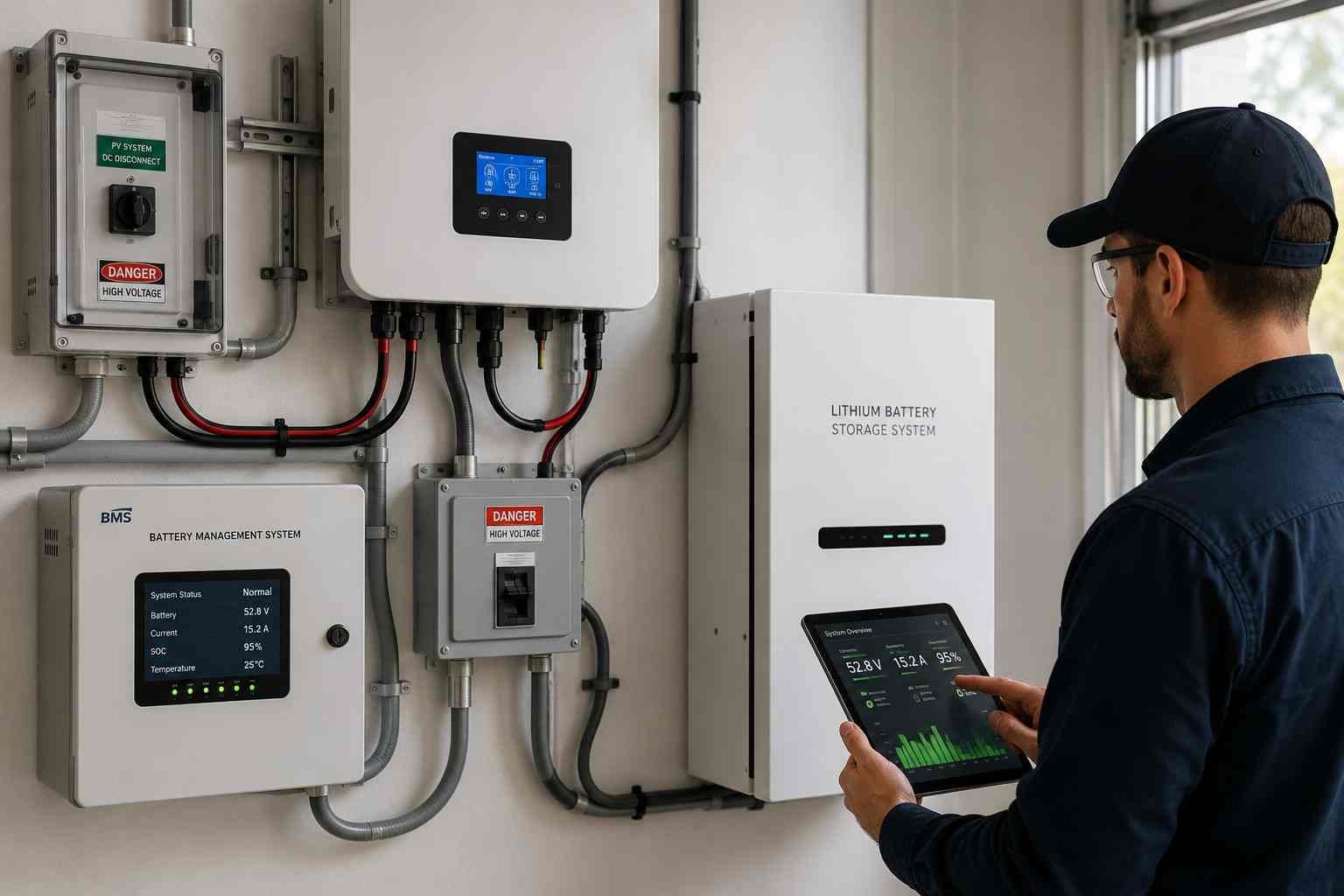
LiFePO4 vs Lead-Acid Battery Calculation
Battery chemistry changes the assumptions you enter into the calculator. Modern LFP systems generally support a larger usable share of rated capacity and higher cycling efficiency than many traditional lead-acid designs. The IEA reports that LFP represented more than 90% of global stationary battery-storage installations in 2025, showing how strongly the market has moved toward this chemistry.
| Factor | LiFePO4 | Lead-Acid |
|---|---|---|
| Usable DoD | Often relatively high | Usually more conservative |
| Cycling suitability | Strong for regular cycling | Depends heavily on type and discharge depth |
| Maintenance | Usually low | Flooded types require more attention |
| Weight per usable kWh | Generally lower | Generally higher |
| Calculator input | Use manufacturer specification | Use manufacturer specification |
| Best sizing source | Product datasheet/BMS limits | Product datasheet and established sizing guidance |
Avoid treating any generic DoD percentage in this table as a universal design value. Product warranty conditions and manufacturers’ operating limits take priority.
IEEE provides a useful expert reference for traditional systems. IEEE 1013-2019 covers sizing lead-acid batteries for stand-alone PV systems where PV is the charging source. Importantly, its scope does not include grid-connected PV systems, hybrid PV systems, lithium batteries, inverter sizing, or wiring design.
That limitation is useful rather than inconvenient. It reminds us that one formula cannot replace the engineering requirements of every battery chemistry and system architecture.
Solar Battery Calculator Apps and Advanced Tools
A solar battery calculator app can help when you are surveying appliances away from a computer. Several current Android listings calculate combinations of appliance load, inverter requirements, panels, voltage, and battery capacity. For example, Solar Load Calculator currently allows users to add appliances and estimate inverter, solar-panel, and battery-bank requirements, while Solar Cal includes appliance inputs, backup days, system voltage, cost estimates, and solar-system calculations. These are third-party tools rather than engineering standards, so check their assumptions before using the results for purchasing decisions.
For browser-based planning, PVWatts is stronger for estimating solar production by location. For detailed techno-economic analysis, SAM goes much further. The current SAM platform supports residential and commercial PV-plus-battery analysis as well as front-of-meter projects.
Excel remains one of the best choices when you want full control. It exposes every number and makes scenario testing easy.
The tool matters less than the inputs. A beautifully designed app using incorrect appliance energy, unrealistic battery limits, or the wrong efficiency value will still produce a poor result.
Why Solar Battery Calculator Results Can Be Wrong
The most common mistake is entering watts when the calculator needs watt-hours or kWh. Watts describe power at an instant. Watt-hours describe energy used over time.
The second mistake is using an entire electricity bill when only selected appliances need backup. That can make battery requirements look far larger than necessary.
The third is ignoring usable capacity and conversion losses. A battery rated at 10 kWh does not necessarily provide 10 kWh of AC energy to household loads under every operating condition.
The fourth is comparing Ah without voltage. A 200Ah 12V bank and a 200Ah 48V bank do not store the same amount of energy.
The fifth is sizing energy but ignoring power. BuildMeter, for example, separates daily energy from peak simultaneous load and explicitly warns that energy capacity controls runtime while power determines which loads can operate simultaneously.
Another mistake is assuming the solar array can always recharge the battery completely the next day. Cloud cover, winter conditions, shading, panel orientation, high daytime consumption, and array size can all reduce available charging energy.
Finally, calculators cannot see product-specific rules. Battery modules may have limits on series connections, parallel strings, charge current, discharge current, temperature, communication protocols, compatible inverters, and minimum firmware versions. Always check the actual manuals before converting a calculator result into hardware.
Advanced Solar Battery Sizing Checks
Once you know the required kWh, check the electrical side of the design.
If a 48V battery bank must supply a 4,000W inverter load, the idealized DC current is already around:
4,000W ÷ 48V = 83A
Real current can be higher because conversion is not perfect. This is why battery discharge-current limits, BMS ratings, inverter specifications, cable sizing, overcurrent protection, disconnects, and installation requirements matter.
Motor loads add another challenge. A refrigerator compressor, pump, or air conditioner may briefly require more power at startup than during normal operation. The inverter needs enough surge capability, and the battery system must permit the corresponding discharge.
Temperature also matters. Battery performance, permitted charge rates, usable capacity, and life can change outside normal operating conditions. Follow the battery manufacturer’s temperature limits instead of applying a generic derating factor.
For advanced modeling, SAM goes beyond a simple calculator by incorporating battery voltage, temperature, degradation, dispatch, and replacement behavior.
A homeowner does not need to model every electrochemical detail before requesting quotes. But understanding these limits makes it easier to recognize a poor proposal. If an installer talks only about battery Ah and never asks about load energy, inverter power, battery voltage, solar production, or expected backup time, the design process is incomplete.
Solar Battery Sizing Checklist
- Measure the appliances that actually need backup.
- Convert their use into Wh or kWh, not just watts.
- Decide the required backup hours or days.
- Check the battery manufacturer’s usable DoD.
- Include realistic discharge and inverter losses.
- Add a justified reserve rather than an arbitrary oversized margin.
- Calculate nominal battery capacity in kWh.
- Convert kWh to Ah only when battery-bank voltage is known.
- Check inverter continuous output.
- Check motor and compressor starting surge.
- Check battery/BMS continuous and peak discharge limits.
- Confirm solar production can recharge the battery.
- Consider seasonal production and poor-weather periods.
- Round to compatible commercial battery modules.
- Verify inverter and battery communication compatibility.
- Follow product manuals for series and parallel limits.
- Have the final electrical design and protection scheme checked by a qualified professional.
Frequently Asked Questions
How do I calculate battery size for solar?
Calculate the energy your loads need in kWh, add any required reserve, then divide by the usable depth of discharge and relevant discharge-system efficiency. For multi-day off-grid systems, multiply daily energy by the required days of autonomy before making those adjustments.
How many kWh of battery do I need for solar?
There is no universal number. A household wanting only refrigerator, lighting, fans, and internet backup may need far less storage than a household trying to operate air conditioning, electric cooking, pumps, and other large loads. Start with measured energy consumption during the backup period.
What is the solar battery calculation formula?
A practical planning formula is:
Battery kWh = Load kWh × autonomy × (1 + reserve) ÷ (DoD × discharge-path efficiency)
Use actual manufacturer limits whenever possible.
How do I calculate a 12V solar battery?
After finding required nominal energy in Wh:
Ah = Wh ÷ 12V
For example, 2,400Wh ÷ 12V equals approximately 200Ah. Use the battery’s actual nominal voltage and specifications for final equipment selection.
How do I create a solar battery calculator in Excel?
Create cells for load energy, backup period, reserve, DoD, efficiency, and voltage. Calculate battery kWh first, then convert that result to Ah. An appliance table can calculate total Wh from watts × quantity × operating hours.
Is there a solar battery calculator app?
Yes. Current mobile app stores include several solar sizing calculators that estimate battery, solar-panel, and inverter requirements. Their formulas and assumptions vary, so use them for planning and verify results against equipment specifications.
What is the difference between kW and kWh in a solar battery?
kWh measures stored energy and strongly influences runtime. kW measures the rate at which power can be delivered and determines whether the battery and inverter can operate demanding loads.
Is a 10 kWh battery enough for a home?
It can be, but the answer depends on what the home expects to run. If critical loads consume 1 kW continuously, 10 kWh may provide several hours of useful backup after accounting for system limits and losses. Whole-home air conditioning, electric heating, EV charging, cooking, or pumps can shorten runtime dramatically.
Should battery size depend on household use or solar production?
Both matter. Energy demand establishes how much storage would be useful. Solar production determines how much of that storage can be recharged from the PV system. Grid-tied self-consumption systems should compare evening consumption with normal daytime solar surplus, while off-grid systems require deeper analysis of solar resource and autonomy.
Useful Solar Battery Sizing Resources
For basic solar-production estimates, PVWatts provides location-based PV performance calculations and openly explains that weather, losses, shading, and other assumptions create uncertainty.
For advanced PV-plus-storage modeling, System Advisor Model (SAM) can analyze multiple battery technologies, system configurations, financial models, battery dispatch, degradation, and operating conditions.
For general energy-storage fundamentals, the U.S. Department of Energy provides a useful explanation of energy capacity versus power capacity.
For stand-alone PV systems using lead-acid batteries, IEEE 1013-2019 provides a formal sizing practice, although its scope does not extend to lithium batteries, hybrid systems, or grid-connected systems.
Final Thoughts Before You Size Your Battery
A solar power battery calculator works best when you treat it as a transparent planning tool rather than a black box.
Start with the loads that genuinely need backup. Measure their energy use. Decide how long they need to operate. Apply the battery manufacturer’s usable-capacity limits and realistic system losses. Add an appropriate reserve. Calculate nominal battery capacity in kWh. Convert the result to Ah only after choosing the battery-bank voltage.
Then perform the second half of the job: check power.
Make sure the inverter can supply the simultaneous and starting loads. Make sure the battery-management system can deliver the required current. Confirm that the solar array can replace the energy you expect to use. Finally, verify battery, inverter, wiring, protection, and installation requirements against the manufacturers’ documentation and applicable electrical rules.
That process can be summarized as:
Measure load → calculate energy → choose backup time → account for DoD and losses → calculate battery kWh → convert to Ah → check kW and surge power → verify solar recharge → confirm hardware limits.
When those steps are visible, a solar power battery calculator becomes more than a number generator. It becomes a useful way to compare battery options, understand installer proposals, build an Excel sizing sheet, evaluate 12V, 24V, and 48V systems, and avoid paying for storage that is either too small to do the job or too large to use effectively.

Certified network engineer and published author on emerging internet technologies. David translates technical knowledge into easy steps, ensuring readers learn practical fixes backed by professional experience and proven technical standards.