
A data center can have the fastest servers, the newest AI accelerators, and advanced cooling, but none of it works without reliable electricity. That makes data center power supplies one of the most important parts of modern digital infrastructure.
The scale of the challenge is growing quickly. The International Energy Agency projects global data center electricity consumption to rise from about 485 terawatt-hours in 2025 to around 950 TWh in 2030. That would put data centers near 3% of global electricity demand. AI-focused facilities are growing even faster because high-density GPU servers need far more power than conventional computing equipment.
The United States shows how significant the change could become. Lawrence Berkeley National Laboratory’s June 2026 update estimates that data centers could account for 11.8% of total U.S. electricity consumption by 2030 in its reference case. Its scenarios range from 9.5% to 15.3%, showing how much uncertainty remains around AI growth, hardware deployment, utilization, and efficiency.
Here’s what matters: a data center does not rely on one giant power supply. Electricity passes through a chain of utility connections, transformers, switchgear, UPS systems, batteries, distribution equipment, rack PDUs, and finally the power supplies inside servers.
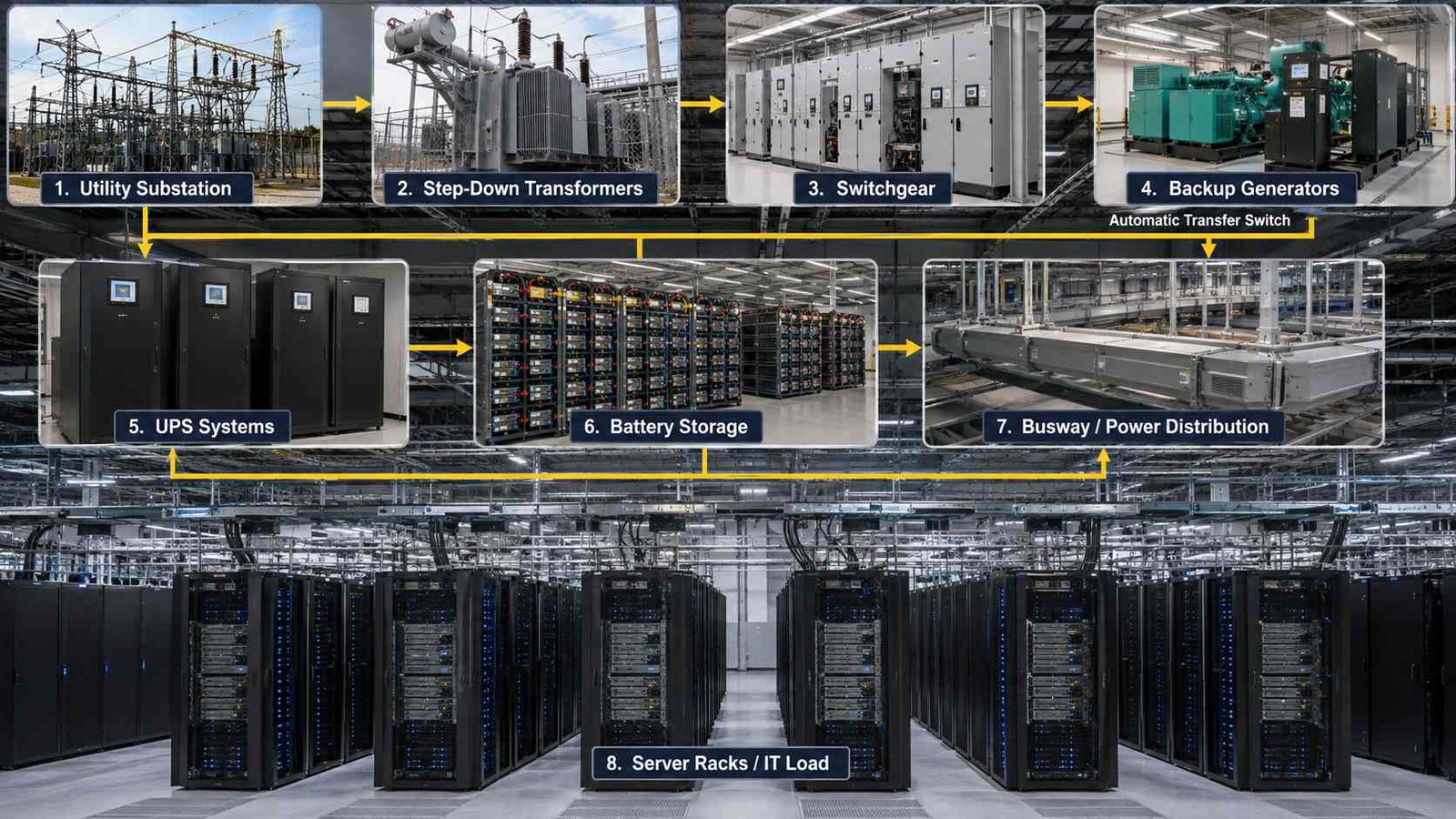
Understanding that chain explains where data centers get power, why they need generators, what happens during an outage, and how operators keep thousands of servers running without interruption.
What Are Data Center Power Supplies?
The term data center power supplies can mean two different things, and this often creates confusion.
At the facility level, it means the complete electrical infrastructure needed to bring electricity into a data center and distribute it safely. This includes utility feeds, substations, transformers, switchgear, automatic transfer switches, UPS systems, batteries, generators, power distribution units, busways, and monitoring systems.
At the server level, a power supply usually means the power supply unit, or PSU, installed inside a server. The PSU converts incoming electrical power into the regulated DC voltages required by processors, GPUs, memory, storage devices, fans, and other electronic components.
Think of the facility power system as a city’s water network. The utility connection is the reservoir. Transformers and switchgear act like pumping and control stations. Distribution equipment carries power closer to its destination. The server PSU is similar to the final valve that delivers exactly what the equipment needs.
Modern infrastructure suppliers illustrate how broad this system has become. Vertiv’s critical-power portfolio, for example, spans onsite power, battery storage, switchgear, transfer systems, UPS equipment, busway, PDUs, monitoring, and DC systems. Schneider Electric also packages UPS systems, switchgear, lithium-ion batteries, controls, and monitoring into prefabricated power modules.
So when discussing data center power, looking only at the server PSU gives you only the final few centimeters of a much larger electrical system.
Why Data Center Power Has Become a Bigger Issue
Data center power planning used to focus mainly on keeping conventional servers, networking equipment, storage, and cooling systems online. AI has changed the equation.
The IEA expects global data center electricity demand to roughly double by 2030. Accelerated servers, which include systems designed for AI and similar workloads, are expected to be one of the biggest drivers of that increase. The IEA projects electricity consumption from accelerated servers to grow around 30% annually in its base case through 2030.
AI infrastructure also concentrates much more computing power into each rack. Instead of spreading a workload across many low-density racks, operators can install powerful GPU systems in a smaller space. That creates large electrical and cooling loads at specific points inside the facility.
Power availability is becoming a business problem as well as an engineering problem. Uptime Institute’s 2026 Global Data Center Survey identifies limited power availability, grid reliability, rising costs, capacity forecasting, and supply-chain constraints among the industry’s growing concerns.
IEA Executive Director Fatih Birol summarized the issue clearly:
“There is no AI without energy – specifically electricity.”
The problem is not simply producing enough electricity globally. Operators also need sufficient generation, substations, transmission infrastructure, transformers, switchgear, and local distribution capacity in the exact locations where new data centers are being built.
That is why power availability can now influence where companies build new AI campuses.
Where Do Data Centers Get Their Power From?
Most data centers receive their normal operating electricity from the local electrical grid.
A utility or electricity provider delivers power to the facility, usually at a voltage suitable for large commercial or industrial customers. Data-center electrical equipment then transforms and distributes that power to cooling systems, networking equipment, storage, and servers.
The electricity reaching a data center can originate from many generation sources. Depending on the regional grid, that may include natural gas, coal, nuclear, hydroelectric power, solar, wind, or other resources.
Renewable-energy agreements add another layer. Large technology companies often sign power purchase agreements with wind and solar developers. However, buying renewable electricity contractually does not necessarily mean that electrons from a specific solar farm travel directly to a particular server rack. The data center normally remains connected to a wider electrical grid.
The IEA expects a mix of sources to meet growing data-center electricity demand. Renewables are projected to supply nearly half of the additional demand over the next several years, followed by natural gas and coal, while nuclear power plays a larger role later in the decade and beyond.
Some operators are also installing onsite generation, batteries, microgrids, fuel cells, or other systems.
Uptime Institute found that among giant data-center projects proposed in 2025, 68% planned to rely on grid power alone, 28% planned grid power plus onsite energy, and 4% planned fully off-grid operation.
That tells us something important: the conventional grid remains central, but the power model is becoming more diverse.
How Electricity Travels From the Grid to a Server
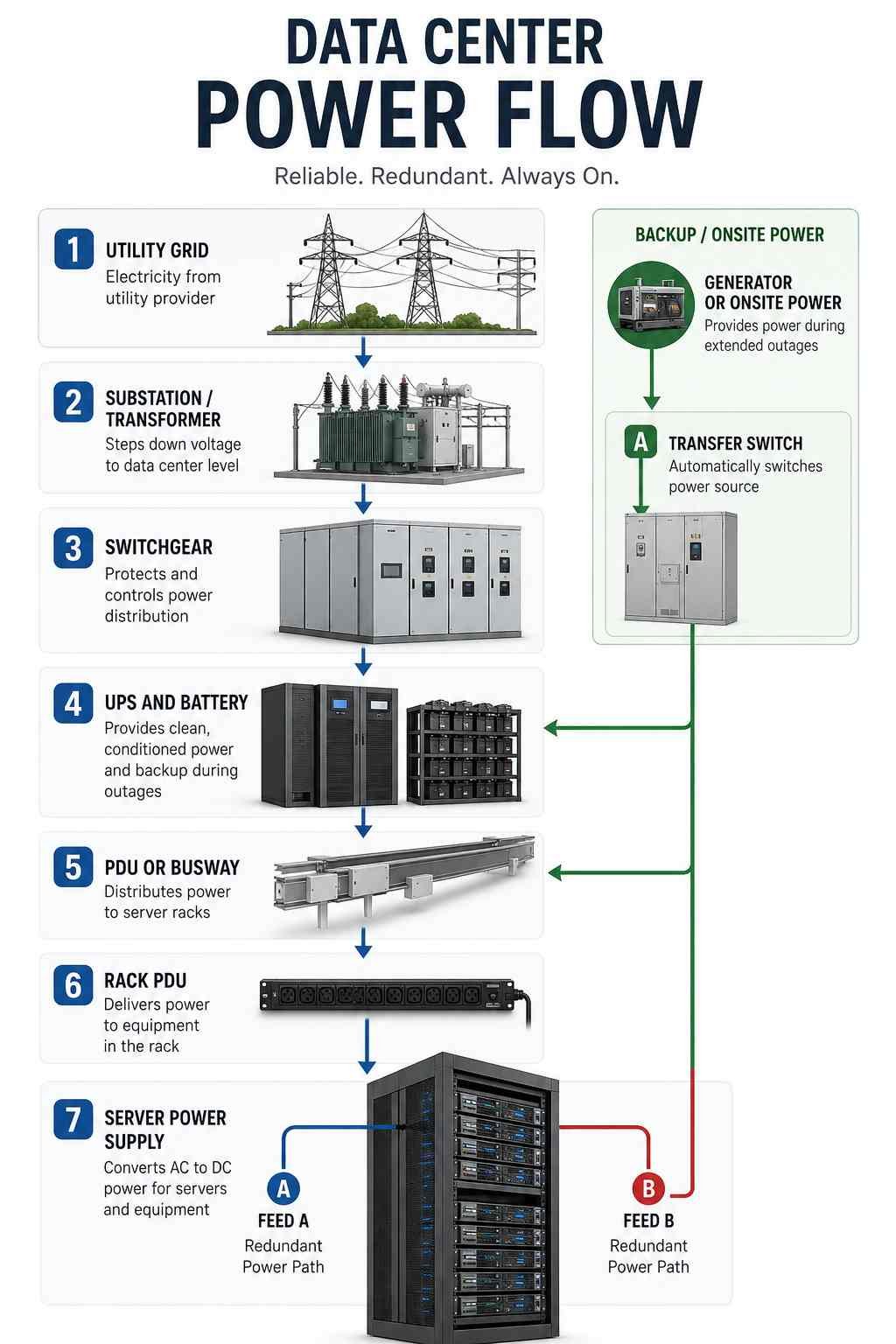
A typical data center power path looks roughly like this:
Utility grid to substation or transformer to switchgear to UPS to power distribution to rack PDU to server PSU to electronic components.
The exact design varies between facilities, but the purpose of each stage remains similar.
Utility Feed and Transformers
Electricity first enters the facility from the grid or onsite generation system. Large sites may receive medium-voltage or higher-voltage power.
Transformers then change the voltage to levels suitable for the next stage of the electrical system. New modular architectures may perform several voltage-conversion steps before power reaches the IT floor.
Switchgear
Switchgear controls, isolates, and protects electrical circuits.
It allows operators to safely disconnect equipment during maintenance and helps prevent an electrical fault in one part of the system from spreading throughout the facility.
UPS and Batteries
The uninterruptible power supply, or UPS, sits between the incoming electrical system and critical IT equipment.
Its most visible job is maintaining power when utility electricity suddenly disappears. Batteries provide immediate energy while generators or another longer-duration source becomes available.
The UPS can also help protect sensitive equipment against certain power-quality problems.
Power Distribution
After the UPS stage, electricity moves through PDUs, switchboards, remote power panels, or overhead busway.
Modern busway systems make it easier to add or reposition electrical connections above server racks as rack layouts change.
Rack PDU and Server PSU
A rack PDU distributes electricity among individual servers and networking devices.
Finally, the PSU inside each server converts the incoming supply into DC power required by its electronics.
What Happens When Grid Power Fails?
A well-designed data center should not simply switch off when the utility grid fails.
Instead, several systems work together.
The sequence normally starts when monitoring and switching equipment detects the loss of utility power. UPS batteries immediately support critical loads. Backup generators start and stabilize. Transfer equipment connects the appropriate electrical system to generator power. Once reliable utility power returns, operators or automatic controls transfer the facility back according to the site’s operating procedure.
The important point is that UPS systems and generators perform different jobs.
A UPS reacts almost immediately. Its batteries provide short-term ride-through power and prevent servers from dropping offline during the transition.
Generators support longer outages. Their potential runtime depends on generator capacity, stored fuel, fuel delivery, maintenance, load, site design, and operational procedures.
AWS describes this layered strategy in its own facilities. Its infrastructure documentation says electrical systems use redundancy, UPS units can support functions during disruptions, and generators can provide backup power for an entire facility.
That is why asking, “How long will a data center run on backup power?” has no universal answer.
Battery runtime may be measured in minutes in some architectures, while generator operation can continue much longer when fuel remains available. Some sites also add battery energy storage systems that can serve broader energy-management and resilience functions.
The real goal is not to make one component last forever. It is to create enough overlapping protection that a single electrical interruption does not become a server outage.
Do Data Centers Have Their Own Power Supply?
Yes, most professional data centers have their own backup power infrastructure, but most do not generate all of their normal electricity themselves.
This distinction matters.
Traditional facilities usually obtain normal power from the grid while keeping UPS batteries and generators onsite for emergencies. Newer facilities may combine utility electricity with onsite natural-gas generation, solar, battery storage, fuel cells, or microgrids.
| Power Model | Normal Source | Onsite Power | Typical Purpose |
|---|---|---|---|
| Grid-based | Utility grid | UPS and generators | Conventional operation |
| Grid plus onsite | Grid plus local generation | Batteries/generation | Capacity and resilience |
| Microgrid | Several coordinated sources | Usually extensive | Greater local control |
| Off-grid | Onsite generation | Essential | Limited or unavailable grid |
Uptime Institute’s research shows that full off-grid operation remains unusual among major proposed projects. Only 4% of giant projects proposed during 2025 fell into its off-grid category, compared with 68% that planned grid-only operation.
However, giant AI campuses are creating exceptions. Uptime reports that some multi-gigawatt North American proposals intend to build and operate their own off-grid energy infrastructure because obtaining sufficient utility capacity can be difficult.
So the answer depends on what “own power supply” means.
Data centers almost always have backup electrical systems. A growing number also produce some of their own electricity. But complete independence from the wider grid remains far from standard.
What Kind of Power Do Data Centers Need?
Large data centers normally use three-phase AC electricity through much of their facility-level distribution system.
Three-phase power is well suited to large commercial and industrial loads because it can efficiently deliver substantial amounts of electricity. UPS systems designed for major data centers commonly operate on three-phase power as well. Vertiv, for example, lists three-phase UPS systems among its current critical-power products for data centers, including AI and high-performance computing environments.
The voltage is not identical in every country or facility.
A large campus may receive medium-voltage service and then use transformers to step that voltage down. Different voltage levels may appear between the utility entrance, UPS, busway, rack, and IT equipment.
Inside the server, the situation changes again.
Servers contain power conversion electronics that convert incoming AC power into DC voltages used by CPUs, GPUs, memory, drives, and motherboard components. Some emerging high-density architectures move portions of this AC-to-DC conversion closer to the rack or use different DC distribution strategies.
Eaton’s recent work on high-density data center architecture, for example, describes designs that move from high-voltage/grid connectivity through medium- and low-voltage electrical systems before power reaches IT equipment.
Data centers also need stable power, not merely large quantities of it. Voltage disturbances, equipment failures, switching events, and overloaded circuits can affect sensitive electronic systems.
The real requirement is therefore reliable, correctly conditioned, properly distributed power with enough capacity and redundancy for both current equipment and future expansion.
Who Supplies Data Centers With Power?
There are two answers because “supplier” can refer to electricity or electrical equipment.
Electric utilities and energy companies supply the electricity. The exact company depends on the data center’s location and market structure. Some operators also sign contracts directly with independent power producers or renewable-energy developers.
Infrastructure manufacturers supply the equipment that manages the electricity.
Major companies operating across different parts of the data-center power market include Schneider Electric, Vertiv, Eaton, ABB, Siemens, Cummins, Caterpillar, and other specialized electrical manufacturers.
Their equipment may include:
- Transformers and switchgear
- UPS systems
- Batteries and battery energy storage
- Automatic and static transfer switches
- Generator systems
- PDUs
- Busway
- Intelligent rack PDUs
- Electrical monitoring software
Schneider Electric’s current prefabricated power modules illustrate how these pieces are increasingly packaged together. Its systems can integrate UPS equipment, switchgear, lithium-ion batteries, cooling, controls, and monitoring within factory-built modules.
Vertiv takes a similar grid-to-rack approach, offering onsite power equipment, BESS, switchgear, UPS systems, busway, PDUs, DC power, and monitoring as parts of the overall power train.
So a utility company may sell the electricity, while several different equipment vendors make the systems that transform, protect, store, switch, monitor, and distribute it.
Main Data Center Power Components Compared
Each piece of the power chain solves a different problem.
| Component | Problem | Main Function | Impact of Failure |
|---|---|---|---|
| Utility connection | Need for primary energy | Supplies normal electricity | Facility loses primary source |
| Transformer | Wrong voltage | Changes voltage | Downstream equipment cannot operate correctly |
| Switchgear | Circuit control and faults | Protects and isolates systems | Greater outage and safety risk |
| UPS | Short interruption | Provides immediate backup | Servers may restart or shut down |
| Battery | Temporary energy need | Stores electrical energy | Reduced ride-through capability |
| Generator | Long outage | Produces backup electricity | Extended outage may stop operations |
| ATS/STS | Source change | Transfers load between sources | Backup source may not reach load |
| PDU | Power distribution | Distributes electricity | Downstream racks may lose power |
| Busway | Flexible distribution | Carries power along rows | Limits rack power availability |
| Rack PDU | Device distribution | Powers equipment inside rack | Individual rack loses power |
| Server PSU | AC/DC conversion | Powers server electronics | Server stops operating |
This table also shows why redundancy cannot focus only on generators.
A data center with two generators but one critical switchboard could still have a serious single point of failure. The same applies to UPS modules, transformers, distribution paths, controls, cooling systems, and fuel systems.
Reliability comes from the architecture as a whole.
N, N+1 and 2N Power Redundancy Explained
Data center engineers often describe redundancy with terms such as N, N+1, and 2N.
N means the facility has the amount of capacity needed to support its design load. If three UPS modules are required and exactly three are installed, that represents N capacity for that part of the system.
N+1 adds one extra component. If three modules are required, four are available. One unit can fail or undergo maintenance while the remaining capacity continues supporting the load.
Eaton describes modular UPS systems that can use this type of parallel N+1 design to add redundancy while allowing capacity to grow with demand.
2N generally refers to two complete capacity systems. This approach can support independent A and B power paths to dual-corded IT equipment.
However, an important mistake is assuming that simply installing N+1 or 2N equipment automatically gives a data center a particular Uptime Institute Tier rating.
It does not.
Uptime Institute defines four infrastructure classifications:
- Tier I: Basic Capacity
- Tier II: Redundant Capacity Components
- Tier III: Concurrently Maintainable
- Tier IV: Fault Tolerant
A Tier III facility allows required capacity components and distribution paths to be removed for planned maintenance without interrupting operations. Tier IV goes further so that an individual equipment failure or distribution-path interruption does not affect operations.
The architecture and distribution topology matter, not simply the number of backup boxes installed.
How Much Power Does a Data Center Need?
There is no standard number because data centers range from small enterprise rooms to hyperscale campuses drawing hundreds of megawatts.
Start with the IT load. That includes servers, storage equipment, networking hardware, and related computing devices.
Then account for everything that supports the IT load. Cooling systems, pumps, fans, UPS losses, power conversion, lighting, controls, and other building infrastructure also consume electricity.
AI makes capacity planning harder because GPU-dense racks can concentrate much greater loads into smaller areas.
A useful distinction is power versus energy.
A megawatt, or MW, measures the rate at which power is being used or delivered at a given time.
A megawatt-hour, or MWh, measures energy consumed over time.
For example, a facility operating continuously at an average 10 MW would use about 240 MWh during 24 hours. Real facilities vary because server utilization, cooling demand, weather, and other factors change.
Operators also track Power Usage Effectiveness, or PUE.
The U.S. Department of Energy defines PUE as:
Total facility energy divided by IT equipment energy.
A theoretical PUE of 1.0 would mean every unit of facility energy goes directly to IT equipment, with no overhead. Real facilities always require additional infrastructure. DOE notes that PUE measures supporting-infrastructure efficiency rather than the total useful computing efficiency of a data center.
Capacity planning therefore needs more than adding the wattage printed on server specifications. Engineers must account for utilization, redundancy, cooling, electrical losses, future racks, and expansion headroom.
Common Data Center Power Problems
Electrical reliability depends on hundreds of components working together. A failure in one overlooked area can affect equipment far beyond the original fault.
| Problem | Common Cause | Possible Impact |
|---|---|---|
| Utility outage | Grid fault or weather | Facility switches to backup |
| Voltage sag | Utility disturbance or heavy load | Equipment instability |
| UPS failure | Component fault or poor maintenance | Loss of immediate backup |
| Weak batteries | Age, heat, cycling | Reduced backup runtime |
| Generator failure | Mechanical or fuel problem | Extended outage risk |
| Overloaded rack | Higher-than-planned IT density | Breaker trip or overheating |
| Breaker trip | Overload or fault | Loss of circuit |
| Single power path | Poor redundancy design | One fault affects many racks |
| Poor phase balance | Uneven electrical loading | Reduced capacity and efficiency |
| Grid constraint | Insufficient local infrastructure | Expansion delays |
| Transformer shortage | Capacity or supply problem | Deployment delay |
| Monitoring gap | Inadequate metering | Problems remain hidden |
The practical response starts with visibility.
Operators should know load at the facility, UPS, distribution, row, and rack levels. They should track battery condition, generator readiness, breaker states, available capacity, and environmental conditions.
Testing matters too.
AWS recommends redundant power infrastructure for critical environments and specifically calls for dual feeds where available, redundant UPS and generator systems, and documented power-failover drills.
The worst time to discover that a generator, battery string, transfer switch, or secondary power path does not work is during a real grid failure.
How Operators Monitor Data Center Power
Modern facilities use more than an engineer walking past gauges.
They combine electrical meters, intelligent PDUs, UPS monitoring, building-management systems, and data center infrastructure management, or DCIM, platforms.
At a basic level, operators watch:
- Voltage and current
- kW and kWh
- UPS utilization
- Available capacity
- Battery condition
- Generator readiness
- Breaker status
- Rack load
- Temperature
- PUE trends
Intelligent rack PDUs can show how much power a rack or individual outlet consumes. That helps teams find overloaded circuits and identify unused capacity.
Electrical Power Monitoring Systems provide a wider view of switchboards, transformers, UPS equipment, and distribution networks.
Building Management Systems focus heavily on facility systems such as cooling, electrical equipment, alarms, and environmental controls.
DCIM brings information from several infrastructure areas into a common operational view. Operators can use it for capacity planning, alarms, equipment mapping, trend analysis, and sometimes predictive maintenance.
The U.S. Department of Energy emphasizes that data-center energy metering should occur at enough levels to understand system performance. Monitoring only at the site or building level may not reveal what individual systems are doing.
Current commercial examples include Schneider Electric’s EcoStruxure-related data center tools and Vertiv’s power monitoring ecosystem. The product name matters less than the principle: operators need enough data to see problems before those problems become outages.
Suggested screenshot: Generic DCIM dashboard showing utility input, UPS load, battery health, generator status, rack capacity, and PUE.
Modern Power Solutions for AI Data Centers
The traditional sequence of grid, UPS, generator, and rack distribution is evolving.
One important development is the modular UPS.
Instead of installing maximum future capacity on day one, operators can add modules as the IT load grows. Eaton describes centralized, zoned, and distributed UPS architectures, including systems that scale in smaller increments and support N+1 redundancy.
Prefabricated electrical modules are another trend.
Schneider Electric offers factory-built modules that combine UPS systems, switchgear, lithium-ion batteries, controls, cooling, and monitoring. This approach lets developers deploy repeatable power blocks as a campus expands.
Battery technology is changing as well.
Lithium-ion systems are increasingly common alongside traditional UPS battery technologies. Larger battery energy storage systems, or BESS, can do more than cover a few minutes of outage. Depending on the design, they can support microgrids, help manage power demand, store energy, and improve resilience.
The IEA reported in 2026 that onsite battery storage is becoming increasingly important for next-generation AI data centers.
Other developments include higher-capacity busway, rack-level battery backup, alternative DC architectures, natural-gas generation, fuel cells, and onsite microgrids.
There is no single architecture that will replace every conventional data center. The direction is toward more flexible designs that can handle rapid increases in rack density while reducing dependence on one electrical path or one source of capacity.
Are Data Centers Moving Away From the Power Grid?
Not completely.
Uptime Institute’s 2026 analysis provides useful context. Among giant projects proposed in 2025, 68% still expected to rely on grid power alone. Another 28% planned grid power plus onsite energy. Only 4% planned off-grid operation.
That means grid electricity remains the foundation of most new developments.
What is changing is the willingness to add alternative resources around the grid.
Developers may combine grid connections with battery storage, onsite natural-gas generation, renewable contracts, solar, microgrids, or other technologies. Large technology companies are also exploring nuclear and geothermal projects as longer-term sources of firm electricity.
The IEA expects renewables and natural gas to lead much of the increase in electricity generation serving data centers, with nuclear becoming more important toward the end of the decade and beyond.
The driver is not only sustainability.
Grid interconnection can take much longer than constructing the computing facility itself. The IEA notes that a data center can sometimes become operational within two to three years while broader energy infrastructure often requires longer planning and construction periods.
For a developer spending billions on AI infrastructure, waiting years for sufficient utility capacity can become a major financial problem.
The likely future is therefore not grid versus off-grid.
It is a more complex combination of grid power, storage, backup generation, onsite generation, demand management, and long-term energy contracts.
Real-World Examples of Data Center Power Design
AWS: Redundancy Beyond One Building
AWS provides a useful example because it treats electrical resilience at both the facility and geographic levels.
AWS states that its data-center electrical systems include redundant power and backup systems. Its Availability Zones are physically separate locations, and each consists of one or more data centers with redundant power, networking, and connectivity.
That illustrates an important principle: resilience does not stop at the UPS.
Applications can also be designed across separate facilities so that a local infrastructure failure does not become an application-wide failure.
Modular Expansion
A growing colocation facility provides another practical example.
Suppose the operator initially needs 400 kW of protected IT capacity but expects several new customers over the next three years. Installing the full future electrical system immediately can leave expensive equipment underused.
A modular UPS and prefabricated power design allows capacity to expand as racks are installed. Eaton and Schneider Electric both market current systems around this type of scalable deployment.
AI Campus With Limited Grid Capacity
Now consider a proposed multi-gigawatt AI campus.
The computing equipment could be ready before the local grid can deliver the requested electricity. That changes the design conversation from “Which UPS should we install?” to “Where will hundreds of megawatts actually come from?”
Uptime Institute says some of the largest North American proposals now include substantial onsite or off-grid energy infrastructure for this reason.
Frequently Asked Questions
Who supplies data centers with power?
Local utilities supply electricity to most data centers. Operators may also purchase energy from independent producers or renewable projects. Inside the facility, companies such as Schneider Electric, Vertiv, Eaton, ABB, Siemens, Cummins, and others supply equipment that transforms, protects, stores, generates, and distributes electricity.
What kind of power do data centers need?
Large data centers generally use three-phase AC power through much of the facility. Transformers adjust voltage at different stages, while UPS equipment protects critical loads. Near or inside servers, power electronics convert incoming electricity into regulated DC voltages required by processors, GPUs, memory, and storage devices.
Do data centers have their own power supply?
Most have onsite backup power through UPS batteries and generators. Some also operate batteries, solar, fuel cells, natural-gas generation, or microgrids. However, most facilities still rely on the electrical grid for normal operation.
Where do data centers get their power from?
Most receive electricity through regional utility grids. That electricity may originate from natural gas, coal, nuclear, hydro, solar, wind, or other sources. Some operators supplement grid electricity with onsite generation or storage and purchase renewable energy through long-term contracts.
Do data centers run on generators all the time?
Normally, no. Traditional standby generators operate mainly during utility outages, testing, maintenance events, or specific power-management situations. Some newer facilities use onsite generation as part of normal operations, so the answer depends on the site’s architecture.
How long can a data center run without grid power?
There is no universal runtime. UPS batteries may bridge short interruptions while generators start. Generator operation can continue as long as the equipment remains functional and sufficient fuel is available. Site design, load, fuel contracts, redundancy, and maintenance all influence actual endurance.
What is the difference between a UPS and a generator?
A UPS provides almost immediate power when the primary electrical source fails. A generator takes longer to start but can provide power for a much longer period. Data centers commonly use both so that batteries cover the transition to generator operation.
Why do data centers use two power feeds?
Dual power paths reduce the chance that one failed electrical component will shut down equipment. Dual-corded servers can connect to separate A and B power paths, supporting maintenance and higher levels of fault resilience.
Do servers use AC or DC power?
Servers commonly receive AC power from a rack PDU, but their internal power supplies convert it into DC for electronic components. Some modern high-density designs use different rack-level DC conversion and battery architectures.
Data Center Power Planning Checklist
Use this checklist when reviewing or planning data center power infrastructure.
- Confirm available utility capacity and connection timeline.
- Calculate present IT load.
- Estimate future AI and high-density rack demand.
- Include cooling and facility electrical loads.
- Define required redundancy level.
- Size UPS equipment for the critical load.
- Check battery capacity and battery condition.
- Verify generator capacity.
- Review onsite fuel storage and delivery plans.
- Identify single points of electrical failure.
- Confirm A and B distribution paths where required.
- Monitor rack-level electrical loads.
- Check phase balancing.
- Track spare capacity in transformers and switchgear.
- Monitor UPS loading and efficiency.
- Test automatic transfer systems.
- Perform scheduled generator tests.
- Run documented power-failure drills.
- Monitor battery health and replacement schedules.
- Track PUE and supporting infrastructure energy.
- Reserve electrical capacity for future expansion.
- Review grid, storage, and onsite-generation options.
Further Reading and Technical Resources
For deeper technical research, several primary sources are worth bookmarking.
The International Energy Agency’s Energy and AI research provides current projections for global data-center electricity demand, AI load growth, energy supply, and grid constraints.
The Lawrence Berkeley National Laboratory United States Data Center Energy Usage Report: 2025 Update, published in June 2026, provides detailed U.S. electricity-demand scenarios through 2030.
The Uptime Institute Tier Standard and Tier Certification resources explain Basic Capacity, Redundant Capacity Components, Concurrent Maintainability, and Fault Tolerance.
The U.S. Department of Energy Best Practices Guide for Energy-Efficient Data Center Design covers PUE, energy metering, cooling, electrical systems, and facility efficiency.
For practical equipment architecture, Eaton, Schneider Electric, Vertiv, and AWS also publish technical material on UPS design, power distribution, modular infrastructure, backup systems, and resilience.
Final Thoughts Before Planning Data Center Power
The easiest way to understand data center power supplies is to stop thinking of them as one device.
A reliable data center uses a complete electrical chain.
Electricity may begin at a utility grid, renewable project, onsite generator, or microgrid. Transformers prepare that electricity for facility use. Switchgear controls and protects it. UPS systems and batteries prevent short interruptions from reaching servers. Generators handle longer outages. PDUs and busways move power toward racks. Rack PDUs feed individual devices. Server PSUs finally convert the electricity into the DC power used by processors, GPUs, memory, storage, and networking electronics.
Every link matters.
That becomes even more important as AI drives higher power density and faster data-center growth. Global demand is rising quickly enough that grid capacity, transformers, battery systems, onsite generation, and electrical distribution are now becoming strategic constraints, not background infrastructure.
A successful design therefore has to answer three questions at the same time: Is enough power available? Can it reach the equipment safely? And will the IT load continue running when part of the system fails?
If those questions are answered well, the power system becomes almost invisible.
That is exactly what a good data center power system is supposed to do.

Certified network engineer and published author on emerging internet technologies. David translates technical knowledge into easy steps, ensuring readers learn practical fixes backed by professional experience and proven technical standards.