
Ethical hacking penetration testing gives organizations a controlled way to discover security weaknesses before criminals find and exploit them. That matters more in 2026 because attackers can move from discovering a weakness to exploiting it much faster than they could only a few years ago.
The 2026 Verizon Data Breach Investigations Report examined more than 31,000 real-world security incidents and over 22,000 confirmed breaches across 145 countries. More important for penetration testing, exploitation of software vulnerabilities became the leading breach entry point for the first time in the DBIR’s 19-year history, accounting for 31% of breaches.
The financial impact has also increased. IBM’s 2026 Cost of a Data Breach Report puts the global average breach cost at $4.99 million, 12% higher than the previous year. IBM also reports a 56% increase in AI-driven attacks.
Those numbers explain why businesses cannot depend only on firewalls, antivirus software, or automated vulnerability scanners. Security teams also need to know whether a weakness can create meaningful business risk.
That is where penetration testing helps.
A professional penetration test does not mean attacking random systems. It is an authorized, scoped, controlled security assessment. Testers examine approved systems, validate selected weaknesses, measure their possible impact, and give the organization clear recommendations for fixing them.
For students and people entering cybersecurity, there is another important distinction to learn from the start: ethical hacking and penetration testing are closely connected, but they are not exactly the same thing.

What Is Ethical Hacking and Penetration Testing?
Ethical hacking is the authorized use of hacking knowledge, tools, and techniques to find weaknesses and improve cybersecurity. An ethical hacker may perform vulnerability assessments, penetration tests, malware analysis, security research, or other defensive work.
IBM describes ethical hacking as using hacking techniques to uncover, understand, and fix vulnerabilities. It also makes an important distinction: “penetration tests are only one of the methods that ethical hackers use.”
Penetration testing, often shortened to pen testing, is more specific. It is a structured security assessment in which an authorized tester simulates parts of a real attack against defined applications, networks, infrastructure, APIs, cloud resources, or other assets. The purpose is not simply to produce a list of possible vulnerabilities. A good test helps determine which weaknesses could actually create meaningful risk within the agreed scope.
Think of the difference this way. A building safety specialist might inspect doors, alarms, emergency exits, cameras, and procedures. That entire discipline is similar to ethical hacking. Asking the specialist to test whether a particular approved entrance could be bypassed under controlled conditions is closer to penetration testing.
Authorization separates professional testing from unauthorized intrusion. Scope gives the engagement boundaries. Controlled validation shows what matters. Reporting turns technical findings into actions that the organization can use.
Ethical Hacking vs. Penetration Testing
| Area | Ethical Hacking | Penetration Testing |
|---|---|---|
| Meaning | Broad defensive cybersecurity practice | Specific type of security test |
| Scope | May cover many security activities | Defined systems and objectives |
| Duration | Can be continuous or project based | Usually time limited |
| Main purpose | Improve overall security | Find and validate exploitable weaknesses |
| Activities | Assessments, research, testing, analysis | Structured simulated attacks |
| Final output | Depends on activity | Formal findings and remediation report |
The two terms are sometimes used interchangeably in everyday conversation, but IBM treats penetration testing as a method inside the broader ethical-hacking field.
Are Penetration Testers Ethical Hackers?
Yes, legitimate penetration testers are ethical hackers when they have authorization and operate within agreed rules.
Technical skill alone does not make someone an ethical hacker. Permission, intent, scope, safety, confidentiality, and professional conduct matter just as much.
Before testing begins, the tester and system owner should establish what may be tested, what must remain untouched, when testing can occur, what techniques are allowed, how sensitive information will be handled, and what happens if testing causes unexpected problems.
NIST SP 800-115 recommends creating an assessment plan for security testing regardless of whether an internal team or an outside company performs the assessment. NIST says this plan establishes the “rules and boundaries to which assessors must adhere.” It should identify authorized systems, scope, logistics, sensitive-data handling, and incident procedures.
Cloud environments make this especially important because your application can run on infrastructure that belongs to someone else. Microsoft, for example, allows penetration testing against authorized Azure resources under its published Rules of Engagement. Third-party testers must have “explicit written authorization from the resource owner.”
Here is what matters: a tester should never assume that a publicly accessible system is automatically available for security testing. Ownership, contracts, provider policies, local laws, and written authorization all affect what is permitted.
Common Problems Penetration Testing Can Find
A vulnerability scanner can identify many known security problems, but penetration testing adds context. A tester can examine whether separate weaknesses combine into a larger risk and whether security controls actually reduce the impact.
| Problem | Common Cause | Possible Impact |
|---|---|---|
| Weak access controls | Incorrect permissions | Unauthorized access to data |
| Exposed services | Poor configuration | Larger external attack surface |
| Outdated software | Slow patching | Known flaws remain exploitable |
| Weak authentication | Poor credential policies | Account takeover |
| Application security flaws | Unsafe application logic or coding | Data exposure or manipulation |
| Excessive privileges | Poor role design | Greater damage after compromise |
| Weak network segmentation | Flat network architecture | Threats move between systems |
| Cloud misconfiguration | Incorrect permissions or deployment settings | Sensitive resources become exposed |
One important lesson is that severity cannot always be judged from a vulnerability name alone. A weakness on an isolated test server may have limited impact. A similar weakness on an internet-facing system connected to customer information could demand immediate attention.
That business context is one reason human-led testing remains valuable.
What Is Penetration Testing in Hacking?
Penetration testing in hacking means using selected attacker-style techniques under authorization to test defenses.
The simplified process looks like this:
Authorization → Discovery → Analysis → Controlled validation → Impact assessment → Reporting → Remediation → Retesting
A penetration tester may look for insecure configurations, weak authentication, exposed services, broken access controls, vulnerable applications, or ways that several minor issues could combine into something more serious. The tester does not receive unlimited permission to do anything technically possible. Every activity remains constrained by the rules of engagement.
Penetration Testing vs. Vulnerability Scanning
A vulnerability scan mainly searches for known weaknesses and reports possible findings. It can run regularly across large numbers of assets.
A penetration test goes further by applying human judgment and controlled validation.
IBM notes that scanning is more automated and suited to regular monitoring, while penetration testing can expose false positives, root causes, and vulnerabilities that become dangerous when chained together.
Penetration Testing vs. Red Teaming
These terms are also different.
A penetration test usually asks, Which exploitable weaknesses exist in this defined environment?
A red-team exercise asks a broader question: Could a realistic adversary achieve a particular objective despite our people, processes, detection systems, and technical controls?
IBM describes red teaming as more scenario-based, while penetration testing behaves more like a focused security assessment.
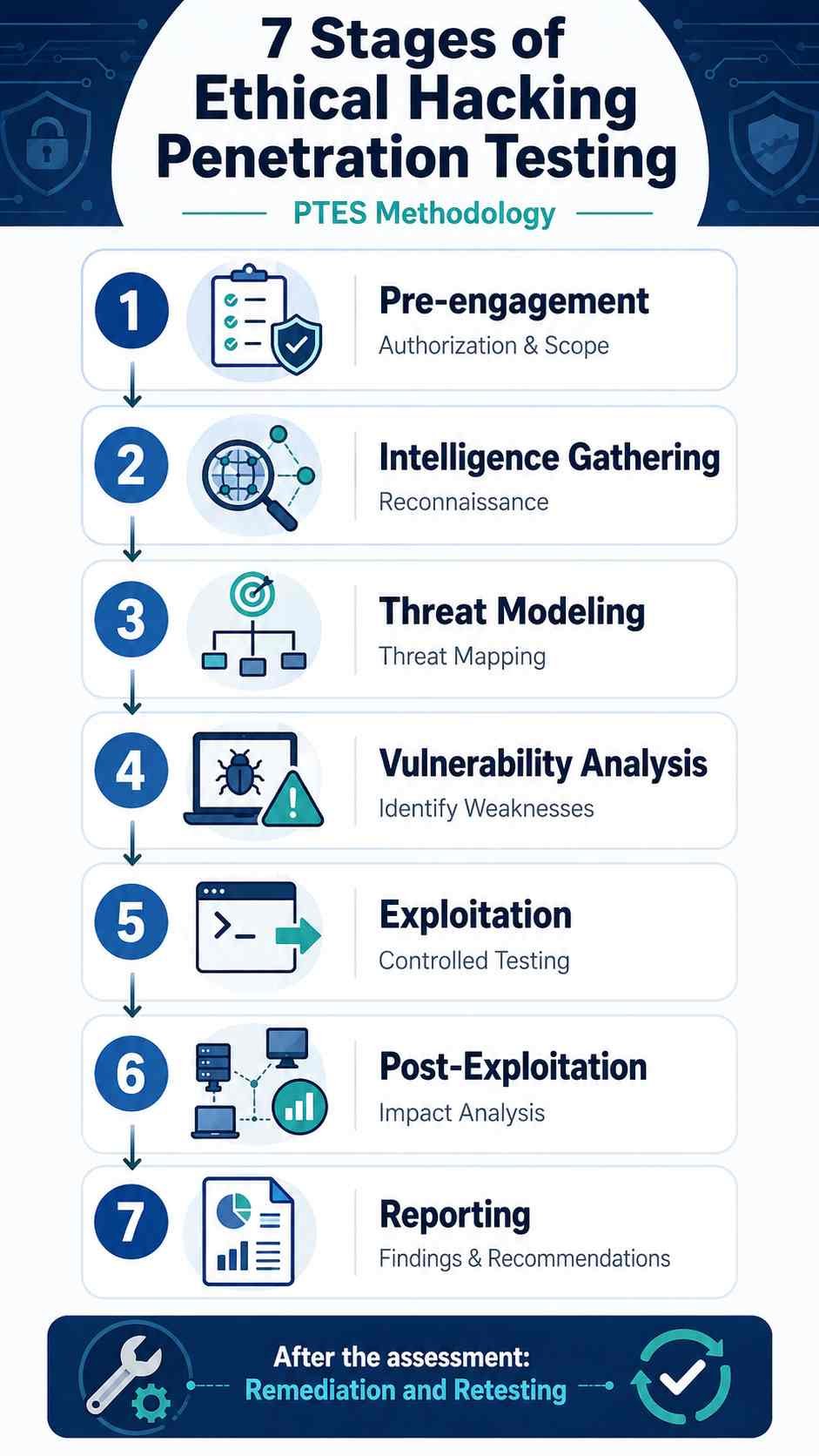
What Are the 7 Stages of Penetration Testing?
There is no single stage model that every company uses. Some methodologies use three, four, five, six, or seven phases.
For a clear seven-stage answer, the Penetration Testing Execution Standard, or PTES, provides one of the best-known frameworks.
PTES defines seven main sections:
- Pre-engagement Interactions
- Intelligence Gathering
- Threat Modeling
- Vulnerability Analysis
- Exploitation
- Post Exploitation
- Reporting
1. Pre-Engagement Interactions
Professional penetration testing starts before anyone runs a security tool.
The organization and tester establish the purpose, scope, systems involved, testing dates, approved techniques, important contacts, exclusions, data-handling rules, and conditions that should stop testing.
Suppose a company wants its customer portal tested. Its internal payroll system may sit on related infrastructure but remain outside the engagement. That boundary needs to be documented.
This phase protects both parties. It also prevents an otherwise legitimate assessment from accidentally affecting systems that were never approved.
2. Intelligence Gathering
The tester builds an understanding of the approved environment.
The goal is to identify relevant assets, technologies, services, applications, relationships, and other information needed for the assessment.
For an external test, this might mean understanding what parts of an organization’s authorized internet-facing environment are visible. An internal assessment may focus more heavily on network structure and access relationships.
Information gathering should remain connected to the scope. Collecting unrelated employee or customer information simply because it is technically available does not make an engagement better.
3. Threat Modeling
Threat modeling connects technical information with business risk.
The tester asks questions such as:
Which assets matter most?
Which types of threat would realistically target them?
Where are the trust boundaries?
Which security failures would create the greatest business impact?
For example, an online shop may care more about unauthorized payment or customer-account access than a low-impact issue on a public marketing page.
Threat modeling helps testers spend limited assessment time where it matters most.
4. Vulnerability Analysis
During vulnerability analysis, testers examine the environment for weaknesses that deserve further investigation.
Automated scanners can contribute, but analysts also review architecture, configurations, authentication, access controls, software behavior, and other security-sensitive areas.
The key word is analysis.
A scanner result should not automatically become a confirmed penetration-testing finding. Testers should determine whether it is relevant, whether compensating controls exist, and whether controlled validation is appropriate.
This reduces false positives and helps the final report focus on meaningful risk.
5. Exploitation
In the PTES framework, exploitation is the phase where testers carefully validate whether selected weaknesses can lead to unauthorized behavior or access.
This stage must stay inside the agreed scope.
The goal is usually to gather enough evidence to prove the security impact, not to maximize damage. A professional tester should stop when further activity would create unnecessary operational risk or exceed the engagement rules.
This difference matters. A criminal wants to benefit from a weakness. A penetration tester wants enough evidence to help remove it.
6. Post-Exploitation
Finding an entry point does not always reveal the true level of risk.
Post-exploitation examines what that access could mean within approved boundaries. A tester may evaluate whether one weakness affects other systems, privileges, information, or security controls.
The question becomes:
If a real attacker reached this point, what could happen next?
This phase helps organizations separate technical severity from business impact. It can expose problems such as excessive permissions or weak segmentation that might otherwise remain hidden.
Again, the objective is controlled risk measurement, not unnecessary access to sensitive information.
7. Reporting
Reporting may be the most valuable phase for the organization because a finding that nobody understands or fixes has limited defensive value.
A professional report should explain:
- What was tested
- What was discovered
- Why each finding matters
- Evidence supporting the finding
- Business impact
- Severity or priority
- Recommended remediation
- Important limitations of the assessment
Technical teams need enough detail to reproduce and fix problems. Managers need a clear explanation of business risk and remediation priorities.
PTES ends its seven named sections with reporting. Many consulting workflows then treat remediation and retesting as an additional operational step after the formal penetration test.
Main Types of Penetration Testing
Penetration testing is not one single test. Organizations choose the assessment based on what they need to protect.
Network penetration testing examines approved internal or external network infrastructure. It can help uncover exposed services, security configuration problems, segmentation weaknesses, and access-control issues.
Web application penetration testing focuses on websites and browser-based applications. OWASP’s Web Security Testing Guide provides a widely used framework for testing web applications and web services. OWASP currently lists WSTG 4.2 as a versioned release while version 5.0 remains under development.
API penetration testing examines the interfaces applications use to exchange data. Authentication, authorization, input handling, and unintended data exposure often receive particular attention.
Cloud penetration testing evaluates workloads and configurations hosted in environments such as Azure, AWS, or Google Cloud. Provider-specific testing rules must be followed.
Wireless penetration testing evaluates authorized Wi-Fi and wireless infrastructure.
Testing can also be classified by how much information the tester receives. In a black-box assessment, the tester starts with limited knowledge. A gray-box assessment provides some access or technical information. A white-box assessment gives the tester extensive information, which can include architecture details, accounts, or source code.
No approach is automatically best. The right choice depends on the security question the business wants answered.
Ethical Hacking and Penetration Testing Tools in 2026
Tools can make testing faster, but tools do not replace methodology, judgment, or authorization.
Kali Linux
Kali Linux is a Linux distribution built for penetration testing and security work. Offensive Security released Kali Linux 2026.2 on June 29, 2026, with updated desktop environments, infrastructure changes, package updates, and nine newly added tools.
Kali is useful because it brings many security utilities into one environment. Installing Kali does not, however, turn someone into a penetration tester. Understanding networks, applications, operating systems, security principles, and scope remains more important than the operating system itself.
Nmap
Nmap is commonly used for network discovery and security auditing. In professional testing, it can help a tester understand the approved network environment and exposed services.
Burp Suite
Burp Suite focuses heavily on web application security testing. PortSwigger’s documentation describes a workflow that combines manual and automated tools for mapping applications, analyzing attack surfaces, and testing security-sensitive behavior. Its documentation was updated in August 2026.
PortSwigger also warns that security testing can damage vulnerable targets and says Burp should not be used against systems without authorization from their owner.
Metasploit Framework
Metasploit is commonly associated with controlled vulnerability validation and security research. Professional testers can use frameworks like this when the engagement permits validation of specific weaknesses.
Wireshark
Wireshark is a free, open-source network protocol analyzer. It lets security professionals inspect network traffic for troubleshooting, analysis, development, education, and security work. The Wireshark project currently lists the 4.6 branch as its stable release series.
Why Tools Cannot Replace a Skilled Tester
Automated products can identify known patterns. They do not always understand business logic, unusual trust relationships, compensating controls, false positives, or the impact of combining several weaknesses.
That is why penetration testing remains partly a human reasoning exercise.
PTES vs. OWASP vs. NIST: Which Methodology Should You Use?
Several respected frameworks can guide security assessments, and organizations often combine them.
| Framework | Best Known For | Useful When |
|---|---|---|
| PTES | Full penetration-testing lifecycle | Planning broad penetration tests |
| OWASP WSTG | Web application and web-service testing | Assessing web apps and APIs |
| NIST SP 800-115 | Structured security testing and assessment guidance | Building formal organizational assessment programs |
PTES provides the seven-stage structure explained above.
OWASP WSTG gives detailed categories and test scenarios for web security. Its strength lies in application-focused coverage rather than acting as a complete organizational penetration-testing lifecycle.
NIST SP 800-115 provides broader guidance for planning, conducting, analyzing, and managing technical security assessments. It places strong emphasis on formal assessment plans and approved boundaries.
A small company testing one web application may lean heavily on OWASP. A consultant conducting a wider penetration test may organize the engagement around PTES. A larger organization building repeatable security-assessment processes may also use NIST guidance.
The important point is consistency. A methodology should make the test more complete and repeatable, not become paperwork that distracts from actual risk.
Authorization and Rules of Engagement Come First
The most important penetration-testing control is not a scanner. It is authorization.
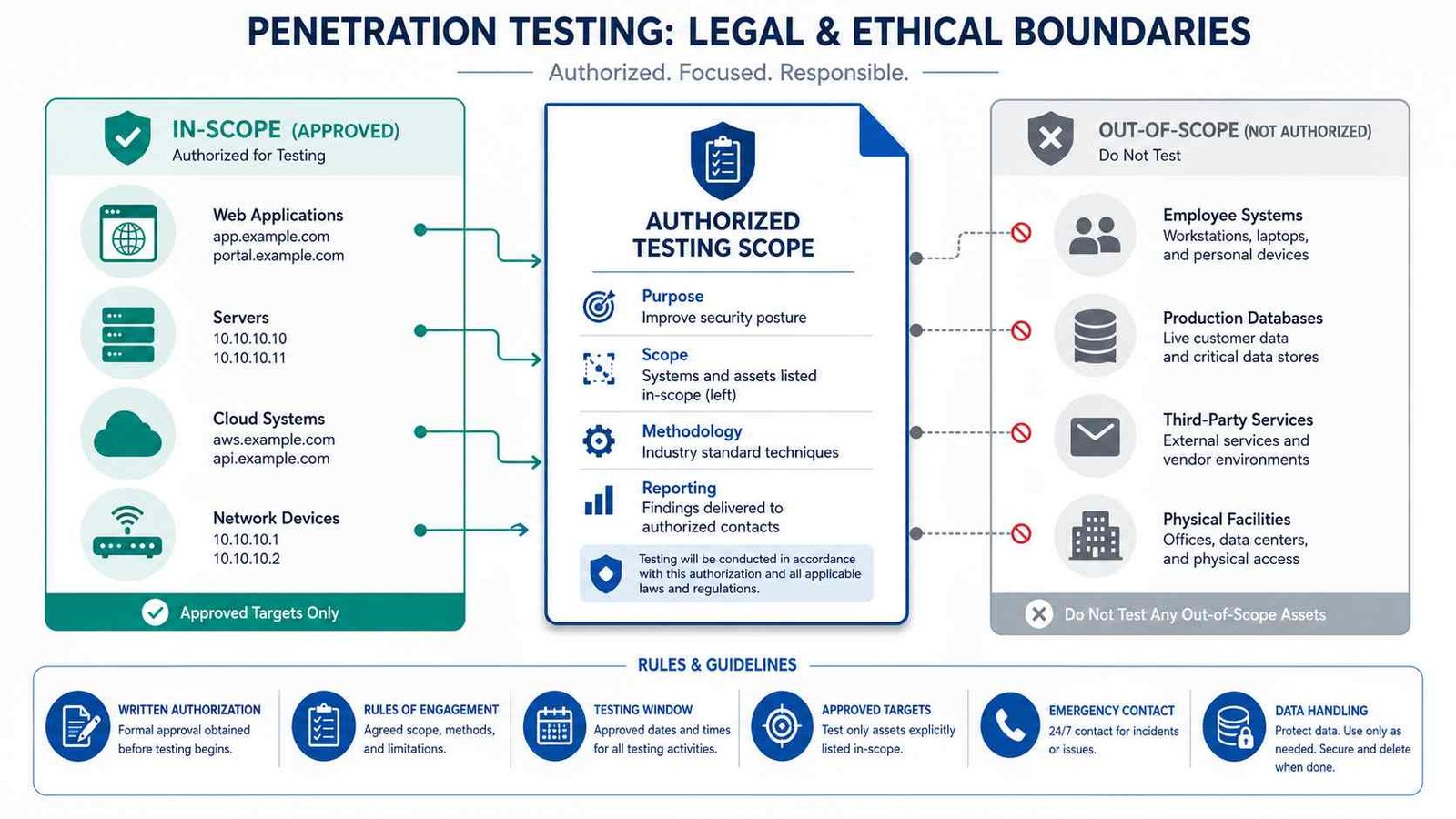
A written agreement should identify the systems that may be tested and those that must remain untouched. It should also define testing dates, accepted techniques, emergency contacts, sensitive-data handling, reporting procedures, and conditions requiring the tester to stop.
NIST specifically recommends documenting who is authorized to conduct the assessment, its scope, logistics, sensitive-data handling, and procedures for incidents.
Cloud services add another layer because the organization may own its application but not the underlying platform. Microsoft’s current Azure guidance provides a useful real-world example. Customers can test authorized Azure-hosted resources without Microsoft’s prior approval, but they must follow Microsoft’s penetration-testing Rules of Engagement. Third-party consultants still need written authorization from the resource owner.
A good rules-of-engagement document should answer several practical questions before testing starts:
- Which domains, IP ranges, applications, APIs, accounts, and networks are in scope?
- Which systems are specifically excluded?
- When can active testing occur?
- Which activities are prohibited because they may disrupt production?
- Who should the tester contact if something unexpected happens?
- How will screenshots, logs, credentials, and other evidence be protected?
- When and how should test data be deleted?
- Who receives the final report?
These controls do not weaken a penetration test. They make professional testing possible without creating unmanaged risk.
What Does a Penetration Testing Report Include?
The report converts technical work into business value.
A useful report normally has two levels. The executive section explains overall security risk, major findings, business impact, and recommended priorities in plain language. The technical section gives security and IT teams enough evidence to understand each issue and plan remediation.
A strong report usually records the scope, dates, methodology, affected assets, findings, evidence, severity, potential impact, recommendations, limitations, and retesting status.
Imagine that a small online retailer receives 40 scanner alerts. That number alone tells the owner very little. A penetration test might show that 32 alerts have limited practical impact, while two apparently unrelated weaknesses could combine to expose customer information.
That changes the remediation order.
Instead of simply saying you have 40 vulnerabilities, the report can say fix these two issues first because they create the clearest path to serious business impact.
This ability to prioritize is one of penetration testing’s strongest practical benefits.
When Should a Business Conduct a Penetration Test?
There is no universal schedule for every organization. Testing frequency should reflect risk, system changes, regulatory obligations, customer requirements, and the importance of the assets involved.
Common triggers include launching a major application, moving sensitive workloads to new infrastructure, making significant authentication or network changes, adding important third-party integrations, or completing major remediation work.
Compliance can also create specific requirements.
For example, organizations within the relevant scope of PCI DSS have explicit penetration-testing obligations. This illustrates why businesses should map security testing to the standards and contracts that apply to them rather than relying on a generic calendar.
Businesses should also avoid treating an annual penetration test as proof that everything will remain secure for the next 12 months. Applications change. Cloud configurations change. New vulnerabilities appear. Employees and suppliers change. New integrations create new trust relationships.
Penetration testing therefore works best as one part of a larger security program that also includes patching, vulnerability management, secure development, monitoring, backups, access management, employee awareness, and incident response.
Practical Ethical Hacking Penetration Testing Checklist
Use this checklist before commissioning or performing an authorized assessment.
- Define the business reason for the penetration test.
- Obtain clear written authorization.
- List all in-scope systems and assets.
- Document systems that are out of scope.
- Agree on testing dates and time windows.
- Define permitted and prohibited activities.
- Create emergency communication procedures.
- Confirm backups and recovery arrangements where appropriate.
- Define how sensitive evidence will be handled.
- Choose a suitable testing methodology.
- Record findings with clear supporting evidence.
- Rank findings by technical and business risk.
- Assign remediation owners and priorities.
- Remove temporary testing artifacts after the engagement.
- Retest important findings after remediation.
- Store the final report securely.
Frequently Asked Questions
What is ethical hacking and penetration testing?
Ethical hacking is the authorized use of hacking skills and techniques to improve cybersecurity. Penetration testing is a specific ethical-hacking method that uses a controlled simulated attack to identify and validate weaknesses in approved systems. IBM describes ethical hacking as the broader field and penetration testing as one of the methods used within it.
Are penetration testers ethical hackers?
Yes, professional penetration testers are ethical hackers when they have permission to test, remain inside the agreed scope, avoid unnecessary harm, protect sensitive findings, and report weaknesses responsibly. A person testing someone else’s systems without authorization should not assume that good intentions make the activity ethical or lawful.
What is penetration testing in hacking?
Penetration testing is an authorized security assessment that simulates selected attacker behavior against defined systems. Testers identify potential weaknesses, safely validate relevant findings, assess their possible impact, and report what the organization should fix.
What are the 7 stages of penetration testing?
Using the PTES framework, the seven stages are Pre-engagement Interactions, Intelligence Gathering, Threat Modeling, Vulnerability Analysis, Exploitation, Post Exploitation, and Reporting.
Some organizations use different names or add remediation and retesting as another stage, so there is no single seven-stage model used everywhere.
Is vulnerability scanning the same as penetration testing?
No. Vulnerability scanning mainly identifies possible weaknesses, usually through automated checks. Penetration testing applies additional human analysis and may safely validate selected weaknesses to determine their actual security impact.
Is penetration testing legal?
Authorized penetration testing is a legitimate cybersecurity activity, but legal permission depends on ownership, written authorization, contracts, provider rules, testing methods, and applicable law. Do not test third-party systems merely because they are publicly accessible.
What tools do penetration testers use?
Common professional tools include Kali Linux, Nmap, Burp Suite, Metasploit, and Wireshark. Different tools serve different purposes, such as network discovery, web application assessment, vulnerability validation, and traffic analysis. Tools should only be used on systems the tester is authorized to assess.
What is the difference between PTES and OWASP?
PTES describes an overall penetration-testing lifecycle. OWASP’s Web Security Testing Guide focuses specifically on web application and web-service security testing. A professional web penetration test may use PTES for the engagement structure and OWASP guidance for application-specific coverage.
Can a beginner learn ethical hacking legally?
Yes. Beginners can practice through their own isolated lab systems, purpose-built cybersecurity training environments, capture-the-flag exercises, and platforms that explicitly authorize security testing. Deliberately vulnerable training applications are especially useful because they let learners build technical skills without targeting real third-party systems. PortSwigger, for example, provides deliberately vulnerable labs through its Web Security Academy for learning web security testing.
Resources for Further Reading
For readers who want to go deeper, start with authoritative material rather than random hacking tutorials.
PTES provides the seven-stage penetration-testing framework used in this guide.
NIST SP 800-115, Technical Guide to Information Security Testing and Assessment explains assessment planning, execution, reporting, and testing controls.
OWASP Web Security Testing Guide provides extensive guidance for web application and web-service security assessments.
Microsoft Security Testing Rules of Engagement gives a useful example of how a major cloud provider defines authorized testing boundaries.
Verizon’s 2026 DBIR provides current evidence about how attackers gain access to organizations and why vulnerability management matters.
Final Thoughts Before You Test Your Security
Ethical hacking penetration testing is valuable because it changes security from a theoretical question into a practical one.
A scanner might tell you that a weakness exists. A well-run penetration test can help explain whether that weakness matters, how it relates to other security controls, what business impact it could create, and what the organization should fix first.
The process should always begin with permission and a clearly defined scope. From there, frameworks such as PTES, NIST SP 800-115, and the OWASP Web Security Testing Guide can make assessments more structured and repeatable.
That discipline matters in 2026. Verizon’s latest DBIR shows vulnerability exploitation becoming the leading breach entry point, while IBM puts the average breach cost at $4.99 million.
The purpose of penetration testing is not to prove how clever a hacker can be. It is to give defenders useful evidence before a real attacker gets the same opportunity.
That is what separates professional ethical hacking from unauthorized hacking: permission, control, evidence, remediation, and measurable improvement in security.
*Author persona and audience approach follow Techoble’s Alex Turner cybersecurity profile: practical, authoritative, and written for everyday users, small businesses, and technology learners. *

Technology journalist with 12+ years in networking and cybersecurity. Known for simplifying complex tech into everyday solutions, Alex combines research, industry insight, and hands-on testing to guide readers with authority and clarity.