
Home battery storage has moved from a niche solar add-on to a serious home-energy option. The International Energy Agency reported that the world added 108 GW of battery storage capacity in 2025, 40% more than in 2024. Installed battery storage capacity is now about eleven times higher than in 2021. Lithium iron phosphate, or LFP, batteries accounted for around 90% of new deployments. About 20% of the new capacity installed in 2025 was behind the meter, which includes residential and commercial systems.
That growth leaves homeowners with a very practical question: how much battery storage do I need? For many homes, 10 to 20 kWh of usable storage is a reasonable starting range, but there is no universal size. A small system that keeps lights, Wi-Fi, a refrigerator, and a few electronics running may need only 5 to 10 kWh. A home that needs overnight air conditioning, electric heating, pumps, cooking equipment, or whole-home backup may need 20, 30, or even 40+ kWh.
Your electricity bill gives useful context. U.S. residential customers used an average of about 865 kWh of grid electricity per month in 2024, or roughly 28.4 kWh per day. Homes with rooftop solar may consume more electricity than their utility purchases show because some solar energy is used directly on site. 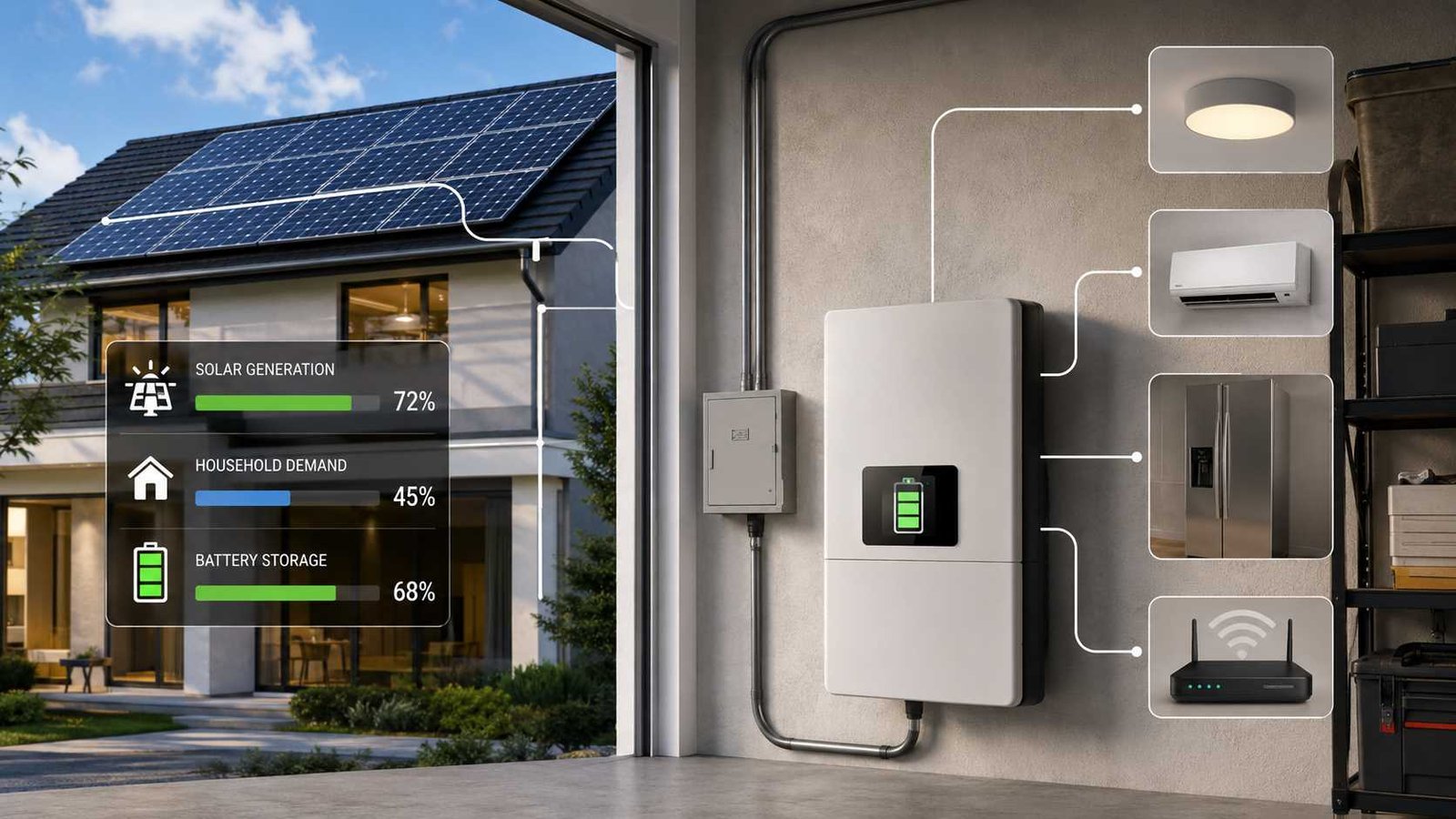
Here’s what matters: do not size a battery from the average home. Size it from your loads, your backup time, your solar production, and your peak power demand.
How Much Battery Storage Do I Need? The Quick Answer
If you only want a starting point, use this table.
| Backup Goal | Practical Starting Storage Range |
|---|---|
| Lights, router, phones, small electronics | 2–5 kWh |
| Refrigerator plus essential household loads | 5–10 kWh |
| Essential loads through the night | 10–15 kWh |
| Larger essential-load backup | 15–20 kWh |
| Partial to whole-home backup | 20–40 kWh |
| Large all-electric or multi-day backup | 30–60+ kWh |
These are planning ranges, not guaranteed requirements. A 10 kWh battery could be more than enough for one house and far too small for another.
The fastest calculation is:
Average backup load in kW × required backup hours = required usable energy in kWh
Suppose the appliances you want to keep running average 1.2 kW during an outage. You want eight hours of backup:
1.2 kW × 8 hours = 9.6 kWh
You therefore need roughly 9.6 kWh of energy delivered to those loads. In practice, you should also consider conversion losses, battery reserve settings, temperature, battery condition, and how the manufacturer defines usable capacity. The U.S. Department of Energy notes that storing and retrieving electricity is never 100% efficient.
Do not automatically add the same loss allowance twice. Some batteries advertise usable capacity, which already excludes energy the battery management system does not make available to normal household loads.
kW vs. kWh: Get This Right Before Buying a Battery
The most common battery-sizing mistake is confusing kilowatts with kilowatt-hours.
A kilowatt, or kW, measures power. It tells you how much electricity the system can supply at one moment.
A kilowatt-hour, or kWh, measures energy. It tells you how much electricity is stored and available over time.
Think of a water tank. The amount of water inside the tank is similar to kWh. The size of the pipe coming out of it is similar to kW. A huge tank connected to a narrow pipe holds plenty of water but cannot deliver it quickly. A large pipe connected to a tiny tank can deliver water quickly, but only for a short period.
The Department of Energy makes the same distinction, defining storage systems by both their energy capacity and their power capacity. NREL’s 2024 residential battery model uses a 5 kW / 12.5 kWh representative system. That is a useful example because it treats power and stored energy as separate specifications rather than one number.
For a theoretical 10 kWh battery:
| Average Load | Theoretical Runtime |
|---|---|
| 0.5 kW | 20 hours |
| 1 kW | 10 hours |
| 2 kW | 5 hours |
| 4 kW | 2.5 hours |
| 5 kW | 2 hours |
Actual runtime will usually differ because household demand changes constantly and system losses, reserves, temperature, and battery operating limits matter.
Step-by-Step: Calculate the Battery Storage Your Home Needs
The best battery calculation starts with actual electricity data rather than a salesperson’s estimate.
Step 1: Find Your Daily Electricity Consumption
Check several recent electricity bills. Look for total kWh used during each billing period.
For example:
900 kWh per month ÷ 30 days = 30 kWh per day
Do not immediately buy a 30 kWh battery. That number represents total daily electricity use. During an outage, you may decide to power only 25% or 40% of your normal loads.
Smart meters, solar inverter apps, home energy monitors, and utility dashboards can provide better information because they show when you consume electricity, not just how much you use each month.
Step 2: Choose the Loads You Actually Need
Write down the appliances that must keep operating during a blackout.
For many households, that means refrigeration, Wi-Fi, lighting, phone charging, computers, fans, security equipment, and selected outlets.
Whole-home backup changes the calculation dramatically. Air conditioners, electric ovens, water heaters, dryers, pumps, and EV chargers can consume far more power.
Step 3: Decide How Long Backup Must Last
A battery designed for four hours is very different from one designed for a 24-hour outage.
Choose a realistic target such as:
- 4 hours
- 8 hours
- Overnight
- 24 hours
- Multiple days
Step 4: Calculate Required Energy
Use:
Average load × backup time = energy required
A measured 0.8 kW essential load for 12 hours needs:
0.8 × 12 = 9.6 kWh
Step 5: Check Peak Power
Energy capacity alone cannot tell you whether the system will work.
Your refrigerator compressor, water pump, or air conditioner may demand high power when starting. The battery inverter must handle both the normal continuous load and any permitted short-duration peaks.
The final flow is simple:
Measure electricity use → choose essential loads → set backup hours → calculate kWh → verify kW output
Is a 5kW Battery Enough to Run a House?
Possibly, but this question mixes two different battery specifications.
If you mean a system that can provide 5 kW of continuous power, it may run a home’s essential circuits and several normal appliances at the same time. It will not necessarily run every high-power appliance together.
Imagine your active loads total:
Refrigerator and freezer: operating
Lights: operating
Wi-Fi: operating
Television and computers: operating
Fans: operating
Microwave: switched on
If the combined demand remains under the battery system’s continuous output limit, a 5 kW inverter may support them. Turn on a large air conditioner, electric oven, electric water heater, or EV charger at the same time, however, and demand could exceed that limit.
If you mean a 5 kWh battery, the question becomes one of runtime instead.
At a constant 1 kW load, 5 kWh represents about five hours of theoretical stored energy. At 2.5 kW, it represents only about two hours.
Current hardware shows why the distinction matters. The North American Enphase IQ Battery 5P has 5.0 kWh of usable capacity but a continuous output rating of 3.84 kVA at 240 V. A battery can therefore have 5 kWh of energy without having a 5 kW continuous power rating.
So, is a 5kW battery enough to run a house? It can be enough for carefully managed essential loads. It may not be enough for unrestricted whole-home operation.
How Long Will a 10kWh Battery Last?
A 10 kWh battery lasts about 10 hours at a constant 1 kW load in an ideal calculation. Double the average load to 2 kW and theoretical runtime drops to five hours.
Here are the basic numbers:
| Average Household Load | 10 kWh Theoretical Runtime |
|---|---|
| 0.5 kW | 20 hours |
| 1 kW | 10 hours |
| 1.5 kW | 6.7 hours |
| 2 kW | 5 hours |
| 3 kW | 3.3 hours |
| 5 kW | 2 hours |
Real homes do not draw constant power. A refrigerator cycles on and off. An air conditioner may run harder during a hot afternoon. Someone may use a microwave for five minutes and then turn it off. Loads can also fall sharply while everyone sleeps.
That is why average load over the backup period matters more than simply adding every appliance’s maximum wattage.
Suppose your essential circuits consume an average of 600 watts, or 0.6 kW, overnight. A 10 kWh system gives a theoretical calculation of:
10 ÷ 0.6 = 16.7 hours
If the same house averages 2 kW because an air conditioner runs frequently:
10 ÷ 2 = 5 hours
The difference is huge. When people say their battery lasted all night while someone else’s lasted only a few hours, load profile is often the reason.
How Long Will a 20 kWh Battery Last?
A 20 kWh battery doubles the theoretical energy available from a 10 kWh battery.
| Average Load | 20 kWh Theoretical Runtime |
|---|---|
| 0.5 kW | 40 hours |
| 1 kW | 20 hours |
| 2 kW | 10 hours |
| 3 kW | 6.7 hours |
| 4 kW | 5 hours |
| 5 kW | 4 hours |
This does not mean a 20 kWh battery automatically provides a full day of home backup.
A household consuming 30 kWh per day cannot normally run its usual 24-hour load entirely from a 20 kWh battery without additional energy coming from solar, the grid, or another source.
The opposite can also happen. Suppose a family shuts off central air conditioning, the dryer, oven, EV charging, and other large loads during a blackout. Their critical circuits might consume only 8 kWh over 24 hours. In that situation, 20 kWh could support critical loads well beyond one day, especially if rooftop solar recharges the battery during daylight.
This is why the answer to how long will a 20 kWh battery last can range from a few hours to more than a day.
Battery capacity tells you how large the energy tank is. Your household load determines how quickly you empty it.
Problems That Cause Home Battery Systems to Disappoint
Many poor battery experiences start with incorrect sizing rather than defective equipment.
| Problem | Common Cause | Likely Impact |
|---|---|---|
| Battery empties too soon | Too little kWh capacity | Short backup duration |
| System shuts down under heavy load | Insufficient kW output | Appliances lose power |
| Battery rarely gets deeply used | Oversized system | Money tied up in unused capacity |
| Solar cannot refill battery | PV array too small or weak conditions | Reduced multi-day backup |
| Battery drains rapidly overnight | HVAC or other large load | Less runtime than expected |
| Calculation looks good but reality differs | Losses and load variation ignored | Incorrect runtime estimate |
| Motor will not start | Peak/startup demand too high | Pump or HVAC may fail to start |
The lesson is straightforward. You must size both energy and power.
How Solar Panels Change the Battery Storage You Need
Solar can completely change the battery calculation because a battery paired with solar does not always have to supply every kWh by itself.
During a typical solar day, energy may flow like this:
Solar panels → household loads → excess solar → battery → nighttime loads
The Department of Energy explains that storage allows solar energy to be used after it was generated, including when sunlight is weak or unavailable. DOE puts the principle clearly: “storage allows the flexible use of energy at different times.”
Suppose your home needs 12 kWh of essential electricity per day. Without any charging source, two days of backup could require roughly 24 kWh of usable energy, plus whatever design margin your system requires.
Now suppose your solar panels reliably generate enough excess electricity during the outage to put 8 kWh back into the battery every day. Your battery no longer needs to carry the complete two-day energy requirement from its starting charge.
But solar does not guarantee unlimited backup. Clouds, shade, dust, season, panel orientation, snow, and high daytime household demand can reduce the amount available for charging. DOE also notes that many grid-connected solar systems shut down during outages unless they have the equipment needed to operate safely in an islanded configuration. Properly designed solar-plus-storage systems can provide outage resilience.
So when sizing a solar battery, ask two separate questions: how much electricity do I use overnight, and how much surplus solar can realistically recharge the battery tomorrow?
Three Realistic Home Battery Sizing Examples
Example 1: Small Home With Essential Backup
A small home or apartment wants to keep refrigeration, Wi-Fi, lights, laptops, phones, and a few fans running during outages.
Energy monitoring shows these circuits consume about 5 kWh overnight.
A battery in the 5 to 10 kWh class may make sense. Choosing closer to 10 kWh provides more flexibility for a longer outage or extra loads.
The owner does not need to size the battery from the home’s full daily electricity use because high-demand appliances will remain off during outages.
Example 2: Family Home With Overnight Backup
A family measures its selected backup circuits and finds they consume about 11 kWh between evening and morning. The family wants refrigeration, electronics, lighting, fans, and moderate climate control.
A 10 kWh system sits close to the calculated requirement and leaves little margin. A system around 15 kWh may provide more breathing room, depending on usable capacity, expected losses, climate-control demand, and available solar.
This is a case where measurement beats guessing.
Example 3: Large All-Electric Home
A larger home uses electric HVAC, an electric water heater, induction cooking, a pool or well pump, and an EV.
The owner wants something close to normal operation during grid outages.
A single 10 kWh battery may be badly undersized even if it technically runs some of the equipment. The owner may require 20 to 40+ kWh of storage and a high enough continuous and peak power rating to support simultaneous appliances.
The smarter alternative may be to separate critical loads and avoid running the EV charger, dryer, water heater, and other flexible loads during a blackout.
That single change can reduce the required battery size substantially.
Essential Loads vs. Whole-Home Backup
Before spending money on more batteries, decide what backup actually means to you.
Essential-load backup keeps the circuits that matter most alive. A well-designed essential-load setup might cover refrigeration, lighting, communications, computers, selected outlets, security devices, fans, and critical medical equipment.
Whole-home backup attempts to keep most or all normal appliances available.
The second option sounds more convenient, but it changes both kWh and kW requirements. A home may use relatively little energy while everyone sleeps, then experience a large power spike when the air conditioner, pump, oven, and other equipment operate together.
This creates an important sizing rule:
Battery capacity determines endurance. Inverter power determines what can run at the same time.
A current Tesla Powerwall 3 illustrates the difference. It has 13.5 kWh of energy capacity and, in its U.S. configuration, up to 11.5 kW of continuous on-grid power. Tesla also supports adding expansion capacity.
Those numbers describe two different capabilities. The 13.5 kWh figure helps determine runtime. The 11.5 kW figure helps determine how much simultaneous load the system can support.
Appliances That Can Increase Battery Size Fast
Heating and cooling equipment often has the biggest impact on battery runtime, particularly in hot or cold climates. Other large electrical loads can have the same effect.
Pay special attention to:
- Central air conditioning and large heat pumps
- Electric resistance heating
- Electric water heaters
- Clothes dryers
- Electric ovens and cooktops
- Well and pool pumps
- Workshop machinery
- EV charging
An EV deserves special attention. A home battery intended mainly for backup can lose a large share of its stored energy if it also charges a vehicle during an outage.
You do not necessarily have to remove these appliances from the house battery permanently. A modern energy-management system can prioritize loads or allow the owner to switch flexible equipment off during a grid failure.
That can be cheaper than buying enough batteries to operate every appliance without restriction.
This is one of the most useful battery-sizing questions to ask an installer:
Which loads should I manage during an outage instead of buying more battery capacity to support them?
The answer can save more money than choosing between two battery brands.
One Large Battery or Several Smaller Batteries?
Modern residential battery systems increasingly use modular designs. This allows homeowners to start with a smaller capacity and add compatible modules when their needs grow.
For example, the Enphase IQ Battery 5P provides 5.0 kWh of usable capacity per unit, while Tesla’s Powerwall 3 provides 13.5 kWh per main battery and supports additional expansion capacity.
A modular approach can make sense when your future electricity demand is uncertain. Perhaps you plan to buy an EV, install a heat pump, expand your solar array, or convert gas appliances to electricity later.
However, do not assume every battery system can be expanded indefinitely. The inverter, electrical panel, system controller, communications architecture, utility interconnection rules, physical installation space, and manufacturer limits all matter.
There is also little benefit in buying a huge battery bank simply because larger sounds safer. If you routinely use only a small portion of the stored capacity and outages are rare, some of that investment may provide little practical benefit.
Start with the job the battery must perform. Then buy enough capacity to perform that job with a sensible margin.
Use an Energy Dashboard Instead of Guessing
The best diagnostic tool for battery sizing is not a battery calculator. It is your own electricity data.
Review at least several weeks of energy use if possible. A full year is even better when heating and cooling demand changes strongly with the seasons.
Look for four numbers:
- Total daily kWh
- Overnight kWh
- Peak simultaneous kW
- Essential-load kWh during your desired backup window
A smart meter, solar monitoring portal, home energy monitor, or battery app can reveal patterns that a monthly electricity bill hides.
For example, two homes may each consume 25 kWh per day. One uses most of its energy while the sun is shining. The other uses 15 kWh after sunset because of air conditioning and evening appliances. The second home may need much more battery storage for overnight solar self-consumption.
Modern storage systems can also provide detailed monitoring. The latest Enphase IQ Battery 5P documentation supports remote monitoring and reports 90% AC round-trip efficiency under its specified test conditions, illustrating why real systems do not return every unit of energy used to charge them.
Advanced Battery Sizing Factors Most Simple Calculators Miss
A basic kW × hours calculation gets you close. A professional design goes further.
Usable vs. nominal capacity: Some manufacturers advertise total battery capacity while others emphasize usable energy. Compare like with like.
Round-trip efficiency: Energy is lost while charging, storing, converting, and discharging electricity. DOE explicitly notes that storage is never 100% efficient.
Reserve settings: Owners often configure a percentage of battery energy to remain available for outages instead of using all storage for daily solar shifting.
Battery degradation: Battery capacity changes with age and cycling. Check warranty capacity-retention terms rather than assuming today’s capacity will remain unchanged for the life of the product.
Temperature: Very hot or cold conditions can affect battery operation. Manufacturer operating ranges matter, especially for garage or outdoor installations.
Startup loads: Motors and compressors may briefly need much more power than their normal running load.
Future electrification: An EV, heat pump, electric water heater, second refrigerator, pool, or home extension can change the calculation.
Solar recharge rate: A large battery combined with a small solar array may take a long time to recharge.
The broader battery market is also evolving quickly. The IEA says LFP batteries represented around 90% of battery storage deployments in 2025, up from well below 50% only five years earlier.
Home Battery Safety Matters as Much as Capacity
A battery is high-energy electrical equipment. Treat installation as an electrical and fire-safety project, not a DIY appliance upgrade.
The battery needs suitable electrical protection, approved wiring, proper isolation equipment, enough physical space, appropriate environmental conditions, and installation that follows the manufacturer’s instructions and local requirements.
Modern batteries include extensive safety systems, but those protections do not make poor installation safe. For example, Enphase lists its IQ Battery 5P as using LFP chemistry and being evaluated to UL 9540A. Tesla’s installation documentation specifies breaker sizing, conductor requirements, and procedures for de-energizing equipment before electrical work.
Have a qualified installer evaluate the service panel, backup circuits, inverter configuration, solar integration, location, clearances, and applicable electrical and fire requirements.
A Simple Home Battery Storage Calculator
You can make a useful first estimate with three calculations.
Calculation 1: Backup Energy
Average essential load × backup hours = required usable kWh
Example:
1.2 kW × 8 hours = 9.6 kWh
Calculation 2: Longer Backup
Suppose your selected circuits consume 7 kWh every 24 hours and you want two days without assuming solar recharge:
7 kWh × 2 = 14 kWh
Your starting target is therefore around 14 kWh of delivered energy before considering the specific battery’s usable capacity definition, system losses, reserve strategy, and design margin.
Calculation 3: Runtime From a Known Battery
Use:
Battery energy in kWh ÷ average load in kW = theoretical hours
For a 20 kWh battery at 1.5 kW:
20 ÷ 1.5 = 13.3 hours
For a 10 kWh battery at the same load:
10 ÷ 1.5 = 6.7 hours
These equations are deliberately simple. They give you a screening estimate, not an engineering design.
The important next step is checking whether the battery’s continuous and peak kW rating can support the loads you want to operate.
Common Battery Sizing Mistakes
Most avoidable mistakes come from treating one number as the complete answer.
Common examples include:
- Confusing kW with kWh
- Sizing from national average electricity use
- Looking only at monthly consumption
- Ignoring overnight demand
- Ignoring inverter output
- Forgetting motor startup requirements
- Assuming nameplate capacity always equals usable capacity
- Expecting solar to recharge normally during every weather condition
- Ignoring future EV or heat-pump demand
- Buying whole-home backup when essential-load backup would meet the real need
- Oversizing the battery but undersizing the solar array
- Failing to measure actual loads before installation
The IEA’s Executive Director Fatih Birol described the wider storage shift simply: “Batteries are changing the game before our eyes.”
For homeowners, however, better technology does not remove the need for good sizing. It makes accurate sizing even more valuable.
Frequently Asked Questions
How much battery storage should I have?
For many homes, 10 to 20 kWh is a useful starting range for substantial backup, but your actual requirement may be lower or much higher. Measure the electricity consumed by the loads you want to back up and multiply that by the number of hours you need them to operate.
Is a 5kW battery enough to run a house?
A battery system capable of 5 kW continuous output may run many essential household loads, but it may not support several high-power appliances simultaneously. You also need to know its kWh capacity because 5 kW describes power, not runtime.
Is 5 kWh enough for a house?
Five kWh can be useful for short outages, light overnight use, or a limited set of essential loads. It is usually small for unrestricted whole-home backup.
How long will a 10kWh battery last?
At a constant 1 kW load, 10 kWh represents around 10 theoretical hours. At 2 kW, it represents around five hours. Actual runtime depends on usable capacity, efficiency, reserve settings, temperature, battery condition, and changing household loads.
How long will a 20 kWh battery last?
At 1 kW, theoretical runtime is about 20 hours. At 2 kW, about 10 hours. At 5 kW, about four hours. Solar charging during the day can extend practical outage duration substantially.
Is 10 kWh enough for a house?
It can be enough for essential-load backup in many homes, particularly if high-power appliances are managed. It may be insufficient for whole-home backup where HVAC, electric water heating, pumps, cooking equipment, or other large loads operate frequently.
How many kWh does a house use per day?
Consumption varies widely. U.S. residential customers averaged about 865 kWh of utility electricity per month in 2024, equivalent to roughly 28.4 kWh per day. Solar households may use more electricity than their grid purchases indicate.
How much battery do I need for an eight-hour outage?
Measure the average load you plan to back up and multiply it by eight. A 1 kW average load requires 8 kWh of delivered energy. A 2 kW average load requires 16 kWh.
How much battery storage do I need with solar panels?
Start with your overnight and outage consumption, then estimate how much surplus solar energy can recharge the battery during daylight. A battery that can comfortably cover the period between sunset and the next day’s solar production is often more useful than simply matching total 24-hour household use.
Can a home battery run an air conditioner?
Many modern home batteries can run compatible air-conditioning systems, but you must check continuous power, startup demand, battery capacity, electrical configuration, and manufacturer requirements. Running HVAC can greatly shorten battery runtime.
Should I oversize my battery?
A modest margin can help with changing loads, degradation, and future needs. Extreme oversizing can leave expensive storage capacity unused. If expansion is likely, a modular battery system may be more practical.
Practical Battery Storage Checklist
Before choosing a system, confirm:
- Average daily electricity use in kWh
- Overnight electricity use
- Essential appliances during an outage
- Desired backup duration
- Average backup load in kW
- Maximum simultaneous load
- Motor and compressor startup requirements
- Battery usable capacity
- Continuous inverter output
- Peak inverter output
- Expected conversion losses
- Backup reserve settings
- Existing solar array size
- Expected surplus solar production
- Cloudy-day and seasonal performance
- Future EV or heat-pump plans
- Battery expansion options
- Installation location
- Electrical panel compatibility
- Warranty and capacity-retention terms
- Local installation and safety requirements
Final Thoughts Before Choosing Your Battery Size
The best answer to how much battery storage do I need does not start with 5 kWh, 10 kWh, or 20 kWh. It starts with your home.
Measure the loads you actually need during an outage. Find their average energy use. Decide whether you need four hours, overnight backup, a full day, or several days. Then make sure the battery can provide enough kWh for runtime and enough kW for simultaneous loads.
A 10 kWh battery can last most of the night in an efficient essential-load setup and disappear in a few hours in a high-demand home. A 20 kWh battery can provide long backup when loads are controlled, yet still struggle to cover a full day of unrestricted all-electric household use.
Solar makes the calculation more flexible because tomorrow’s sunlight may refill energy used tonight. Load management can reduce the required capacity even further.
So do not ask only, How big should my battery be?
Ask a better question:
What must my battery power, how much energy will those loads use, and how long do I need them to keep running?
Once you know those three things, choosing the right battery size becomes much easier.

Certified network engineer and published author on emerging internet technologies. David translates technical knowledge into easy steps, ensuring readers learn practical fixes backed by professional experience and proven technical standards.