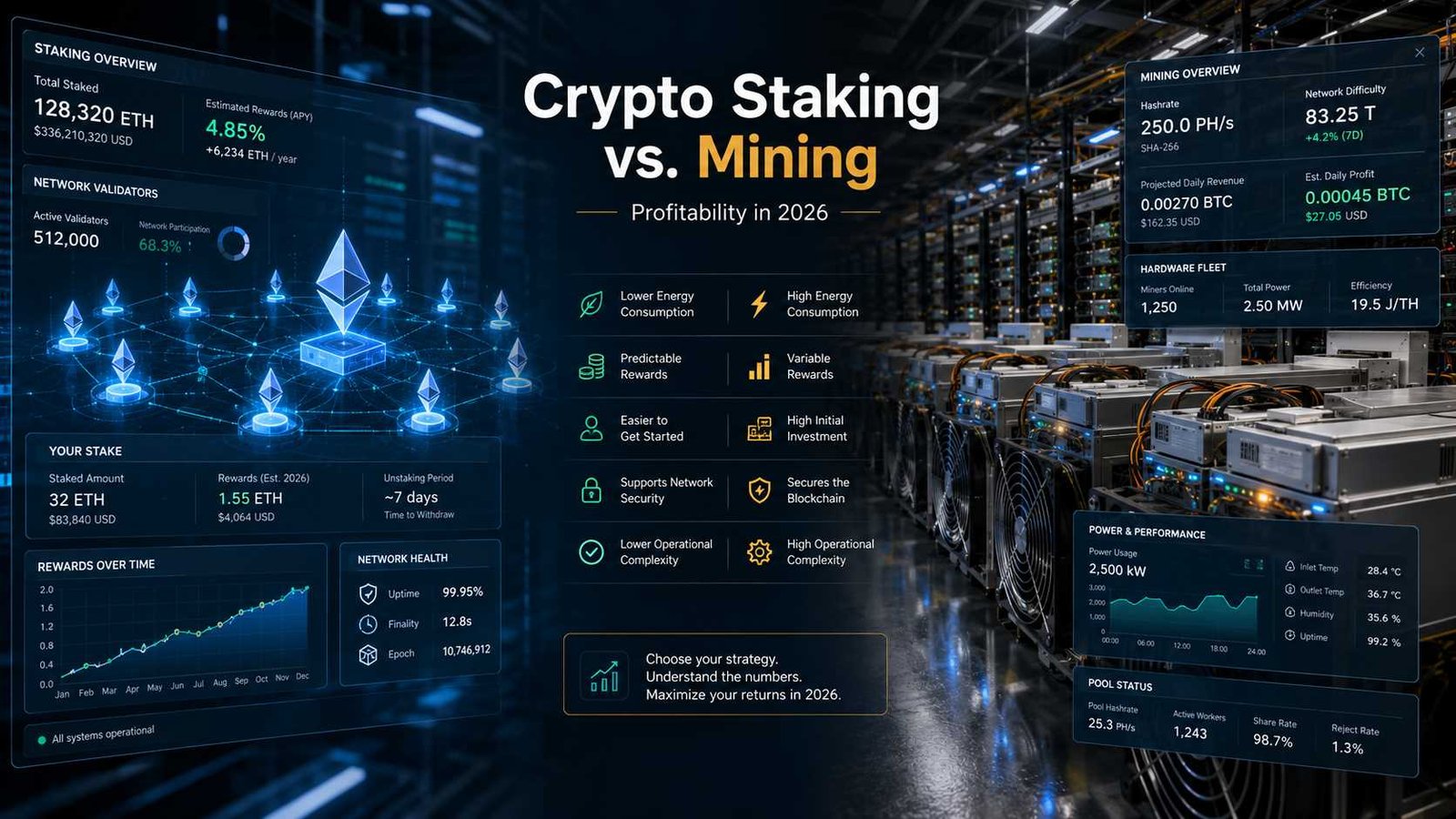
Staking mainly requires crypto capital. You lock or commit coins to a Proof of Stake network and receive rewards for helping secure it. Mining requires computing equipment, electricity, cooling, and continuous operation. Miners compete with specialized hardware to secure Proof of Work networks such as Bitcoin.
The numbers show how different these models have become. At the time of checking in August 2026, Ethereum’s validator dashboard showed about 39.45 million ETH staked and a current staking APR of roughly 2.63%. Bitcoin mining’s hashprice, which measures expected mining revenue per unit of hashrate, was about $32.66 per PH/s per day.
Those figures do not mean staking automatically beats mining. A staking return depends on the amount invested, token price, fees, validator performance, and the staking method you choose. Mining profitability depends on Bitcoin’s price, network difficulty, ASIC efficiency, electricity rates, pool fees, cooling, and equipment costs.
Here’s what matters: staking is generally easier and cheaper for an individual to operate, while profitable mining increasingly behaves like a specialized infrastructure business.
That distinction should guide the rest of the comparison.
Important: The examples below explain how staking and mining economics work. They are not promises of returns or financial advice. Cryptocurrency prices, network rewards, fees, and mining economics can change quickly.
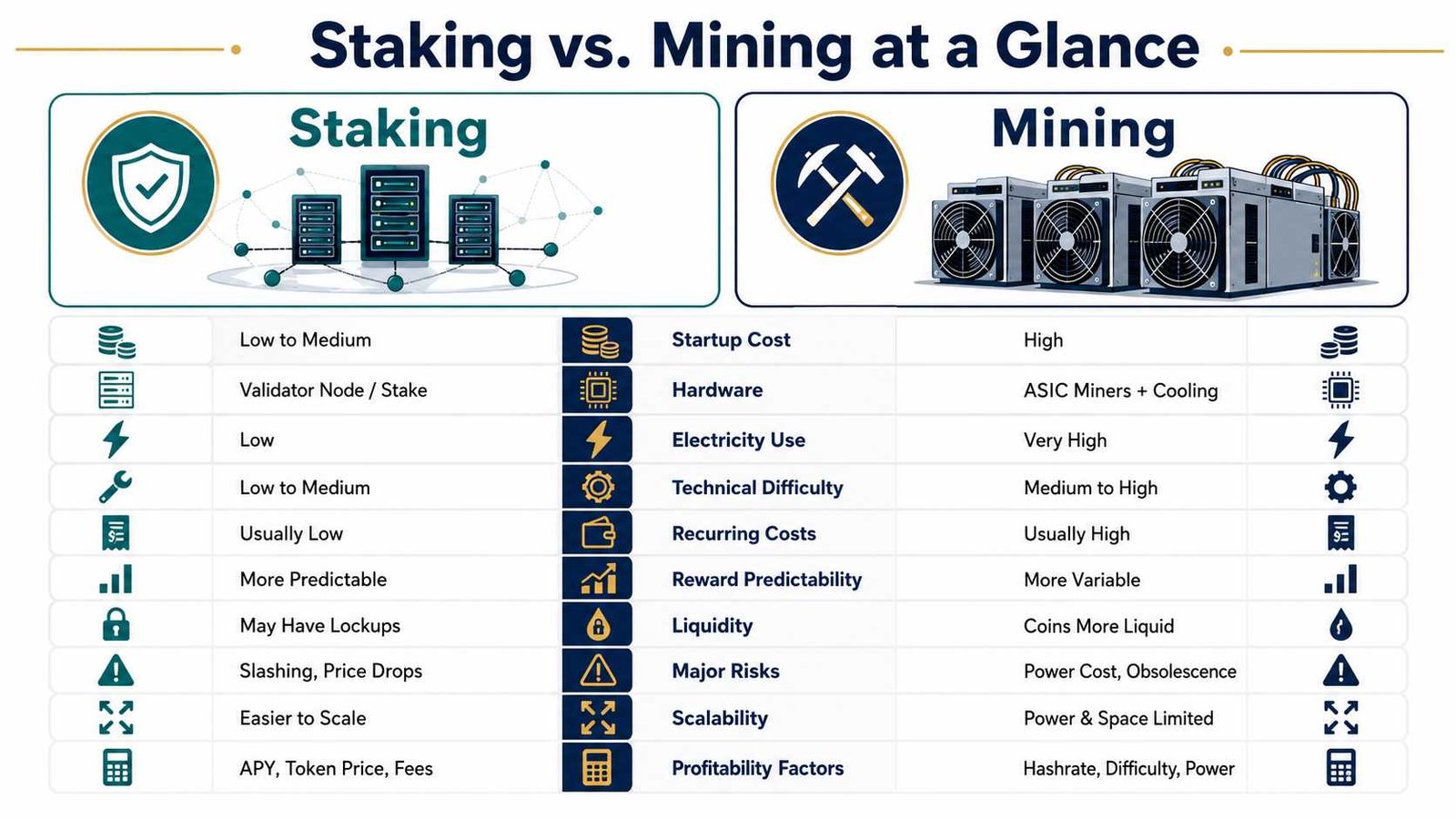
Crypto Staking vs. Mining at a Glance
Both systems help blockchain networks agree on valid transactions. However, they put different resources at risk.
| Factor | Crypto Staking | Crypto Mining |
|---|---|---|
| Consensus system | Proof of Stake | Proof of Work |
| Main resource | Cryptocurrency | Computing power |
| Participants | Validators | Miners |
| Hardware need | Low to moderate | High |
| Electricity use | Relatively low | High |
| Starting cost | Crypto deposit | ASICs plus infrastructure |
| Ongoing expense | Fees and node costs | Power, cooling, repairs |
| Rewards | Staking rewards | Block subsidy and fees |
| Main risks | Price decline, slashing, custody | Price decline, power costs, difficulty |
| Technical difficulty | Low to moderate | Moderate to high |
| Best suited to | Crypto holders | Specialized operators |
Bitcoin’s developer documentation explains that miners can work alone or through pools. Solo miners keep rewards when they successfully find a block but face much greater variance. Mining pools combine participants’ hashrate and distribute rewards according to contributed work.
Ethereum takes the other route. Proof of Stake replaces miners with validators and replaces the importance of computational power with staked ETH.
What Is Crypto Staking?
Crypto staking means committing cryptocurrency to a Proof of Stake blockchain so that the network can use economic incentives to secure transactions and reach consensus.
Ethereum provides one of the clearest examples. A solo Ethereum validator runs node software and deposits ETH as collateral. The validator helps verify network activity, attest to blocks, and sometimes propose new blocks. Correct participation generates rewards. Serious rule violations can result in penalties.
Running your own Ethereum validator traditionally requires at least 32 ETH. Users with less than 32 ETH can use pooled staking services, where many deposits combine to support validators. Ethereum notes that pooling lowers the barrier to entry, but it also introduces third-party, smart-contract, and fee risks that solo staking can avoid.
Think of staking as putting up a security deposit to qualify for a network job. The blockchain does not need you to operate a warehouse full of machines. Instead, it needs you to place valuable cryptocurrency at risk and follow the protocol correctly.
That does not make staking risk-free. Rewards may look predictable in crypto terms, but their dollar value can change sharply if the token price falls.
Where Do Staking Rewards Come From?
Staking rewards generally compensate validators for activities that help a Proof of Stake network reach consensus.
On Ethereum, validators receive rewards for correctly participating in network duties. Block proposers may also receive eligible transaction-related rewards. A validator that goes offline can lose some potential rewards and receive inactivity penalties. More serious malicious behavior can trigger slashing.
The important point is that staking APR is not the same thing as guaranteed investment profit.
A 3% staking return means very little if the token falls 30% against the currency you use for expenses. Likewise, a lower token price may allow a long-term holder to accumulate more units while still suffering a temporary loss in fiat terms.
What Is Crypto Mining?
Crypto mining is the process Proof of Work networks use to secure blocks through computational work.
Bitcoin miners use specialized ASIC hardware to repeatedly calculate hashes. The network defines a difficulty target, and miners compete to find a valid result. The successful miner or mining pool can receive the block subsidy plus transaction fees.
Bitcoin’s current block subsidy in 2026 is 3.125 BTC per block, following the April 2024 halving. Bitcoin’s subsidy follows a programmed schedule that cuts the amount roughly in half every 210,000 blocks.
The reward sounds large, but an individual miner is competing against an enormous global network. That is why most commercial and smaller operators use mining pools instead of hoping that one machine independently finds a Bitcoin block.
Mining also creates continuous expenses.
A miner must pay for electricity whether Bitcoin rises or falls that day. ASIC fans need power. Heat must leave the building. Machines fail. Internet connections go down. Mining difficulty changes. New hardware can make older machines less competitive.
This makes mining fundamentally different from simply buying an asset and staking it.
Is Crypto Staking the Same as Crypto Mining?
No. Crypto staking and crypto mining serve a similar purpose, but they use different mechanisms.
Both help blockchain networks determine which transactions are legitimate. Both can reward people who contribute to network security. Both also impose costs on participants who fail to compete effectively or follow the system correctly.
The difference is what the network asks participants to commit.
Proof of Work commits computation and energy. Proof of Stake commits economic capital.
A Bitcoin miner buys and operates machines that perform hashing work. An Ethereum validator locks ETH and operates validator software or relies on another service to do so.
Ethereum’s transition illustrates the difference well. Its 2022 Merge removed Proof of Work mining from Ethereum and moved the network fully to Proof of Stake. Ethereum states that mining on its main network has been switched off and validators now secure the blockchain by staking ETH.
So if someone asks whether Ethereum can still be mined in 2026, the answer for Ethereum Mainnet is no.
Crypto Staking vs. Mining: Which Is More Profitable in 2026?
There is no universal winner.
For an ordinary user, staking often offers a simpler path to positive net returns because its operating expenses are much lower. Mining can generate attractive returns when an operator has very efficient equipment and unusually cheap electricity, but poor operating conditions can turn mining revenue into a loss.
Current data makes that pressure clear.
Hashrate Index was showing Bitcoin hashprice of about $32.66 per PH/s/day when checked. Hashprice tells miners approximately how much revenue a given amount of computing power can generate before expenses.
Cambridge’s Digital Mining Industry Report found that electricity represented more than 80% of miners’ cash operating expenses. Survey participants reported a median electricity-only cost of approximately $45/MWh, with an all-in median electricity cost of about $55.5/MWh.
Stakers do not face that same energy equation.
Ethereum’s staking dashboard showed an APR near 2.63% during this review. That rate is modest, but a staker does not need an industrial power contract or a room full of ASICs to earn it.
Example: $10,000 in Staking
Assume, purely for illustration, that someone stakes $10,000 worth of cryptocurrency at a 2.63% annual rate.
The approximate gross annual reward would be:
$10,000 × 2.63% = $263
That works out to about $21.92 per month before fees and price changes.
Now suppose the crypto asset falls 20%. The $263 reward does not cancel that market loss. On the other hand, if the token rises, the fiat value of both the principal and rewards may increase.
This is why staking profitability must include token-price risk, not just APR.
Example: A Small Mining Machine
Consider an illustrative ASIC producing 200 TH/s while consuming 3.5 kW.
At a hashprice of $32.66 per PH/s/day, 200 TH/s, or 0.2 PH/s, would generate approximately:
0.2 × $32.66 = $6.53 gross revenue per day
At an electricity rate of $0.05 per kWh:
3.5 kW × 24 hours × $0.05 = $4.20 electricity per day
That leaves approximately $2.33 per day before pool fees, cooling, hardware depreciation, maintenance, taxes, and downtime.
Raise electricity to $0.10 per kWh and the same machine consumes about $8.40 of electricity per day, more than the estimated mining revenue.
That one example explains why two miners operating identical machines can have completely different profits.
Why Mining Revenue Is Not Mining Profit
This is one of the most common mistakes in crypto profitability comparisons.
Suppose a mining calculator says your equipment generates $100 per day. That does not mean you make $100 per day.
Your real calculation is closer to:
Mining revenue − electricity − pool fees − cooling − maintenance − hosting − hardware depreciation = mining profit
Network difficulty also matters. When more efficient hashrate enters the Bitcoin network, your machines compete against more computing power for the same block-reward system.
Cambridge found that Bitcoin mining hardware efficiency improved by about 24% year over year to an estimated 28.2 J/TH by June 2024. Better hardware helps the industry use energy more efficiently per unit of computing work, but it can also increase competitive pressure on operators using older machines.
This is why miners watch efficiency measured in joules per terahash, not only machine hashrate.
What Determines Staking Profitability?
Staking profitability depends on several moving parts. The biggest are the protocol’s reward rate, the market price of the staked asset, fees, validator performance, and the way you stake.
A solo validator may receive the protocol rewards directly but must maintain hardware, software, internet connectivity, and secure keys. Ethereum says validator rewards are tied partly to being online and properly attesting. Downtime causes penalties, although ordinary downtime is different from slashing.
A pooled staker avoids much of that technical work but may pay a fee and accept additional smart-contract or operator risk.
Liquid staking adds another layer. A service may issue a transferable token representing staked assets. That can improve liquidity, but it introduces dependencies beyond the underlying blockchain.
Restaking goes further by using already staked assets to secure additional services. Ethereum describes restaking as a way to potentially earn additional rewards while also placing the underlying stake at additional risk.
Higher yield, therefore, should never be evaluated in isolation.
Ask what new risk produces that higher return.
What Determines Mining Profitability?
Mining economics depend heavily on factors that the individual miner cannot fully control.
| Problem | Cause | Impact on Miner |
|---|---|---|
| Revenue falls | Lower Bitcoin price or hashprice | Longer payback period |
| Power bill rises | Electricity rate increases | Margin can disappear |
| Output per machine declines | Difficulty or network hashrate rises | Lower BTC earned per unit of hashrate |
| Hardware loses value | New ASIC generations arrive | Older rigs become less competitive |
| Operation stops | Heat, maintenance or network failure | Lost revenue |
| Pool payout changes | Fees or payout structure | Lower net return |
Electricity deserves special attention because it is a recurring cost. You pay it every hour the machines run.
Efficient hardware gives miners more room for error. A machine that produces more terahashes for each watt can survive at an electricity rate that might make an older ASIC uneconomic.
Mining businesses also manage factors such as demand charges, cooling design, machine uptime, firmware, repair inventories, power curtailment, and hedging. At that point, mining looks much less like passive investing and much more like operating a data center.
Can I Make $100 a Day From Crypto Staking?
It is mathematically possible, but it usually requires far more capital than social-media examples suggest.
To produce $100 per day consistently, you would need about:
$100 × 365 = $36,500 in annual rewards
The approximate principal required at different annual staking rates would look like this:
| Staking Rate | Capital Needed for $36,500 Gross Annual Rewards |
|---|---|
| 2% | $1,825,000 |
| 2.63% | About $1,388,000 |
| 3% | About $1,217,000 |
| 5% | $730,000 |
| 8% | $456,250 |
These are simple mathematical examples. They assume the rate remains unchanged for an entire year and ignore fees, taxes, token-price changes, downtime, compounding differences, slashing, and platform risk.
The current Ethereum APR of roughly 2.63% provides a useful reality check. At that rate, generating an average of $100 per day in gross reward value would require roughly $1.39 million worth of staked assets at a constant asset price.
A platform offering 15%, 30%, or 50% does not automatically create a better opportunity. High yields can reflect token inflation, leverage, smart-contract exposure, temporary incentives, or substantially higher risk.
Can I Make $100 a Day From Crypto Mining?
Again, separate revenue from profit.
At a hashprice of $32.66 per PH/s/day, producing approximately $100 of gross mining revenue would require:
$100 ÷ $32.66 ≈ 3.06 PH/s
That equals roughly 3,060 TH/s of mining capacity.
But that is only the first half of the calculation.
Using our earlier illustrative 200 TH/s, 3.5 kW machine, reaching roughly 3.06 PH/s would require about 15 to 16 comparable machines. Power demand would be more than 50 kW while they were running.
At $0.05 per kWh, that level of power consumption could cost roughly $65 per day before considering cooling and other infrastructure. At $0.10 per kWh, the electricity bill alone could exceed the estimated $100 gross mining revenue.
The calculation changes whenever hashprice, machine efficiency, power cost, uptime, pool fees or Bitcoin’s market price changes.
So, yes, $100 per day from mining is possible. But $100 in daily mining revenue is very different from $100 in daily profit.
Can I Lose My Crypto When Staking?
Yes.
The most common way to lose money while staking does not involve the blockchain taking your coins. It happens when the market price of the asset falls.
Imagine staking a cryptocurrency worth $10,000 and earning 5% over a year. You gain additional tokens, but if the asset loses 40% of its market value, your portfolio can still be worth much less in dollar terms.
There are also technical risks.
Ethereum can slash validators for serious consensus violations, such as signing conflicting blocks or certain contradictory attestations. Slashing forces the validator out and removes part of its staked ETH. Ethereum distinguishes this from ordinary downtime, which generally results in smaller inactivity penalties rather than slashing.
Using a third-party staking service introduces additional risk. The operator may suffer technical failure, security problems, poor validator performance, or business failure. Smart-contract-based pools create smart-contract risk. Liquid-staking tokens may also trade differently from the underlying asset during stressed market conditions.
The Main Staking Risks
Before staking, understand five areas: cryptocurrency price volatility, validator penalties, custody and key security, smart-contract risk, and withdrawal or liquidity conditions.
Do not assume that the word staking means savings account.
It does not.
Is Mining Safer Than Staking?
Neither system is automatically safer. Their risks simply come from different places.
A miner normally does not have to lock Bitcoin as collateral just to operate mining equipment. That avoids staking-specific slashing risk. However, miners can lose money through equipment purchases, power contracts, declining hashprice, hardware failure and rising difficulty.
A staker avoids most mining infrastructure costs but exposes cryptocurrency capital directly to market and protocol-related risks.
For many home users, staking is operationally easier. But users who hand coins to centralized platforms may introduce counterparty risk that a self-operated miner does not face.
The useful question is not simply, “Which is safer?”
Ask instead:
Which risks can I understand, control and afford?
Staking vs. Mining Startup Costs
A $1,000 beginner and a $1 million industrial operator should not make the same decision.
With $1,000, pooled staking can be practical on networks that support small deposits. Buying one modern ASIC may not be possible once hardware, shipping, electrical work and cooling are included.
At $10,000, staking remains relatively simple. Mining becomes more realistic, but electricity pricing becomes critical. A cheap machine running at expensive residential power may still be a bad investment.
At $50,000 or more, mining offers more room to spread infrastructure costs across several machines. However, capital alone does not create a competitive operation. The operator still needs affordable power, ventilation or immersion cooling, technical maintenance, suitable facilities and reliable uptime.
That is one reason professional mining tends to concentrate around infrastructure advantages rather than simply around people who want Bitcoin.
Energy Use: Staking vs. Mining
Energy consumption creates one of the largest differences between Proof of Stake and Proof of Work.
Cambridge estimates annual Bitcoin mining electricity consumption at around 138 TWh, equal to roughly 0.54% of global electricity use under the report’s methodology. The study also found continued improvements in ASIC efficiency, showing that the industry can become more efficient per unit of computing work even as total network electricity demand remains large.
Ethereum’s estimated energy use is dramatically smaller after its move to Proof of Stake. Ethereum reports annual network electricity use of approximately 0.0026 TWh and says The Merge reduced its energy consumption by roughly 99.95% compared with its former Proof of Work system.
An earlier IEEE Spectrum analysis captured the basic reason behind Ethereum’s shift: Proof of Stake replaces continuous computational competition with economic collateral and validator selection.
That does not mean every PoS system has identical energy use or every mining operation uses the same energy source. It means their consensus architectures create fundamentally different electricity requirements.
Expert Take: Mining Has Become an Infrastructure Business
Cambridge’s research provides an important reality check for people who still picture crypto mining as a few computers running in a spare bedroom.
Its Digital Mining Industry Report surveyed 49 mining companies whose operations represented nearly half of Bitcoin’s network hashrate at the time of data collection. Researchers describe an industry that has moved from hobbyist mining toward large-scale specialized infrastructure.
The same report says changing mining economics are pushing many firms to explore high-performance computing and AI infrastructure as alternative sources of more predictable revenue. Companies are also investigating strategies such as waste-heat recovery and flexible energy demand.
That trend matters for a 2026 staking-versus-mining comparison.
A home staker may be competing for protocol rewards under roughly the same rules as a large staking participant.
A home miner, however, may compete against businesses with industrial electricity contracts, purpose-built facilities, advanced cooling, firmware optimization, dedicated repair staff and large fleets of latest-generation ASICs.
Scale changes the economics.
Which Is Better for Beginners?
For most beginners, staking is easier to understand and operate.
You do not need to estimate airflow through a mining room, calculate ASIC efficiency or negotiate commercial power. Depending on the blockchain and staking method, you may be able to participate with a small amount of cryptocurrency.
That convenience comes with a warning: easy staking services can hide complicated custody arrangements. Before sending crypto anywhere, understand who holds the private keys, how withdrawals work, whether the service uses smart contracts, what fees it takes and what happens if a validator is penalized.
Mining makes more sense for a beginner who specifically wants to learn about Proof of Work infrastructure and has access to low-cost electricity, suitable hardware and a safe place to operate high-powered equipment.
For most people choosing purely between the two as a way of generating crypto rewards, staking has the lower operational barrier in 2026.
How to Compare Staking and Mining Yourself
Do not begin with the advertised yield.
Begin with net return.
For staking, estimate your invested capital, expected protocol reward, validator or platform fees, expected downtime, withdrawal restrictions and the risks attached to the staking method.
For mining, calculate hashrate, machine efficiency, expected hashprice, electricity, pool fees, cooling, hosting, repairs, hardware cost and resale value.
Then stress-test both models.
If cryptocurrency prices fall 30%, does the strategy still make sense?
If electricity rises from $0.05 to $0.08 per kWh, does the miner remain profitable?
If staking APR drops from 5% to 3%, would you still want to lock or delegate the asset?
That approach gives you a much clearer answer than simply asking whether mining or staking has the higher advertised percentage.
Useful 2026 Tools
Ethereum Staking Launchpad: useful for current validator and staking statistics and for users studying solo validation.
Ethereum.org staking documentation: useful for comparing home staking, staking services and pooled staking.
Hashrate Index: useful for monitoring Bitcoin hashprice, network hashrate, difficulty and mining economics.
Bitcoin developer documentation: useful for understanding how solo and pooled mining actually work instead of relying only on profitability calculators.
What Could Change After 2026?
Neither staking nor mining economics will remain fixed.
Bitcoin’s next halving is expected around 2028, when the current 3.125 BTC block subsidy will drop to 1.5625 BTC. Unless other revenue factors compensate, another subsidy reduction will put further pressure on mining revenue per unit of computing power.
Mining hardware will also continue improving. More efficient ASICs can produce more hashes from each unit of electricity, pushing older equipment toward the edge of profitability.
Mining companies may increasingly treat their power access and data-center infrastructure as assets that can support other computing workloads. Cambridge already sees companies exploring HPC and AI because those businesses can provide alternative revenue when mining conditions weaken.
Staking is changing too.
Ethereum now supports compounding validators with effective balances that can grow much higher than the traditional 32 ETH structure, with Ethereum documentation describing compounding validator balances up to 2,048 ETH.
Liquid staking, restaking and institutional staking infrastructure may also continue expanding.
These developments will make the simple question “staking or mining?” increasingly dependent on the type of participant.
Crypto Staking vs. Mining FAQ
Is staking more profitable than mining?
Staking can be more profitable for an individual who has normal residential electricity rates and does not have access to efficient mining infrastructure. Mining can outperform staking under favorable conditions, particularly when electricity is cheap, ASIC efficiency is high and hashprice is strong. Always compare net returns rather than gross rewards.
Is crypto staking the same as crypto mining?
No. Mining uses computational work to secure Proof of Work blockchains. Staking commits cryptocurrency as collateral to secure Proof of Stake networks.
Can I make $100 a day from crypto?
Yes, but the required capital or equipment can be substantial. At a 2.63% staking APR, earning $36,500 per year would require roughly $1.39 million in staked assets before fees and price changes. At a mining hashprice near $32.66 per PH/s/day, about 3.06 PH/s would produce roughly $100 of gross daily mining revenue before operating costs.
Can I lose my crypto when staking?
Yes. The token can lose market value. Validators can also face penalties or slashing under certain conditions. Third-party staking methods add custody, smart-contract and operator risks.
Is Bitcoin mined or staked?
Bitcoin uses Proof of Work, so BTC is mined rather than natively staked for Bitcoin consensus.
Can Ethereum still be mined in 2026?
Ethereum Mainnet cannot be mined. Ethereum switched from Proof of Work to Proof of Stake during The Merge in September 2022.
Does staking require expensive hardware?
Usually not. Solo validators need suitable hardware and reliable internet access, but the equipment requirements are far below those of competitive ASIC mining. Pooled staking can remove most hardware responsibilities.
Is staking passive income?
It can be relatively passive when using a staking service or pool, but it is not risk-free income. Token prices, fees, smart contracts, providers and validator performance can affect your final return.
Practical Crypto Staking vs. Mining Checklist
Before committing money, check:
- Your total available capital
- Staking APR or current mining hashprice
- Crypto price volatility
- Electricity cost per kWh
- ASIC efficiency and purchase price
- Pool, validator or service fees
- Hardware depreciation
- Cooling and maintenance expenses
- Staking withdrawal rules
- Slashing and validator risk
- Custody and private-key control
- Smart-contract exposure
- Expected net return, not gross revenue
- Whether you could tolerate a 30% market decline
- Local tax, electricity and regulatory requirements
Print the list or save it beside your profitability calculations. If several answers are still unknown, you probably do not yet have enough information to compare the two fairly.
Further Reading
For deeper research, start with the Cambridge Digital Mining Industry Report for mining economics, hardware efficiency and electricity data. Use the Bitcoin Developer Guide for the mechanics of Proof of Work and mining pools. For Proof of Stake, Ethereum’s official Staking, Solo Staking, Pooled Staking, Rewards and Penalties, and Energy Consumption guides provide detailed technical explanations.
Final Thoughts Before You Put Your Crypto to Work
For most individual users in 2026, staking is the simpler option. It needs far less electricity, avoids expensive mining equipment, and makes operating expenses easier to forecast.
That does not automatically make staking more profitable.
A staking reward can disappear in fiat terms when the underlying cryptocurrency falls sharply. Pools and centralized providers add risks. Higher staking yields may also come with additional smart-contract, token or liquidity exposure.
Mining has the opposite profile. It requires more technical knowledge and much larger operating expenses, but skilled operators with modern ASICs, cheap electricity, efficient cooling and strong uptime can still build profitable businesses.
The deciding factor is therefore not whether staking or mining has the larger headline reward.
It is what remains after costs and risks.
For a normal crypto holder who wants to participate in blockchain consensus without operating industrial hardware, staking will usually make more practical sense. For someone with energy and infrastructure advantages, mining remains a specialized opportunity worth evaluating.
Run the numbers first. Compare net return. Stress-test bad scenarios. Then decide whether either option actually fits your capital, technical ability and tolerance for crypto risk.

Digital innovation analyst with a focus on AI, IoT, and connectivity. Maria’s articles combine data-driven research, industry statistics, and tested solutions, helping global readers stay informed, confident, and future-ready in technology.