
Crypto tax reporting has become harder as investors spread transactions across centralized exchanges, self-custody wallets, staking platforms, NFTs, and decentralized finance apps. Chainalysis estimates that crypto-related taxable activity now represents about $500 billion globally, including trading gains, on-chain income, and digital payments. That scale helps explain why tax authorities are paying much closer attention to digital assets.
For U.S. taxpayers, 2026 brings another major change. Brokers began issuing Form 1099-DA for certain 2025 digital asset transactions. The IRS says taxpayers still need to report applicable crypto income, gains, and losses whether they receive Form 1099-DA or not. Many 2025 forms also do not contain cost basis, leaving taxpayers responsible for reconstructing what they originally paid for their assets.
That is the problem Koinly crypto tax software tries to solve.
Koinly pulls transaction histories from exchanges, blockchain wallets, and other crypto platforms into one account. It then attempts to match transfers, calculate cost basis, identify gains and income, and prepare tax reports. Koinly’s current documentation says the platform connects with more than 800 exchanges, wallets, and blockchains, although some of its newer marketing pages advertise more than 900 integrations.
Koinly can save a large amount of spreadsheet work, but it does not make crypto taxes completely automatic. Missing wallets, incorrect transaction labels, unsupported activity, or bad source data can still change the final tax calculation.

Here is what matters before you trust those numbers.
Important: This review explains crypto tax software and its features. It is not personal tax, accounting, legal, or investment advice. Tax treatment varies by country and individual circumstances.
What Is Koinly Crypto Tax Software?
Koinly is a cryptocurrency tax calculation and portfolio-tracking platform for individuals and accountants. Instead of manually combining transaction files from Coinbase, Binance, Kraken, MetaMask, Ledger, and other services, users can bring those records into one Koinly portfolio.
The software then analyzes the transaction history. It calculates cryptocurrency capital gains and losses, identifies several forms of crypto income, tracks balances, and prepares tax reports based on the user’s selected country and accounting settings.
Koinly supports API connections for many exchanges, public blockchain addresses, extended public keys for some wallets, and CSV or Excel imports. The company says it supports more than 200 blockchains through automatic synchronization and hundreds of exchanges and services.
Koinly is not an exchange. You cannot buy Bitcoin through it, and Koinly does not hold your cryptocurrency. It is also not a replacement for an accountant. Koinly explicitly states that it organizes crypto activity and performs calculations but cannot provide individual tax advice.
Think of Koinly as a transaction reconstruction and calculation system. You provide the records. Koinly tries to determine what happened and calculate the corresponding gains, losses, income, and reports.
That distinction matters. A polished tax report can still contain inaccurate figures when its underlying transaction history is incomplete.
Koinly Crypto Tax Software at a Glance
| Feature | Koinly in 2026 |
|---|---|
| Free version | Yes |
| Free transaction limit | Up to 10,000 account-wide |
| Download tax reports free | No |
| Starting paid price | $49 per tax year |
| Unlimited wallets | Yes |
| Integrations | 800+ officially documented; some pages advertise 900+ |
| API synchronization | Yes |
| CSV imports | Yes |
| Capital gains preview | Yes |
| Portfolio tracking | Yes |
| DeFi support | Yes |
| NFT support | Yes |
| Staking and mining support | Yes |
| Form 8949 | Paid plans |
| International reports | Paid plans |
| Cost-basis methods | FIFO, LIFO, HIFO, Average Cost and others |
| Read-only API connections | Yes, according to Koinly |
| Best suited to | Investors using multiple wallets or platforms |
Koinly’s main strength is not one special tax form. It is its ability to reconstruct activity spread across different parts of the crypto ecosystem.
A person who bought Bitcoin once and sold it on the same exchange may not need sophisticated software. Someone who moved ETH from Coinbase to MetaMask, swapped tokens on Uniswap, staked assets, bridged funds to another blockchain, and later sold through a different exchange has a much harder record-keeping problem.
That is the type of situation where Koinly becomes more useful.
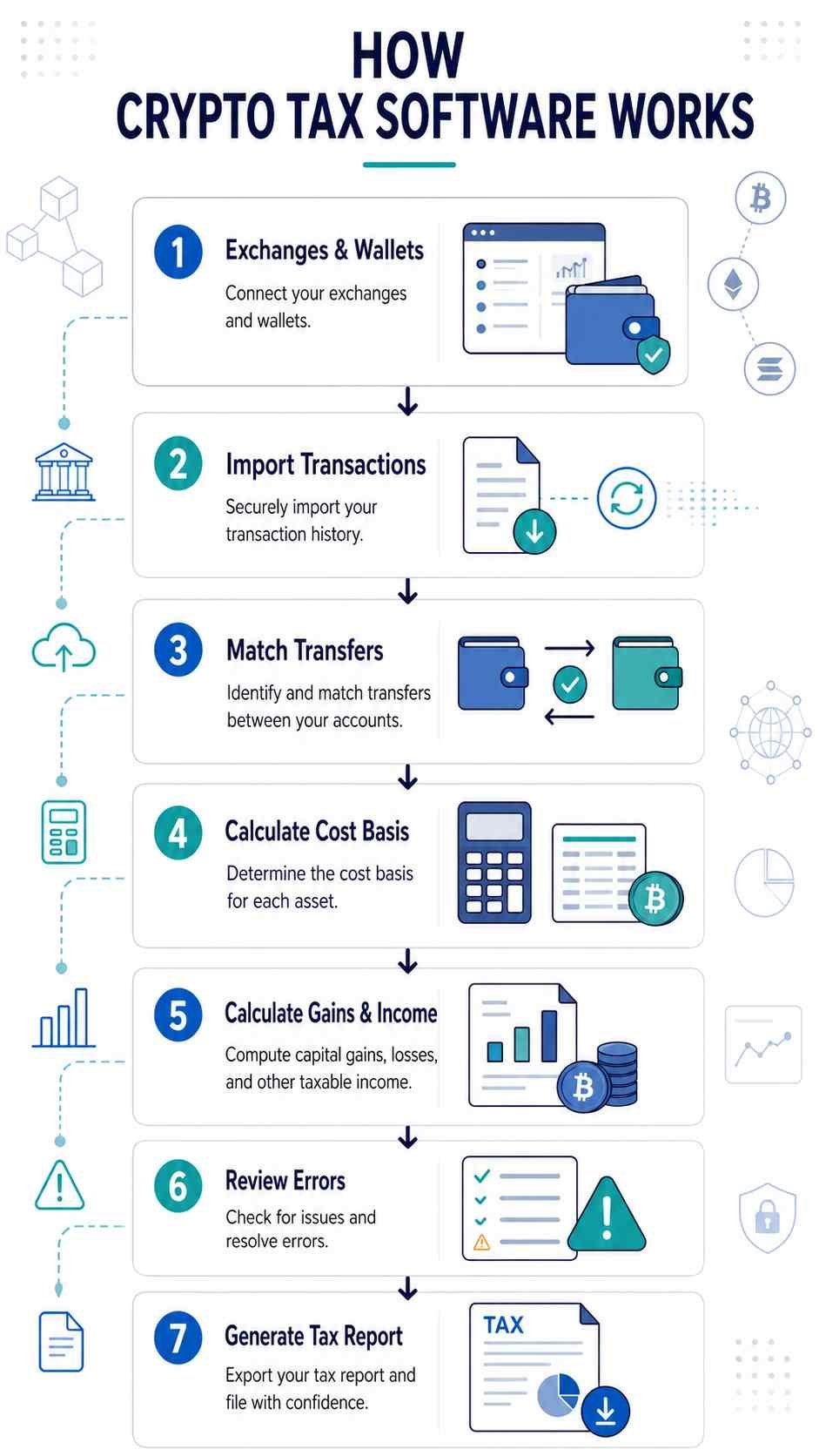
How Does Koinly Work?
Koinly’s workflow starts with transaction data rather than tax forms.
1. Add Your Exchanges and Wallets
You first add every exchange, wallet, and blockchain account you have used.
For supported exchanges, Koinly may offer an API connection that imports the transaction history automatically. Users can also upload CSV or Excel files when API synchronization is unavailable or undesirable. Blockchain wallets can often be imported with a public address. Bitcoin and other UTXO-based wallets may require an extended public key such as an xpub.
You should add old wallets too, even when they are now empty.
2. Import the Full Transaction History
Koinly brings trades, deposits, withdrawals, transfers, token transactions, and supported on-chain activity into a central ledger.
This stage is more important than it looks. A wallet that contains only one incoming transfer may tell Koinly where an asset arrived but not what you originally paid for it.
3. Match Transfers Between Your Own Accounts
Suppose you buy 1 ETH on Coinbase and later move it to MetaMask.
That movement normally needs to be recognized as a transfer between accounts you own rather than treated like a disposal to another person.
Koinly uses automatic transfer matching to connect these movements while preserving the asset’s original cost information.
4. Calculate Cost Basis and Gains
Once Koinly understands the transaction history, it applies the appropriate cost-basis settings.
Supported methods include FIFO, LIFO, HIFO, Average Cost, Share Pooling, and Spec ID in applicable circumstances. The correct method depends on the taxpayer’s jurisdiction and situation.
5. Reconcile Errors
This is the stage users should not skip.
Koinly can flag problems such as missing purchase history and negative balances. Users should also check wallet transfers, duplicate imports, income labels, staking transactions, DeFi activity, and transactions that do not appear as expected.
6. Generate the Tax Reports
Once the transaction history has been checked, paid users can generate reports from Koinly’s Tax Reports section.
Koinly allows users with a paid plan to regenerate reports for that tax year after correcting their data.
The basic process is therefore simple:
Import accounts, reconcile transactions, calculate gains, review results, then generate reports.
Is Koinly Good for Crypto Tax?
For many individual investors, yes, Koinly is a good crypto tax tool, particularly when transactions are spread across several wallets and exchanges.
Its strongest feature is consolidation. Instead of maintaining separate spreadsheets for an exchange account, a hardware wallet, Ethereum addresses, Solana wallets, and DeFi platforms, you can bring much of that activity into one tax ledger.
Koinly also supports common activities beyond straightforward buying and selling. Its current product pages list staking, mining, lending, airdrops, DeFi, NFTs, futures, and margin trades among supported use cases.
Independent professional experience adds some useful context. Crypto Tax Made Easy published a 2026 review based on work involving more than 1,000 Koinly accounts. The accounting firm praised Koinly’s filters, balance tools, bulk editing, and reconciliation workflow, but also reported that complicated portfolios can still require substantial manual cleanup. It specifically noted limitations around certain high-transaction Solana accounts and more complex histories. The reviewer also discloses a commercial relationship with Koinly, so those observations should be considered alongside the disclosure.
That produces a more realistic verdict than simply calling the platform accurate.
Koinly can calculate accurately when the data and classifications going into it are accurate. Software cannot know about an old exchange account you forgot to add.
A Simple Example of Why Complete Data Matters
Imagine Sarah bought 1 ETH for $1,500 on Exchange A.
She later transferred the ETH to MetaMask. Months afterward, she swapped it for another token when ETH was worth $2,500.
If Koinly sees both Exchange A and MetaMask, it can follow the original acquisition and subsequent transfer. The cost history remains connected to the asset.
Now imagine Sarah imports only MetaMask.
Koinly sees ETH arriving in the wallet, but it may not have the original acquisition data from Exchange A. That creates a missing-cost problem. If the original cost basis cannot be reconstructed correctly, the calculated gain may be wrong.
This problem becomes much bigger when an investor has hundreds of deposits across several years.
The same issue explains why U.S. Form 1099-DA does not automatically solve crypto tax reporting. The IRS notes that basis information may be absent, particularly for assets where the broker does not have the necessary acquisition records. When basis is missing, taxpayers may need to determine it from their own books and records.
Crypto tax software is therefore most useful as a record-reconciliation system, not merely as a tax-form generator.
Is Koinly Really Free?
Yes, but with an important limitation: the free plan does not include downloadable tax reports.
Koinly currently allows free users to:
- Import unlimited wallets
- Import up to 10,000 transactions across the account
- See individual imported transactions
- See calculated gains on trades
- View the tax summary
- Track their portfolio
The free tier does not allow users to generate tax reports. It also excludes some advanced features such as transaction cost analysis and bulk editing through Excel. If a free account exceeds 10,000 transactions, Koinly says calculations stop until the user moves to a suitable paid plan.
That makes the free tier more useful than a short demo. You can import your records and see whether Koinly makes sense of your portfolio before paying.
For someone evaluating the software, that is valuable. Import your wallets first. Look for missing data. Check balances. Inspect the calculated gains. Only buy the tax-year plan after the portfolio appears reasonably reconciled.
What “free” does not mean is free tax filing.
If you need downloadable Form 8949 data, an international tax report, TurboTax export, or another paid report, you will need to purchase a plan for the relevant tax year.
How Much Does It Cost to Get a Koinly Tax Report?
Koinly’s publicly advertised 2026 pricing starts at:
| Plan | Price | Transaction allowance |
|---|---|---|
| Free | $0 | Up to 10,000 for free tracking/testing |
| Newbie | $49 per tax year | Up to 100 |
| Hodler | $99 per tax year | Up to 1,000 |
| Trader | From $199 per tax year | 3,000+ |
| Higher-volume options | Varies | Up to 10,000 and additional transaction packages |
Koinly’s Help Center separately lists Newbie at 100 transactions, Hodler at 1,000, Trader at 3,000, and Pro at 10,000. Users exceeding 10,000 transactions can buy additional 1,000-transaction packages on qualifying plans.
The headline price is not the only factor.
Koinly determines the required plan using the tax year, yearly transaction count, account-wide transaction limits, and what it considers billable transactions. This can occasionally make a user eligible only for a higher plan than the transactions in one year might initially suggest.
For example, a casual investor with 70 qualifying transactions may fit the $49 tier. Someone with 600 could fall into the $99 tier. An active trader running thousands of transactions may need Trader or a higher-volume configuration.
Koinly also says users can upgrade by paying the difference when their transaction count exceeds the original plan limit.
Always check the actual Plans page before buying because pricing and transaction rules can change.
Is Koinly a Subscription?
Koinly’s normal tax plans work per tax year rather than as a traditional recurring software subscription.
If you buy a plan for one tax year, that purchase gives you report-generation access for that specific year. If you need reports for another year, you generally need another plan for that year.
You do not need to purchase every historical year automatically. Koinly says users can buy only the years for which they need reports, although account-wide transaction rules may affect the required plan size.
Once a plan covers a year, you can correct transactions and regenerate reports for that same year without paying for every new report. A new charge may become necessary if additional imported transactions push the account above the existing plan limit.
That is an important distinction for anyone comparing Koinly with software charging a conventional monthly or annual membership.
What Tax Reports Can Koinly Generate?
For U.S. users, Koinly advertises Form 8949 and Schedule D-related reporting, as well as exports designed for services such as TurboTax and TaxAct.
The IRS says individuals generally use Form 8949 for digital asset capital transactions unless applicable broker reporting allows the transactions to be reported differently under the current instructions. Capital gains and deductible capital losses are then summarized on Schedule D.
Koinly is not limited to the United States.
Its current Help Center says the platform supports more than 100 countries when the country’s tax system uses a supported cost-calculation method. It lists specialized support for countries including the United States, Canada, Australia, the United Kingdom, Germany, France, Norway, Sweden, Denmark, India, Japan, South Korea, and others.
This international coverage is one of Koinly’s stronger advantages over crypto tax products designed mainly around U.S. forms.
However, supporting a country does not mean every user’s tax situation becomes automatic. Residency changes, businesses, trusts, large DeFi operations, and cross-border situations can require professional advice.
Is Using Koinly Safe?
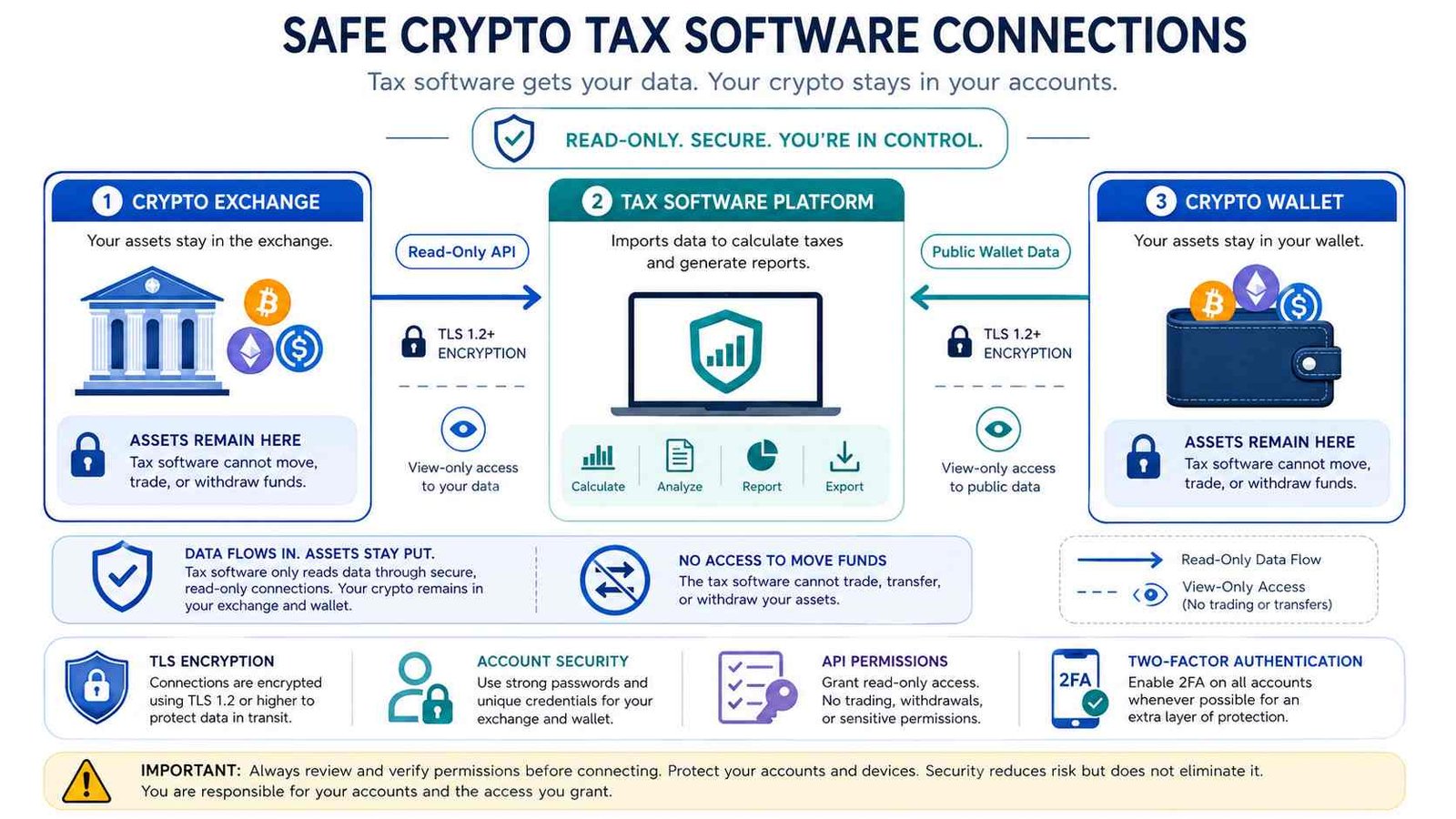
Koinly has a sensible security model for a tax application because it does not need withdrawal access to your cryptocurrency.
According to Koinly, all OAuth and API connections are read-only. Those connections allow Koinly to import transaction information but do not give the service permission to interact with the wallet or withdraw assets.
Blockchain addresses are public by design, so supported self-custody wallets can often be imported using a public address rather than a private key. Bitcoin and similar wallets may use an xpub to retrieve the full transaction history across addresses.
Koinly also states that data sent to its systems is encrypted in transit using TLS/SSL. Its website currently displays SOC 2 Type II and ISO 27001 certification badges.
Those are meaningful security measures, but no online service should be described as risk-free.
Never enter a wallet seed phrase or private key into tax software. Review API permissions when connecting an exchange. The connection should not have trading or withdrawal permissions when they are unnecessary. Protect the email account associated with Koinly and use strong authentication wherever available.
The key distinction is simple: Koinly needs your transaction history, not control of your crypto.
Does Koinly Send Your Crypto Data to the Government?
Koinly says it does not automatically send user tax reports to the IRS, HMRC, ATO, or another tax authority. Its Help Center states that the service creates tax reports for the user rather than filing those reports with government agencies on the user’s behalf.
Do not confuse that with an exchange’s reporting obligations.
A cryptocurrency broker may separately be required by law to report transaction information directly to a tax authority. In the United States, Form 1099-DA is one example. Brokers report covered information to both taxpayers and the IRS under applicable rules.
Using Koinly therefore does not eliminate reporting that may already occur through Coinbase, another broker, or another regulated service.
It also does not eliminate your own responsibility to report taxable transactions.
Koinly’s Biggest Advantages
Koinly’s strongest reason for existing is transaction consolidation. Crypto rarely stays in one account. Someone may buy on Coinbase, transfer to Ledger, interact with Ethereum through MetaMask, bridge assets, earn staking rewards, and sell elsewhere. Reconstructing that history manually can become difficult very quickly.
Its second advantage is the unusually useful free tier. Allowing up to 10,000 transactions means users can inspect much of their portfolio before paying. That reduces the risk of discovering serious import problems only after purchasing a tax plan.
Its other notable strengths include broad exchange and blockchain coverage, automatic transfer matching, several cost-basis methods, portfolio tracking, DeFi and NFT support, and country-specific reporting.
The platform also includes reconciliation tools rather than simply producing a final number. For serious users, warning about missing data can be more valuable than automatically labeling every transaction.
Finally, Koinly has dedicated accountant features. It offers accountant licenses and client portfolios, which can make it easier for taxpayers to hand reconciled transaction data to professionals instead of starting again from raw exchange exports.
Koinly’s Main Limitations
The first limitation is straightforward: you must pay to download tax reports. The free version is excellent for evaluating data and previewing gains, but it is not a complete free tax-report solution.
Transaction volume can also make Koinly expensive. Active trading bots, DeFi protocols, reward transactions, and high-frequency blockchain activity can create thousands of records. Koinly does group or exclude certain transactions when determining billable activity, but users with very large histories can still need higher-priced plans.
Complex DeFi is another weak point, although this problem affects most crypto tax software. A blockchain transaction may involve liquidity tokens, wrapping, bridges, fees, multiple smart-contract interactions, and tokens that represent underlying positions. Software must interpret what those actions mean for tax purposes, and automatic classification is not always enough.
Support also varies by blockchain and integration. Koinly maintains a public feature-request board for unsupported or incomplete integrations, which is a useful reminder that “900+ integrations” does not mean every protocol on every supported chain works perfectly.
Most importantly, Koinly cannot replace records that do not exist in the account.
The final report deserves a human review.
Koinly vs Manual Crypto Tax Tracking
| Task | Spreadsheet | Koinly |
|---|---|---|
| Import exchange history | Manual | API or CSV |
| Track blockchain wallets | Manual | Often automatic |
| Match internal transfers | Manual | Automatic matching with review |
| Historical market prices | Manual lookup | Integrated |
| Calculate cost basis | Formulas required | Automated |
| Track staking income | Manual | Supported |
| DeFi classification | Difficult | Partly automated |
| Find missing data | Manual investigation | Reconciliation warnings |
| Generate tax forms | Manual process | Available on paid plans |
| Human review | Essential | Still essential |
For ten simple transactions, a spreadsheet can be enough.
For 2,000 transactions across six wallets, the balance shifts quickly toward specialized software.
How to Get More Accurate Results From Koinly
The best way to improve Koinly’s results is to think like an auditor rather than someone trying to reach the Download button as fast as possible.
Start by adding every wallet and exchange, including old accounts. Import the full history rather than only the tax year you want to file. Otherwise, an asset purchased years earlier may arrive without the cost information needed to calculate its eventual gain correctly.
Next, compare Koinly’s wallet balances with the actual balances or historical records from your exchanges. Investigate negative-balance warnings and missing purchase history. Check transfers between your own wallets so they have not been mistaken for disposals.
Then review transactions that require more context: staking rewards, mining, airdrops, gifts, lost assets, NFTs, liquidity pools, bridges, wrapped tokens, lending activity, and unusual smart-contract transactions.
U.S. users should pay particular attention to current cost-basis rules. Koinly has added wallet-based cost-tracking features in response to IRS guidance, but tax settings can materially change calculations. Consult a qualified tax professional when you are unsure which settings apply.
Finally, compare the completed report with records from exchanges and any forms you received. Software should make reconciliation easier. It should not replace reconciliation.
Who Should Use Koinly?
Koinly makes the most sense for investors who have moved cryptocurrency between multiple exchanges and wallets.
It is especially useful for people who use self-custody, trade on several platforms, earn staking rewards, interact with DeFi, hold NFTs, or need to reconstruct several years of crypto activity. Accountants dealing with clients who have fragmented crypto histories can also benefit from its centralized ledger and reconciliation features.
Koinly may be unnecessary for someone with a handful of transactions on one platform. If an investor bought Bitcoin twice and sold it once through the same broker, specialized tax software may add more complexity than value.
Professional help becomes more important when records are missing, transaction values are large, business and personal activity overlap, residency changed between countries, historical filings need correction, or complicated DeFi transactions cannot be classified confidently.
The right question is therefore not simply, “Is Koinly worth $49 or $99?”
Ask how much work it replaces and how complicated your transaction history is.
Koinly Crypto Tax Software Review: Our Verdict
Koinly is one of the stronger crypto tax software options for investors who need to combine activity from multiple exchanges, wallets, and blockchains.
Its free tier is particularly useful because you can import up to 10,000 transactions, preview gains, and inspect much of the calculation before purchasing a report. Its broad integration coverage, transfer matching, cost-basis tools, international support, and accountant workflow address the problems that make crypto tax preparation difficult in the first place.
The software’s biggest limitation is also the most important lesson from this review: automation does not guarantee correct taxes.
Koinly can only work with the activity it receives and the classifications applied to that activity. Complex DeFi, unsupported integrations, missing exchange histories, and incorrect labels can all require manual investigation.
Techoble Rating
| Area | Rating |
|---|---|
| Ease of use | 4.5/5 |
| Exchange and wallet support | 4.5/5 |
| Free plan | 4.5/5 |
| Tax reporting | 4.5/5 |
| Reconciliation tools | 4.5/5 |
| Complex DeFi handling | 3.5/5 |
| Pricing for active traders | 3.5/5 |
| Security approach | 4.5/5 |
| Overall | 4.3/5 |
Best for: Investors with transactions spread across multiple crypto platforms.
Think twice if: You have only a few simple transactions or expect complex DeFi activity to be classified perfectly without review.
Frequently Asked Questions About Koinly
Is Koinly good for crypto tax?
Yes. Koinly is particularly useful for consolidating transactions from different exchanges and wallets, calculating cost basis, matching transfers, and preparing tax reports. However, users should review the imported transaction history before relying on the final numbers.
Is Koinly really free?
Koinly has a genuine free tier. It currently supports unlimited wallets and up to 10,000 account-wide transactions for importing, calculation, tax summaries, and portfolio tracking. You need a paid plan to generate downloadable tax reports.
How much does it cost to get a Koinly tax report?
Koinly’s advertised paid pricing currently starts at $49 per tax year for Newbie, followed by $99 for Hodler and $199 or more for Trader-level accounts. The required plan depends on transaction volume and other account limits.
Is using Koinly safe?
Koinly says all OAuth and exchange API connections are read-only and that information sent to its service is encrypted in transit. It cannot use those read-only connections to withdraw crypto. Users should still follow standard account-security practices.
Does Koinly report crypto to the IRS?
Koinly says it does not automatically send users’ tax reports to the IRS or other tax authorities. Exchanges and brokers may separately have their own reporting obligations.
Does Koinly work with Coinbase and Binance?
Yes. Koinly lists Coinbase and Binance among its supported exchange integrations and supports API or file-based imports depending on the service.
Can Koinly handle MetaMask?
Yes. Koinly supports blockchain-wallet imports using public addresses and lists MetaMask among its supported wallet integrations. Because MetaMask can interact with several networks, users may need to add each blockchain they used separately.
Does Koinly support DeFi and NFTs?
Yes, Koinly supports DeFi and NFT transactions on supported blockchains. That does not guarantee that every protocol or complex transaction will be interpreted correctly, so manual review remains important.
Can accountants use Koinly?
Yes. Koinly provides accountant accounts and license packages designed for managing multiple client portfolios.
Do I give Koinly my wallet seed phrase?
No. A crypto tax service should not need your recovery seed or private key. Supported blockchain wallets generally use public addresses or public extended keys for transaction imports.
Koinly Checklist Before Generating Your Tax Report
- Set the correct country and tax year.
- Add every exchange you used.
- Add every self-custody wallet.
- Include old and inactive accounts.
- Import the complete transaction history.
- Confirm API synchronization completed.
- Compare wallet balances with source records.
- Investigate missing-cost warnings.
- Resolve unexpected negative balances.
- Check transfers between your own wallets.
- Review staking, mining, and airdrop income.
- Review DeFi transactions manually.
- Check NFT purchases and disposals.
- Verify bridges and wrapped-token transactions.
- Confirm the correct cost-basis settings.
- Compare Koinly totals with broker tax forms.
- Correct errors before generating reports.
- Ask a qualified tax professional about uncertain transactions.
Further Reading
For current information, prioritize Koinly’s official Help Center for pricing, imports, security, tax plans, and supported countries. U.S. taxpayers should also use the IRS Digital Assets section, Form 1099-DA guidance, Form 8949 instructions, and Schedule D instructions rather than relying on crypto blogs for tax rules.
Readers outside the United States should check their own tax authority, such as HMRC in the UK, the Canada Revenue Agency, the Australian Taxation Office, or the relevant national authority.
Independent reviews are useful for understanding workflow and practical limitations, but official tax authorities should remain the primary source for actual filing requirements.
Final Thoughts Before You Trust the Numbers
Koinly solves a real problem. Crypto transactions are easy to create and surprisingly hard to reconstruct months or years later.
For investors who use several exchanges, wallets, and blockchains, Koinly crypto tax software can turn a fragmented transaction history into something much easier to review and report. The free plan makes it possible to test that process before paying, while the paid plans provide the reports needed for filing or sharing with an accountant.
But the most important feature is not automatic tax calculation.
It is reconciliation.
A tax calculation can only be as reliable as the transaction history behind it. Import every account, investigate warnings, review complicated transactions, and verify the results before filing.
If Koinly saves you hours of manually matching transfers and calculating cost basis, its paid plan can be good value. If your crypto activity consists of a handful of straightforward trades on one exchange, you may not need it.
Either way, do not treat the first number on a crypto tax dashboard as the final answer.

Digital innovation analyst with a focus on AI, IoT, and connectivity. Maria’s articles combine data-driven research, industry statistics, and tested solutions, helping global readers stay informed, confident, and future-ready in technology.