
Cybersecurity conversations often use threat, vulnerability, and risk as if they mean the same thing. They do not. Understanding the difference matters because each term answers a different security question. A threat tells you what could cause harm. A vulnerability tells you where you are weak. Risk tells you how much that weakness could actually hurt you when a relevant threat is present. Think about a small office after closing time. A burglar outside is a threat. An unlocked back door is a vulnerability. The possibility that the burglar enters, steals computers, exposes customer data, and stops business operations is the risk. Cybersecurity works in much the same way.
This distinction matters even more in 2026. Verizon’s 2026 Data Breach Investigations Report found that vulnerability exploitation became the leading initial access method for the first time in the report’s 19-year history. About 31% of breaches began with exploitation of software vulnerabilities, overtaking stolen credentials. Verizon also reported that third-party involvement appeared in 48% of breaches and had increased sharply from the previous year. Cisco’s latest Cybersecurity Readiness Index also shows a large preparedness gap. Only 4% of surveyed organizations reached Cisco’s Mature readiness level, while 71% of respondents expected a cybersecurity incident could disrupt their organization within the following 12 to 24 months.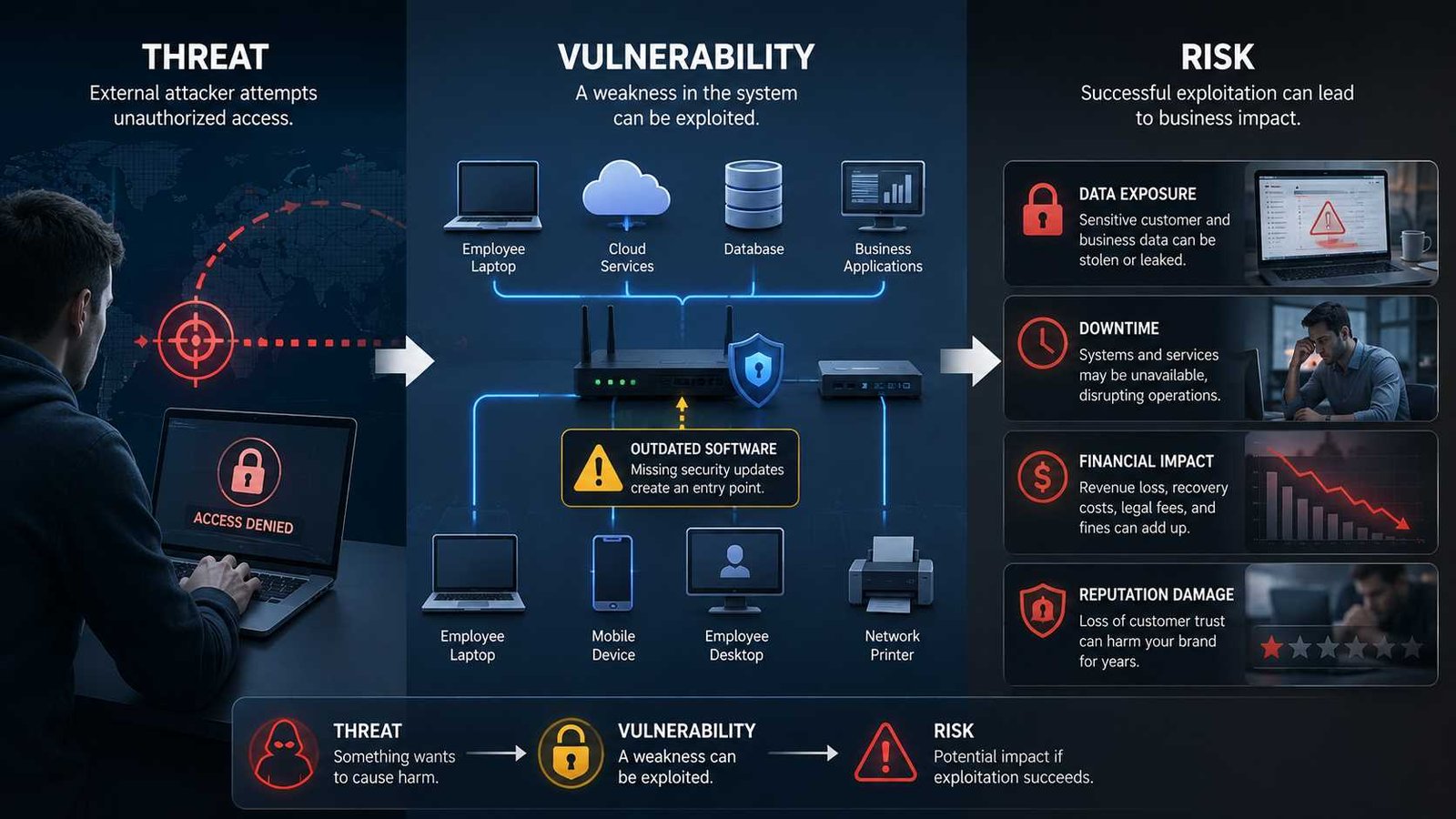
Here’s what matters: finding vulnerabilities is not enough. Security teams must understand which threats can exploit them, which assets could be affected, and which problems deserve attention first.
Threat vs Vulnerability vs Risk at a Glance
The easiest way to understand threat vs vulnerability vs risk is to separate the three questions they answer.
| Term | Plain-English Meaning | Example | Main Question |
|---|---|---|---|
| Threat | Something that could cause harm | Ransomware attacker | What could hurt us? |
| Vulnerability | A weakness that could be exploited | Unpatched server | Where are we weak? |
| Risk | Potential harm based on circumstances such as likelihood and impact | Customer data theft and downtime | How serious could this become? |
| Control | A safeguard that reduces likelihood or impact | MFA, patching, backups | How can we reduce the risk? |
NIST defines a vulnerability as a weakness in an information system, security procedure, internal control, or implementation that a threat source could exploit or trigger. A cyber threat is an event or circumstance with the potential to cause adverse effects. NIST describes risk as typically involving both the likelihood of an event and the magnitude of its harmful consequences.
Suppose a company runs an old web server. The outdated software itself is not a hacker. It is a vulnerability. A criminal group scanning the internet for that vulnerable software represents a threat. If the server contains customer payment information and faces the public internet, successful exploitation could produce serious financial, operational, and reputational damage. That creates high risk. Move the same vulnerable server into an isolated laboratory with fake data and no internet connection, and the technical vulnerability may remain exactly the same while the practical risk drops significantly.
That example explains why professional security teams do not simply count vulnerabilities. They prioritize them.
What Is a Threat in Cybersecurity?
A cybersecurity threat is something capable of causing damage to information, systems, people, or business operations. The threat could involve a human attacker, malicious software, an insider, a natural event, or another harmful circumstance. NIST’s terminology focuses on the potential for an event or circumstance to negatively affect operations, assets, individuals, or information systems.
A useful distinction also exists between a threat source and a threat event. A cybercriminal may be the threat source. Sending a phishing message, deploying ransomware, or exploiting an internet-facing server may be the threat event. This distinction helps security teams understand who or what could cause damage and how the damage might happen.
What Are Four Types of Threats?
There is no single universal list limited to exactly four threat categories, but a practical cybersecurity classification is:
- Malware and ransomware threats: Viruses, ransomware, spyware, worms, and other malicious software.
- Social engineering threats: Phishing, fake login pages, fraudulent calls, text-message scams, and impersonation.
- Network and application threats: Vulnerability exploitation, denial-of-service attacks, credential attacks, web attacks, and unauthorized access.
- Insider and physical threats: Malicious employees, accidental data exposure, stolen devices, unauthorized visitors, fire, flooding, or equipment damage.
Modern threats frequently cross categories. A ransomware attack may start with social engineering, use stolen credentials, exploit a software flaw, move through the network, and finally encrypt systems. MITRE ATT&CK exists partly because real attackers operate through chains of tactics and techniques rather than neat textbook categories. MITRE describes ATT&CK as a knowledge base built from real-world observations of adversary behavior.
What Is a Vulnerability?
A vulnerability is a weakness. It does not need to be actively exploited to exist. A company may have hundreds or thousands of vulnerabilities without knowing about them.
Software bugs are obvious examples, but cybersecurity vulnerabilities go much further. A weak password is a vulnerability. Giving every employee administrator rights creates another. Exposing a cloud database to the internet by mistake can create a serious weakness. Poor employee training can make phishing more successful. An unlocked server room creates a physical vulnerability.
What Are the Four Types of Vulnerability?
Again, cybersecurity standards do not require one official four-category model, but dividing vulnerabilities into four practical groups makes them easier to understand.
1. Software and application vulnerabilities
These include coding errors, outdated software, insecure APIs, vulnerable libraries, and missing security patches.
2. Network and configuration vulnerabilities
Examples include exposed ports, weak firewall rules, insecure Wi-Fi, default router credentials, and misconfigured cloud services.
3. Human vulnerabilities
People can become part of the attack path through weak passwords, poor security awareness, credential reuse, accidental disclosure, or excessive privileges.
4. Physical and operational vulnerabilities
Unsecured buildings, stolen laptops, poor backup procedures, missing recovery plans, and weak vendor controls can all increase exposure.
A vulnerability becomes more concerning when attackers can realistically exploit it. CISA’s Known Exploited Vulnerabilities Catalog, or KEV, helps security teams identify vulnerabilities that attackers have actually exploited in the wild. CISA recommends using the catalog as an input when prioritizing vulnerability remediation.
That is an important lesson: a vulnerability scanner tells you where weaknesses exist. Threat intelligence helps tell you which weaknesses attackers are using.
Vulnerability vs Exploit: They Are Not the Same
Another common mistake is confusing a vulnerability with an exploit.
The vulnerability is the weakness. The exploit is the technique, code, command, or process used to take advantage of that weakness.
Imagine a lock that can be opened with a specially shaped piece of metal. The faulty lock design is the vulnerability. The specially shaped tool and the method for using it form the exploit. The person attempting the break-in is the threat actor.
Cybersecurity follows the same pattern.
One of the clearest real-world examples is Log4Shell, disclosed in 2021. The weakness existed in the widely used Apache Log4j logging library. Attackers could send specially crafted requests to vulnerable systems and potentially execute unauthorized code remotely. CISA, the FBI, NSA, and international partners warned that attackers were actively scanning for and exploiting affected systems.
The episode showed why risk can rise quickly. A software flaw may exist quietly for years. Once details become public, proof-of-concept code appears, automated scanning begins, and attackers actively exploit it, the likelihood side of the risk calculation changes dramatically.
What Is Cybersecurity Risk?
Cybersecurity risk describes potential harm to an organization when threats interact with valuable assets, vulnerabilities, and existing security conditions.
A useful beginner formula is:
Risk ≈ Likelihood × Impact
It is not a universal mathematical equation for every organization, but it captures the core idea.
Likelihood asks how probable successful exploitation is.
Impact asks what would happen if it succeeds.
Imagine two businesses with the same vulnerable web application. Company A uses it only for an internal training system containing fake data. Company B uses it for customer payments and stores sensitive account information. Both may have the same software vulnerability. Their business risk is not equal because the consequences are different.
Professional assessments may also examine asset value, internet exposure, exploit availability, attacker activity, security controls, data sensitivity, legal obligations, recovery capability, and business dependence.
NIST’s cybersecurity risk definition connects risk to potential adverse effects on confidentiality, integrity, availability, organizational operations, assets, individuals, and other parties.
Inherent Risk vs Residual Risk
Inherent risk is the level of risk before protective controls are considered.
Residual risk is the risk that remains after controls are applied.
Suppose employees can access payroll accounts with only passwords. The organization faces credential theft risk. Adding MFA, login monitoring, employee training, conditional access, and strong recovery procedures reduces that risk. The threat has not disappeared. Phishing still exists. What changed is the probability of successful compromise and possibly the scale of resulting damage.
What Is the Difference Between Vulnerability and Risk?
The difference between vulnerability and risk is simple once you separate weakness from consequence.
A vulnerability describes what is weak.
Risk describes how much that weakness matters in a specific situation.
A vulnerability may receive a high technical severity score while creating limited business risk in one environment. Another vulnerability with a lower severity score might create greater risk because attackers actively exploit it, the affected server faces the internet, and the system controls important business data.
This is why security teams should be careful with CVSS scores. The Common Vulnerability Scoring System provides a standard way to communicate vulnerability severity. FIRST’s CVSS v4.0 guidance specifically emphasizes that the CVSS Base Score measures severity, not risk. Environmental and threat information can improve prioritization, but organizations still need their own business context. The U.S. National Vulnerability Database makes the same distinction and states directly that CVSS is not a measure of risk.
So a team that automatically patches every CVSS 9.8 vulnerability before examining anything else may still make poor decisions. A lower-scoring weakness being actively exploited against an internet-facing business system could demand faster action.
A Real-World Example: The Equifax Data Breach
The 2017 Equifax breach remains a useful case study because it shows how a vulnerability turns into business risk.
The Federal Trade Commission alleged that Equifax had been alerted to a critical vulnerability affecting a system handling consumer credit information but failed to ensure the relevant system was patched. Attackers later exploited the weakness. The breach affected approximately 147 million people, and the resulting settlement with the FTC, Consumer Financial Protection Bureau, and U.S. states and territories was worth at least $575 million and potentially up to $700 million.
Break the incident into the concepts discussed here:
| Component | Equifax Example |
|---|---|
| Asset | Consumer credit and personal data |
| Threat | Attackers seeking unauthorized access |
| Vulnerability | Unpatched software weakness |
| Exploit | Technique used to take advantage of the weakness |
| Impact | Exposure of sensitive personal information |
| Risk | Financial, regulatory, operational, and reputational harm |
| Controls that mattered | Patching, asset inventory, segmentation, monitoring |
The lesson is not simply “install patches.” The deeper lesson is that vulnerability management depends on knowing which systems exist, verifying remediation, controlling access, monitoring networks, and understanding what is at stake.
Problem vs Cause vs Impact
The following table shows how common weaknesses turn into practical cybersecurity risk.
| Problem | Common Cause | Potential Impact |
|---|---|---|
| Weak passwords | Poor password policy or reuse | Account takeover |
| Missing software patches | Delayed updates or poor asset inventory | System exploitation |
| Excessive permissions | Weak access management | Larger data exposure |
| Successful phishing | Limited awareness or weak authentication | Credential theft |
| Public cloud storage | Misconfiguration | Sensitive data exposure |
| No usable backups | Poor resilience planning | Extended ransomware downtime |
| Unsupported software | Legacy systems | Unpatched security flaws |
| Unmonitored accounts | Weak identity controls | Persistent unauthorized access |
| Third-party access | Poor vendor oversight | Supply-chain compromise |
The important point is that the problem alone does not tell you the final risk level. You still need to ask who can exploit it, how easily they can do so, what assets are exposed, and what damage could follow.
How Threats Exploit Vulnerabilities to Create Risk
A useful security flow looks like this:
Asset → Vulnerability → Threat exposure → Exploitation → Impact → Risk
Start with the asset. This could be a laptop, customer database, cloud application, industrial controller, email account, or payment system.
Next identify the vulnerability. Perhaps the software is outdated or an account lacks MFA.
Then examine the threat. Are attackers actively targeting this technology? Is exploitation public? Is the system visible from the internet?
Next ask what a successful attack could do. Could an attacker read information, alter records, shut down operations, steal money, or move deeper into the network?
Finally, measure the likely business impact.
This explains why exposure matters so much. A vulnerable database disconnected from the internet and protected behind several controls does not face the same immediate risk as an identical database accessible from anywhere online.
It also explains why modern vulnerability management is moving toward risk-based prioritization. Verizon reported that 31% of breaches in its 2026 dataset began with vulnerability exploitation. Verizon’s Daniel Lawson summarized the lesson well: “the foundational principles of security and strong risk management remain the most effective defense.”
How to Perform a Basic Cybersecurity Risk Assessment
A small business does not need a massive security department to start thinking in terms of risk. Use a simple process.
Step 1: Identify Important Assets
List systems that would hurt the business if attackers stole, altered, or disabled them. Include customer records, payment systems, email, cloud storage, websites, backups, laptops, routers, and important third-party services.
Step 2: Identify Relevant Threats
Ask what could realistically attack those assets. Consider phishing, ransomware, stolen passwords, software exploitation, malicious insiders, accidental mistakes, equipment loss, and supplier compromise.
Step 3: Find Vulnerabilities
Use software inventories, patch reports, configuration reviews, vulnerability scanners, security assessments, and employee feedback. Look beyond technical bugs. Missing MFA or poor backup testing also matters.
Step 4: Estimate Likelihood
Consider internet exposure, active exploitation, attacker interest, exploit availability, existing controls, and past incidents.
Step 5: Estimate Impact
Ask what happens if the attack succeeds. Measure lost revenue, downtime, data exposure, legal consequences, safety effects, recovery cost, and damage to customer trust.
Step 6: Assign a Risk Level
A simple Low, Medium, High, Critical scale works for many small organizations.
Step 7: Apply Controls
Patch software, add MFA, reduce privileges, segment networks, create backups, train employees, improve logging, or replace unsupported systems.
Step 8: Review Residual Risk
Check whether the controls actually worked. Risk management is not complete when someone clicks “resolved” in a dashboard.
How a Risk Matrix Works
A simple risk matrix compares likelihood against impact.
| Likelihood | Low Impact | Medium Impact | High Impact | Critical Impact |
|---|---|---|---|---|
| Low | Low | Low | Medium | High |
| Medium | Low | Medium | High | High |
| High | Medium | High | High | Critical |
| Very High | High | High | Critical | Critical |
Imagine a vulnerability that attackers rarely exploit and that affects an unimportant test computer. Its risk may be Low.
Now imagine attackers are actively exploiting the same weakness, but it exists on an internet-facing system that processes customer payments. Both likelihood and impact rise. The organization should treat that issue with far greater urgency.
Risk matrices are useful because they force teams to think beyond vulnerability counts. They are not perfect. Human judgment can differ, and real attacks do not fit neatly into colored boxes. Still, a consistent matrix gives small teams a practical way to decide what to fix first.
How to Reduce Cybersecurity Risk
Organizations cannot eliminate every cyber threat. Criminal groups will continue sending phishing messages. New vulnerabilities will continue appearing. Employees will sometimes make mistakes. Security therefore focuses on reducing the chance of successful attacks and limiting their consequences.
Start with patch management. Know which software and devices you operate, follow vendor security updates, prioritize internet-facing and actively exploited vulnerabilities, and verify that patches actually installed.
Use multifactor authentication, especially for email, administrator accounts, remote access, finance systems, and cloud services. Reduce privileges so users receive only the access they need.
Maintain tested backups that attackers cannot easily modify or encrypt. Segment important systems so one compromised device does not automatically expose the whole network.
Train staff to recognize phishing, fraudulent login pages, suspicious requests, and social engineering. Monitor accounts and systems for unusual behavior.
Businesses should also review suppliers. Verizon’s 2026 DBIR reports substantial growth in third-party involvement in breaches, which makes vendor access and supply-chain risk difficult to ignore.
Cisco’s 2025 Readiness Index adds another warning. Only 4% of surveyed organizations reached the Mature stage, while 86% reported experiencing AI-related security incidents during the previous 12 months. The practical lesson is not to buy every new security tool. It is to understand the gaps that create the most meaningful risk.
Modern Tools for Threat and Vulnerability Management
Security tools become much more useful when you understand what each one answers.
Vulnerability scanners such as Tenable Nessus, Qualys, Rapid7 InsightVM, and Greenbone/OpenVAS can help identify missing patches, insecure configurations, and known weaknesses.
CVE records give standardized identifiers to publicly disclosed vulnerabilities.
CVSS helps communicate technical vulnerability severity. Remember that severity is not the same as organizational risk.
CISA’s KEV Catalog highlights vulnerabilities known to have been exploited in real attacks, making it especially useful for prioritization.
MITRE ATT&CK helps defenders understand adversary tactics and techniques based on observed attacker behavior.
Security information and event management platforms, endpoint detection tools, identity dashboards, cloud security platforms, and attack-surface management tools can add further context.
The key is to connect these sources. A scanner might say, “This machine has 300 vulnerabilities.” CVSS might tell you which ones have severe technical characteristics. KEV might show which vulnerabilities attackers actively exploit. Asset data tells you which systems matter. Threat intelligence tells you what attackers are doing. Business analysis tells you what failure would cost.
That combined view produces better decisions.
What Are the 5 C’s of Cybersecurity?
A common business-oriented answer to What are the 5 C’s of cybersecurity? is:
- Change
- Compliance
- Cost
- Continuity
- Coverage
Current cybersecurity education and industry material continues to use this five-part model. However, an important clarification is necessary: the 5 C’s are not the official NIST Cybersecurity Framework.
The model works as a useful management checklist.
Change means security cannot remain static while technology and attacks evolve.
Compliance means understanding relevant laws, contracts, standards, and regulatory obligations.
Cost means balancing security investment against potential business losses.
Continuity means keeping essential services operating and recovering quickly after an incident.
Coverage means understanding whether important devices, accounts, cloud environments, applications, suppliers, and data fall within your security program.
For comparison, the current NIST Cybersecurity Framework 2.0 uses six Functions: Govern, Identify, Protect, Detect, Respond, and Recover. NIST added Govern in CSF 2.0 to emphasize cybersecurity governance and enterprise risk management.
So use the 5 C’s as a simple management lens, but use recognized frameworks such as NIST CSF when you need a formal cybersecurity structure.
Common Mistakes When Assessing Cyber Risk
One of the biggest mistakes is treating every vulnerability as equally dangerous. Thousands of findings can overwhelm a small security team. Prioritize based on exploit activity, exposure, asset importance, and possible impact.
A second mistake is relying only on CVSS Base scores. FIRST explicitly warns that CVSS Base measures severity rather than complete risk.
Third, organizations often forget human vulnerabilities. Perfectly patched software cannot stop every employee from entering credentials into a convincing fake login page.
Fourth, businesses may ignore third-party exposure. Vendors often need access to systems or data, which means their security practices can affect your risk.
Fifth, teams sometimes patch a vulnerability without verifying remediation. A failed deployment, forgotten server, or incomplete inventory can leave vulnerable systems behind.
The Equifax case illustrates this problem clearly. The FTC alleged that the company had a patch directive but failed to ensure the affected system was actually patched.
Finally, organizations often focus so heavily on prevention that they neglect recovery. Strong backups, incident-response procedures, communication plans, and restoration tests reduce impact even when an attack gets through.
Practical Threat, Vulnerability, and Risk Checklist
Use this checklist during a basic security review:
- Maintain an inventory of important devices, applications, cloud services, and data.
- Identify which systems face the public internet.
- Check operating systems, applications, routers, and firmware for missing updates.
- Review CISA KEV for vulnerabilities known to be actively exploited.
- Enable MFA on important and privileged accounts.
- Remove unnecessary administrator privileges.
- Review firewall rules, cloud permissions, and exposed services.
- Use unique, strong passwords and a password manager.
- Train employees to identify phishing and social engineering.
- Keep protected backups and test restoration regularly.
- Monitor critical accounts and systems for unusual behavior.
- Review third-party and supplier access.
- Create and test an incident-response plan.
- Rank security issues by likelihood and business impact.
- Recheck systems after remediation.
- Document residual risks that cannot immediately be removed.
Frequently Asked Questions
What is the difference between threat, vulnerability, and risk?
A threat is something capable of causing harm. A vulnerability is a weakness that a threat may exploit. Risk reflects the potential consequences and likelihood associated with that situation. For example, ransomware is a threat, an unpatched server is a vulnerability, and the possibility of ransomware shutting down business operations represents risk.
What is the difference between vulnerability and risk?
A vulnerability describes a weakness. Risk describes how much that weakness matters when you consider threats, exposure, likelihood, asset value, security controls, and possible impact.
What are four types of threats?
A practical four-part grouping includes malware and ransomware, social engineering, network and application attacks, and insider or physical threats. Cybersecurity standards may classify threats differently depending on the purpose of the assessment.
What are the four types of vulnerability?
A useful practical classification includes software vulnerabilities, network and configuration vulnerabilities, human vulnerabilities, and physical or operational vulnerabilities. There is no single mandatory four-type classification used by every cybersecurity framework.
What are the 5 C’s of cybersecurity?
The commonly cited 5 C’s are Change, Compliance, Cost, Continuity, and Coverage. They provide a useful business-oriented security checklist but should not be confused with NIST CSF 2.0’s six official Functions.
Is malware a threat or vulnerability?
Malware is generally a threat. A weakness that allows malware to infect or control a device is the vulnerability.
Is a weak password a threat or vulnerability?
A weak password is a vulnerability. A criminal attempting credential stuffing or password guessing represents the threat.
Can a vulnerability exist without high risk?
Yes. A vulnerable system may have low risk if it contains no important information, has no external exposure, or sits behind strong controls. Risk depends on context.
What is an exploit?
An exploit is a method, technique, or code that takes advantage of a vulnerability. The vulnerability is the weakness; the exploit is how an attacker uses it.
Why isn’t a CVSS score the same as risk?
CVSS describes vulnerability severity. Organizational risk requires additional context, such as active exploitation, system importance, exposure, existing safeguards, and business impact. FIRST explicitly states that the CVSS Base Score measures severity rather than risk.
Trusted Resources for Further Reading
For deeper research, start with sources that security professionals use directly:
- NIST Cybersecurity Framework 2.0: Provides a structured approach built around Govern, Identify, Protect, Detect, Respond, and Recover.
- NIST Cybersecurity Glossary: Useful for formal definitions of threat, vulnerability, and risk.
- CISA Known Exploited Vulnerabilities Catalog: Helps identify weaknesses known to be exploited in real attacks.
- MITRE ATT&CK: Helps explain real adversary tactics and techniques.
- FIRST CVSS v4.0: Explains how vulnerability severity scoring works and why Base scores should not be treated as full risk scores.
- Verizon 2026 DBIR: Provides current breach patterns and evidence on vulnerability exploitation, social engineering, suppliers, and other attack paths.
Final Thoughts Before You Assess Your Own Risk
The easiest way to remember threat vs vulnerability vs risk is to keep three questions in mind.
Threat: What could harm us?
Vulnerability: Where are we weak?
Risk: How likely and damaging could that harm be in our situation?
Then add a fourth question: What control will reduce it?
Cybersecurity becomes much easier to manage when these ideas remain separate. An attacker is not a vulnerability. A software bug is not automatically a high business risk. A critical CVSS score does not tell you everything you need to know. And patching a server does not remove every threat.
The strongest approach connects technical findings with real-world context. Identify your valuable assets. Find their weaknesses. Understand the threats most likely to target them. Measure what successful exploitation could do. Apply controls where they can reduce likelihood or impact most effectively, then verify what risk remains.
That approach matters in 2026 because attackers increasingly exploit software weaknesses as an initial path into organizations. Verizon’s latest DBIR puts vulnerability exploitation at 31% of breaches, while Cisco’s readiness research shows that relatively few organizations consider themselves fully prepared.
You do not need to eliminate every vulnerability to improve security. You need to understand which vulnerabilities create meaningful risk and act on those first.

Technology journalist with 12+ years in networking and cybersecurity. Known for simplifying complex tech into everyday solutions, Alex combines research, industry insight, and hands-on testing to guide readers with authority and clarity.