
Business processes sit behind almost everything a company does. An online order must move from payment to inventory, packing, shipping, and customer notification. A new employee must pass through hiring, document collection, account setup, training, and payroll. An invoice may need several checks before anyone releases payment.
When these steps depend on scattered emails, spreadsheets, disconnected applications, and individual memory, small delays quickly become larger problems.
That is where a business process management framework becomes useful. It gives an organization a structured way to understand how work happens, redesign inefficient processes, automate suitable tasks, measure results, and keep improving.
The need for this discipline is growing as businesses automate more work. The World Economic Forum’s Future of Jobs Report 2025, based on more than 1,000 employers representing over 14 million workers, found that 73% of employers expect to accelerate process and task automation by 2030. It also found that 86% expect AI and information-processing technologies to transform their businesses.
BPM therefore matters beyond large enterprises. A five-person online store, a university department, a hospital, a bank, or a software company can all use the same basic idea: understand the process first, improve it second, and automate only where automation creates a better result. 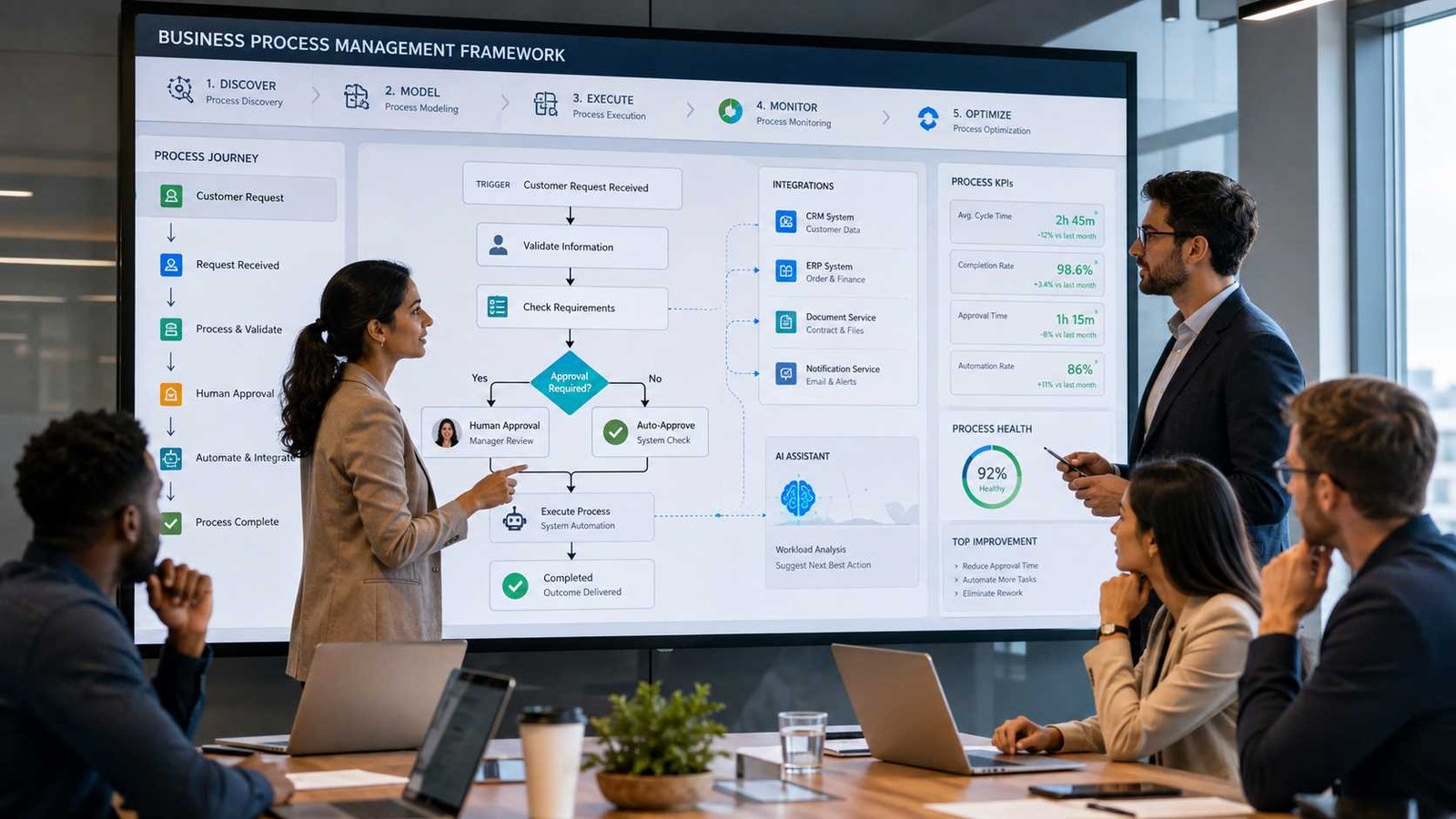
This guide explains the framework, its five practical pillars, the three main BPM types, seven useful implementation steps, modern BPM tools, process mining, AI, metrics, governance, and real-world examples.
What Is a Business Process Management Framework?
A business process management framework, often called a BPM framework, is a structured approach for managing repeatable business processes from beginning to end.
It helps an organization answer several basic questions. What starts the process? What work must happen? Who owns each step? Which systems exchange information? Where do delays occur? What should be automated? How do we know whether the process is improving?
IBM describes business process management as the intersection of “people, processes, and technology.” It also stresses that BPM is iterative. Organizations design, model, execute, monitor, and optimize processes repeatedly instead of treating process improvement as a one-time project.
Consider a customer order.
A customer submits an order. The system verifies the payment. Inventory gets checked. Warehouse staff prepare the item. A delivery service receives shipping information. The customer gets a tracking message.
That entire sequence is a business process.
The BPM framework sits above those activities. It defines how the process should work, assigns responsibility, connects applications, establishes rules, tracks performance, and provides a method for improving the workflow when something goes wrong.
This also explains why BPM is broader than task management. Task management may tell an employee to approve an invoice. BPM examines the whole invoice process, from receiving the invoice to validation, approval, payment, accounting, record storage, and performance reporting.
Visual suggestion: Place the Business Process Management Framework Lifecycle infographic here.
Why Businesses Need a BPM Framework
Many process problems do not come from lazy employees or bad software. They come from poorly designed connections between people, rules, data, and applications.
A manager might complain that purchase approvals take five days. The real problem could be that requests move through email, nobody knows who should approve requests when a manager is absent, and staff must manually copy the same information into an accounting application.
A BPM framework exposes these weaknesses.
| Problem | Common Cause | Business Impact |
|---|---|---|
| Slow approvals | Too many manual handoffs | Longer cycle times |
| Repeated errors | Unclear process rules | Rework and extra cost |
| Bottlenecks | Poor workload distribution | Delays and missed deadlines |
| Duplicate work | Disconnected applications | Lower productivity |
| Limited visibility | No process monitoring | Problems found too late |
| Compliance failures | Weak controls and records | Financial and legal risk |
| Customer complaints | Inconsistent processes | Poor customer experience |
Here is what matters: automation alone does not fix a badly designed process. It may simply make the bad process run faster.
A good BPM framework first asks whether each activity is necessary. It can then simplify the workflow, remove duplicate work, establish ownership, connect systems, automate predictable tasks, and monitor the result.
That approach becomes more important as organizations add more technology. Camunda reported in its 2025 process orchestration research that organizations were managing roughly 50 endpoints within business processes on average, highlighting how modern workflows can cross many applications, APIs, devices, and services. Because this figure comes from vendor-sponsored research, it is best treated as an indicator of growing process complexity rather than a universal benchmark.
What Are the 5 Pillars of Business Process Management?
There is no single global standard that officially defines five BPM pillars. Different consultants, software vendors, and process-management methods organize BPM differently.
For practical implementation, however, a useful business process management framework can be built around five pillars: people, process, technology, data, and governance.
1. People
Processes exist because people need to achieve an outcome.
The people pillar includes customers, employees, managers, process owners, compliance teams, suppliers, and other stakeholders. A good BPM framework clearly establishes who does what and who has authority when an exception occurs.
For example, an expense request might normally receive automatic approval below a set limit but require a finance manager when the amount exceeds that threshold.
Technology can route the work, but the organization still needs clear responsibility.
2. Process
The process pillar defines the actual sequence of work.
It covers triggers, inputs, tasks, decisions, handoffs, exceptions, outputs, and completion conditions.
A company should be able to answer questions such as: What starts this process? What is the expected result? Which steps add value? Which steps create delays?
If nobody can explain the process clearly, automating it should not be the first move.
3. Technology
Technology enables the process to operate efficiently.
This may include BPM software, workflow engines, APIs, CRM systems, ERP platforms, robotic process automation, AI services, databases, document-management systems, and notification tools.
The goal is not to add as much technology as possible. The goal is to make the required systems work together around the business outcome.
4. Data and Measurement
Without measurement, teams cannot tell whether a process improved.
Useful data may include cycle time, transaction cost, waiting time, error rate, customer satisfaction, throughput, rework, approval time, or automation rate.
Modern organizations can also analyze event logs to see how processes actually run instead of relying only on employee interviews.
5. Governance and Continuous Improvement
Governance answers questions about ownership, permissions, compliance, change control, audit records, security, and accountability.
Continuous improvement keeps the framework alive.
A process that works well today may become inefficient after customer demand, regulations, software, or staffing changes. BPM therefore treats optimization as an ongoing activity instead of a final destination.
What Are Business Process Frameworks?
A business process framework is an organized method for describing, managing, or improving business processes. Different frameworks solve different problems.
One company may need to standardize hundreds of activities. Another may need to eliminate waste from one production line. A software company may need an executable process model that coordinates APIs, human approvals, and automated decisions.
Several approaches are commonly used.
| Framework or Method | Main Purpose | Best Fit |
|---|---|---|
| BPM lifecycle | Manage processes continuously | General business operations |
| BPMN | Visually model processes | Complex workflows and software integration |
| Lean | Remove waste | Efficiency improvement |
| Six Sigma | Reduce defects and variation | Quality-focused operations |
| Lean Six Sigma | Combine speed and quality | Operational improvement |
| Continuous improvement | Make frequent small improvements | Stable recurring processes |
| Business process reengineering | Redesign processes radically | Major transformation |
One important standard is Business Process Model and Notation, or BPMN. The Object Management Group maintains BPMN 2.0.2 as a formal specification. BPMN gives business and technical teams a common visual language for representing processes.
BPMN diagrams can show events, activities, decision points, messages, participants, and process paths. They are especially useful when a simple flowchart cannot adequately explain a complex workflow.
A small company does not need BPMN for every procedure. A six-step office approval may work perfectly well as a simple flowchart. BPMN becomes more valuable when a process crosses departments, applications, exceptions, timers, decisions, and integrations.
The Business Process Management Framework Lifecycle
Business process management works best as a cycle.
IBM presents a commonly used five-stage BPM lifecycle consisting of design, model, execute, monitor, and optimize.
For practical implementation, organizations can expand that into seven activities:
- Discover how the process works now.
- Design the desired process.
- Model the process visually.
- Execute or implement it.
- Monitor performance.
- Analyze problems and variations.
- Optimize the process and repeat the cycle.
The important idea is repetition.
Suppose a company improves its customer-return process. It reduces five approval steps to two and automatically generates return labels. The process performs well for six months. Then order volume doubles.
The old improvement may no longer be enough. Monitoring might show that inspection has become the new bottleneck. The organization then analyzes the problem, changes staffing or automation, tests the new workflow, and measures again.
BPM turns that feedback loop into normal management practice.
What Are the 7 Steps of the Business Process?
People searching for the seven steps of the business process will find several models because no single seven-step sequence applies to every BPM methodology.
For most organizations, the following seven-step implementation model works well.
Step 1: Define the Business Goal
Start with the result rather than the software.
Instead of saying, “We need workflow automation,” define the problem clearly: “We want to reduce invoice approval from four days to one day without weakening financial controls.”
That gives the team a measurable objective.
Step 2: Discover the Current Process
Document what really happens.
Interview employees, observe actual work, examine system logs, review forms, and identify exceptions. The written procedure may say that managers approve requests within one day while actual data shows requests sitting untouched for three days.
That difference matters.
Step 3: Map and Model the Workflow
Create a visual representation.
Show the starting event, activities, decision points, responsible roles, systems, delays, exceptions, and final output.
For simple processes, a flowchart may be enough. Complex processes may benefit from BPMN.
Step 4: Analyze Bottlenecks
Look for unnecessary approvals, repeated data entry, waiting periods, rework, manual transfers, unclear ownership, and process variations.
Ask a useful question about every step: What happens if we remove it?
If nothing important breaks, the step may not belong in the process.
Step 5: Redesign and Automate
Simplify before automating.
A redesigned expense process might automatically approve valid low-value claims, send unusual claims to a manager, detect missing receipts, and transfer approved data directly to accounting.
Step 6: Implement and Monitor
Test the redesigned process with a limited group before a full rollout.
Measure the same KPIs defined at the start. If approval time drops but errors increase sharply, the redesign has not achieved the desired business outcome.
Step 7: Optimize Continuously
Review results, exceptions, user feedback, costs, and changing business requirements.
BPM does not end after deployment. Improvement feeds the next cycle.
What Are the Three Types of BPM?
A widely used classification divides BPM into human-centric, integration-centric, and document-centric BPM. Microsoft and IBM both describe BPM using these categories.
| BPM Type | Main Focus | Typical Example |
|---|---|---|
| Human-centric BPM | Employee decisions and approvals | Hiring or expense approval |
| Integration-centric BPM | Communication among applications | Order processing across ERP and CRM |
| Document-centric BPM | Documents moving through a controlled workflow | Contract review |
Human-Centric BPM
Human-centric BPM works best when people must evaluate information, make decisions, approve work, or handle unusual cases.
Employee onboarding is a good example. Software can create accounts automatically, but managers may still approve access rights and HR staff may verify documents.
Integration-Centric BPM
Integration-centric BPM connects systems.
An online retailer might receive an order through an e-commerce platform, send payment information to a payment service, update inventory in an ERP system, trigger warehouse work, and pass shipping details to a courier.
APIs and workflow engines handle much of this process without manual intervention.
Document-Centric BPM
Document-centric BPM organizes processes around documents such as contracts, invoices, purchase orders, insurance claims, or legal forms.
The framework controls who can edit, review, approve, reject, sign, or archive each document.
A Real Business Process Management Framework Example
Consider a growing online retailer.
At first, the company handles 30 orders each day. One employee copies orders into a spreadsheet. Another checks stock. A manager reviews unusual orders. Warehouse employees prepare packages. Staff manually send tracking information.
The process works at low volume.
Then sales reach 500 orders per day.
Manual entry starts creating errors. Inventory data becomes outdated. Customers receive tracking information late. Employees spend hours copying information between applications.
A BPM project maps the entire order-to-delivery process. The team removes duplicate data entry, connects the online store to inventory software through an API, automatically verifies normal payments, sends exceptions for human review, creates warehouse tasks automatically, and triggers customer messages when shipping begins.
The company then tracks cycle time, failed payments, stock exceptions, late shipments, and manual interventions.
That final measurement step matters. The company has not simply “automated orders.” It has built a managed process.
Real Case: Mauritius Commercial Bank
A real example shows the same principle at enterprise scale.
Mauritius Commercial Bank used process orchestration, intelligent document processing, AI and automation to improve customer onboarding. According to Camunda’s published case study, onboarding dropped from about 70 minutes to 25 minutes, a 64% reduction. Documents with high confidence scores could move automatically, while uncertain documents were routed to a person for validation.
The important lesson is not the specific software. It is the design: predictable cases receive automation while uncertain or sensitive cases retain human review.
Visual suggestion: Place the real-world workflow image after this section.
BPM vs Workflow Management vs Automation
These terms overlap, but they are not identical.
Workflow management focuses mainly on coordinating tasks.
Business process automation uses technology to perform activities that people previously completed manually.
Business process management covers the larger system: discovering processes, designing them, assigning responsibility, executing them, measuring them, controlling them, and improving them.
For example, automatically emailing an approved invoice is automation.
Sending an invoice through accounting review, budget verification, manager approval, payment, record storage, audit logging, and performance measurement is BPM.
This difference matters because businesses sometimes purchase automation tools before understanding the process they want to automate.
A better sequence is:
Understand the process first. Simplify it second. Automate suitable work third. Measure the result continuously.
Process Mining Makes BPM More Data-Driven
Traditional process discovery often begins with workshops and interviews.
A consultant asks employees how an invoice moves through the company, then creates a process map.
That approach remains useful, but people do not always remember every exception or workaround.
Process mining adds objective system data.
IBM defines process mining as applying specialized algorithms to event-log data to discover how processes actually unfold. ERP, CRM, accounting, ticketing, and similar systems leave digital records that can reveal bottlenecks, deviations, waiting periods, and unexpected process paths.
A basic event log usually needs three important pieces of information:
- A case ID identifying the transaction
- The activity that occurred
- A timestamp showing when it happened
Celonis explains that process-mining software can use those records to reconstruct different paths taken by transactions through a process.
Real Case: Automotive Maintenance
An IBM Institute for Business Value and APQC example described an automotive manufacturer using process mining to analyze maintenance workflows.
The resulting process model showed that technicians skipped key recommended diagnostic steps in 15% of cases. The organization could then identify the deviation and take corrective action.
That is the practical advantage of process mining: it can show the gap between how a process is supposed to work and how it actually works.
AI Is Changing Business Process Management
Artificial intelligence is moving BPM beyond fixed automation.
Traditional automation handles predictable instructions well. If an invoice is below $500 and contains all required fields, a rule can send it down a predefined path.
AI becomes useful when work involves unstructured information, classification, prediction, language, or situations that cannot be handled easily with simple rules.
Deloitte noted in 2025 that AI agents are expanding automation into more complex and dynamic processes, while human oversight remains important for control and accountability.
Modern BPM systems can increasingly use AI to:
- Extract information from documents
- Summarize cases for employees
- Classify requests
- Recommend the next action
- Detect unusual process behavior
- Predict delays
- Generate process models
- Assist with process redesign
- Handle selected exceptions
The direction became even clearer in May 2026 when Camunda announced ProcessOS, an AI-focused layer designed around process discovery, re-engineering, building and deployment, and continuous improvement.
Bernd Ruecker of Camunda summarized the relationship well: “AI can decide what to do next, but orchestration is what makes it executable.”
That distinction should guide AI adoption.
An AI agent may decide that a customer deserves a refund. The BPM framework still needs to determine what information the agent can access, the maximum refund it may authorize, when human approval is mandatory, how the payment system receives the decision, and how the organization records it for audit purposes.
AI does not remove the need for process governance. It increases it.
Modern Tools Used in a BPM Framework
Businesses do not need every BPM technology at once.
The right tool depends on the process.
BPM and Process Orchestration Platforms
Platforms such as Camunda and IBM Business Automation Workflow help organizations model, execute, orchestrate, monitor, and improve processes that cross people and systems. IBM’s current Business Automation Workflow documentation continues to describe BPM as an iterative cycle involving design, modeling, monitoring, and optimization.
Low-Code Workflow Automation
Platforms such as Microsoft Power Automate can help organizations create approval flows, connect applications, trigger actions, and automate routine work without building every integration from scratch. Microsoft also positions BPM around repeatable workflows and its five-stage design, model, execute, monitor, and optimize lifecycle.
Process Mining Platforms
Process-mining tools analyze event data.
They are most valuable when companies already have large amounts of process activity recorded in ERP, CRM, service, finance, or operational systems.
RPA
Robotic process automation helps when employees repeatedly interact with applications that lack useful APIs.
RPA can copy data, fill fields, open applications, or perform predictable interface actions. It should usually support a wider process rather than become the entire process architecture.
Analytics Dashboards
Dashboards show whether workflows meet expected performance.
A useful BPM dashboard may display average cycle time, open cases, delayed tasks, exceptions, SLA violations, automation rates, and process variations.
Visual suggestion: Place the BPM analytics and automation dashboard image here.
BPM Metrics You Should Track
A business process management framework becomes useful only when organizations measure outcomes.
Common metrics include:
| Metric | What It Tells You |
|---|---|
| Cycle time | How long one process instance takes |
| Throughput | How much work the process completes |
| Waiting time | How long work sits without activity |
| Error rate | How often mistakes occur |
| Rework rate | How often work must be repeated |
| Cost per transaction | Approximate cost of completing one case |
| SLA compliance | Whether deadlines are being met |
| Automation rate | Share of suitable work handled automatically |
| Process conformance | Whether cases follow the expected path |
| Customer satisfaction | Whether improvements help the customer |
Do not optimize a metric in isolation.
Reducing customer-service call time may look good on a dashboard while creating repeat calls because employees rush customers.
A stronger KPI might measure both resolution time and first-contact resolution.
BPM should optimize the business outcome, not simply make one number smaller.
Common BPM Framework Mistakes
One of the biggest mistakes is automating a broken process.
If an approval process contains ten unnecessary steps, building software around those ten steps creates a faster version of the same problem.
Another mistake is beginning with software selection. Teams spend months comparing BPM products when they have not clearly defined the process, objective, owner, or metrics.
Organizations also fail when they ignore the people performing the work. Frontline employees often know where unofficial workarounds exist. Leaving them out of process discovery produces an attractive diagram that does not reflect reality.
Other common problems include weak process ownership, too many KPIs, unclear exception handling, outdated documentation, excessive automation, and failure to review the process after deployment.
A useful rule is simple: automate predictable work, support judgment-based work, and define what happens when the normal process fails.
BPM Governance, Security, and Compliance
As processes become more automated, governance becomes more important.
A BPM framework should define who owns the process, who can change it, who can approve sensitive transactions, what data each participant may access, how changes are tested, and how decisions are recorded.
This is especially important in finance, healthcare, insurance, government, and other regulated environments.
Audit trails should make it possible to determine what happened to a specific case. The organization should know which employee, system, or automated agent made an important decision and when it happened.
AI creates another governance requirement.
If an AI agent participates in a process, companies should define boundaries around its actions rather than granting unlimited authority. High-risk financial, legal, safety, employment, or compliance decisions may still require human validation.
This combination of automated execution and human oversight will become a central part of modern BPM.
Business Process Management Framework for Small Businesses
A small business does not need an enterprise BPM department.
Start with one process that causes repeated frustration.
It might be customer onboarding, purchase approval, invoicing, inventory replenishment, employee leave requests, order fulfillment, or customer support.
Document the current steps. Remove unnecessary work. Assign an owner. Decide what software should automate. Pick two or three meaningful measures. Review the process regularly.
For example, a small marketing agency may receive client requests through email, WhatsApp, phone calls, and meetings. Work gets forgotten because there is no standard intake process.
A basic BPM approach can create one request form, assign a job number, route work to the correct team, request manager approval when costs exceed a threshold, notify the client when work is ready, and record completion time.
The business has created a manageable process without buying a complicated enterprise platform.
Here is the simpler version:
Document. Simplify. Assign. Automate. Measure. Improve.
Business Process Management Framework Checklist
Use this checklist before redesigning or automating a process.
- Define the business outcome.
- Identify what starts the process.
- Identify the process owner.
- List the required inputs.
- Map the current activities.
- Record important decision points.
- Identify all employees and departments involved.
- Identify applications and databases used.
- Find repeated manual work.
- Find unnecessary approvals.
- Measure current cycle time.
- Measure errors and rework.
- Identify automation opportunities.
- Define exception handling.
- Set security and access controls.
- Define audit requirements.
- Select meaningful KPIs.
- Test the redesigned process on a small scale.
- Collect employee and customer feedback.
- Set a regular process review schedule.
Frequently Asked Questions
What is a business process management framework?
A business process management framework is a structured method for discovering, designing, modeling, executing, monitoring, and improving repeatable business processes. It connects people, workflows, technology, data, and governance around a measurable business outcome.
What are the 5 pillars of business process management?
There is no universally mandated set of five BPM pillars. A practical five-pillar model includes people, process, technology, data and measurement, and governance with continuous improvement.
What are business process frameworks?
Business process frameworks provide structured methods for organizing or improving processes. Examples include the BPM lifecycle, BPMN, Lean, Six Sigma, Lean Six Sigma, continuous improvement, and business process reengineering.
What are the 7 steps of the business process?
A useful seven-step BPM sequence is to define the goal, discover the current process, model the workflow, analyze bottlenecks, redesign and automate, implement and monitor, and continuously optimize.
Different BPM methodologies may use different numbers or names for these stages.
What are the three types of BPM?
The three commonly cited types are human-centric BPM, integration-centric BPM, and document-centric BPM. Human-centric BPM focuses on people and approvals. Integration-centric BPM connects applications and systems. Document-centric BPM manages workflows built around documents.
Is BPM the same as business process automation?
No. Automation performs selected work automatically. BPM manages the wider process, including discovery, design, execution, measurement, governance, and continuous improvement.
Is BPM the same as project management?
No. Project management normally coordinates temporary work with a defined beginning and end. BPM usually focuses on processes that occur repeatedly, such as invoice approval, customer onboarding, order fulfillment, or claims processing.
Does a small business need BPM software?
Not always. Small businesses can begin with process maps, shared forms, simple workflow tools, spreadsheets, or low-code automation. Dedicated BPM software becomes more useful when processes cross many systems, departments, rules, and high transaction volumes.
How does AI fit into BPM?
AI can classify information, analyze process data, recommend decisions, predict problems, work with unstructured documents, assist process design, and increasingly operate as an agent within controlled workflows. The BPM framework supplies the rules, boundaries, monitoring, and human oversight needed to use those capabilities responsibly.
Final Thoughts Before Building Your BPM Framework
A business process management framework is not mainly about drawing flowcharts or buying workflow software. It is about understanding how work produces a business result.
Start with one process.
Find out what actually happens rather than what the procedure manual claims happens. Remove unnecessary steps. Establish ownership. Decide where people add judgment and where technology can handle predictable work. Set measurable goals. Monitor the result.
Then improve it again.
The rise of process mining, AI agents, low-code automation, and process orchestration makes BPM more capable than it was a few years ago. It also makes good process design more important. The World Economic Forum expects automation to play a major role in workforce and business transformation through 2030, while current BPM platforms are already bringing AI-assisted discovery and orchestration into enterprise workflows.
The technology will continue changing. The central BPM principle will not.
Understand the work before you automate it, measure what matters, and improve the process around the outcome you actually want.

Digital innovation analyst with a focus on AI, IoT, and connectivity. Maria’s articles combine data-driven research, industry statistics, and tested solutions, helping global readers stay informed, confident, and future-ready in technology.