
Banks have automated repetitive work for decades, but intelligent automation changes what machines can handle. Instead of simply copying information between screens, modern systems can read documents, recognize suspicious transaction patterns, classify customers, coordinate workflows, and help employees make decisions. This shift matters because banks must process enormous transaction volumes while meeting strict requirements for security, fraud prevention, customer identification, lending, and regulatory reporting.
The market reflects that demand. Grand View Research estimates that the global AI and automation in banking market will reach $50.5 billion in 2026, up from $42.6 billion in 2025. It projects the market could reach $239.6 billion by 2033, although these numbers represent market-research estimates rather than audited industry totals.
Intelligent automation in banking combines technologies such as artificial intelligence, robotic process automation, workflow management, machine learning, natural language processing, and intelligent document processing. Banks use them for customer onboarding, Know Your Customer checks, fraud detection, lending, payment reconciliation, customer service, and compliance.
Here’s what matters: intelligent automation does not simply mean replacing employees with software. The more useful model combines machine speed with human judgment. Software handles predictable work and analyzes large amounts of information. Employees investigate exceptions, approve sensitive decisions, and deal with customers when situations require judgment, empathy, or accountability.
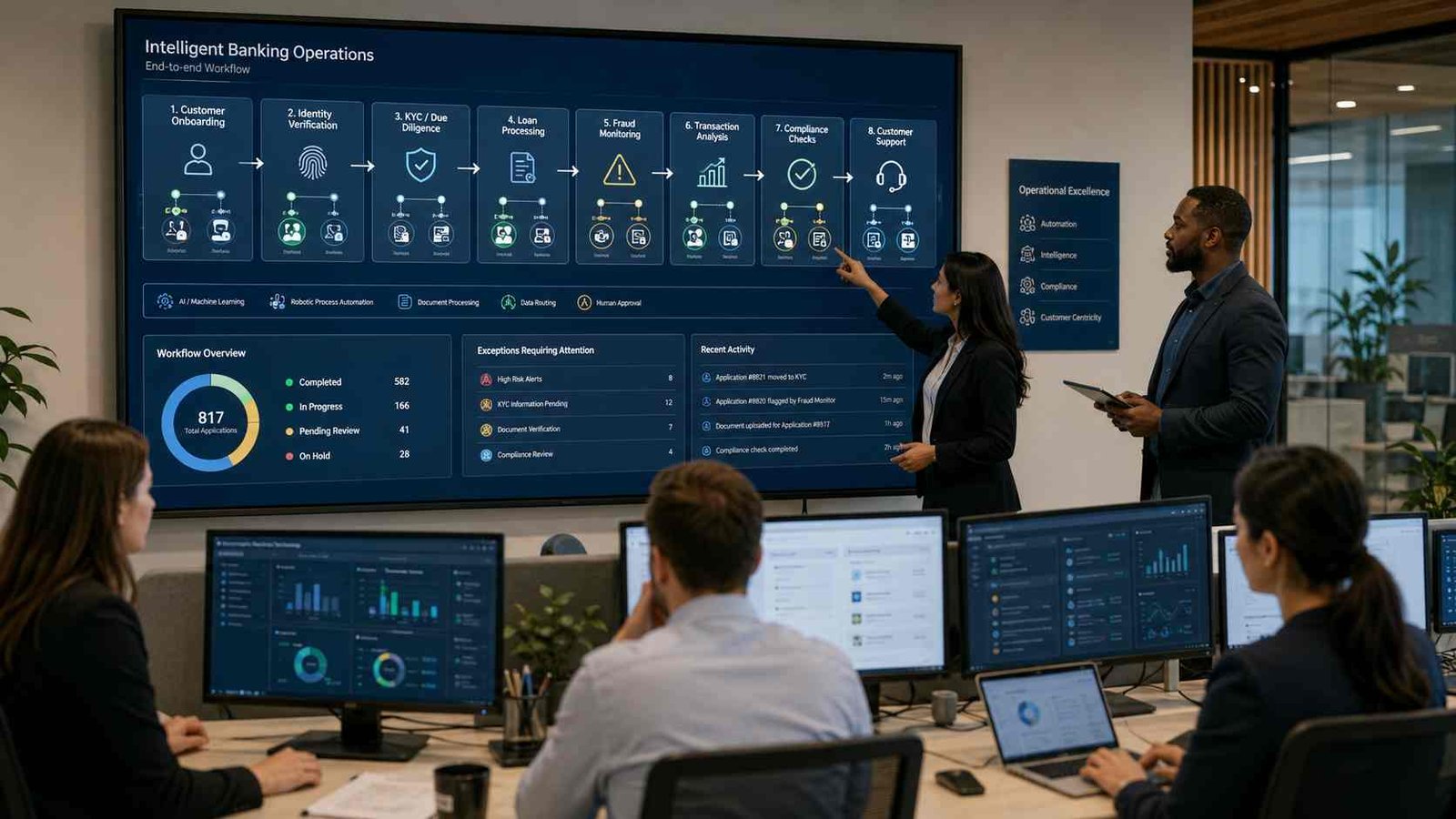
What Is Intelligent Automation?
Intelligent automation is the use of AI and automation technologies together to handle tasks, workflows, and decisions that basic rule-based automation cannot manage effectively on its own.
IBM describes intelligent automation as a combination of artificial intelligence, business process management, and robotic process automation. Each technology performs a different job. AI analyzes information and identifies patterns. Business process management coordinates activities across a workflow. RPA performs predictable actions such as entering information, opening applications, downloading reports, or transferring data between systems.
Think about a loan application. An RPA bot might copy an applicant’s information from an online form into a loan-processing system. Intelligent document processing can extract income figures from uploaded statements. An AI model can identify risk patterns. A workflow system can send unusual applications to an employee for review. Together, these technologies create an intelligent automation process.
Modern banking automation adds several other technologies. Optical character recognition converts scanned documents into machine-readable information. Natural language processing helps software understand customer messages. Machine learning identifies patterns in historical data. APIs connect modern applications directly, while RPA can still interact with older systems that lack suitable integrations.
That distinction matters because RPA and intelligent automation are not the same thing. RPA follows instructions. Intelligent automation can interpret information and coordinate the next action based on context. IBM describes RPA as process-driven while AI works more from data and patterns.
RPA vs AI vs Intelligent Automation in Banking
Banks often use RPA, AI, and intelligent automation together, but each serves a different purpose.
| Technology | What It Does | Banking Example | Handles Complex Data? | Typical Human Role |
|---|---|---|---|---|
| RPA | Follows predefined steps | Copy KYC data between systems | Limited | Review exceptions |
| AI/ML | Finds patterns and makes predictions | Detect suspicious transactions | Yes | Validate important decisions |
| OCR/IDP | Reads and extracts document information | Process IDs and loan statements | Yes | Check unclear documents |
| BPM/Workflow | Coordinates processes | Route a loan through verification and approval | Moderate | Approve defined stages |
| Intelligent Automation | Combines several technologies | Automate onboarding from document upload to account setup | Yes | Governance and exceptions |
| Agentic AI | Plans and performs multistep activities | Collect missing loan documents and continue processing | Potentially high | Define limits and supervise |
A simple way to remember the difference is this: RPA performs an action, AI interprets information, and intelligent automation connects interpretation with action across a business process.
This is why banks rarely need one technology for every problem. A predictable reconciliation task may only require RPA or an API. An AML investigation may require data analytics, machine learning, workflow automation, and an analyst. Successful automation starts by understanding the process rather than buying the most advanced AI product available.
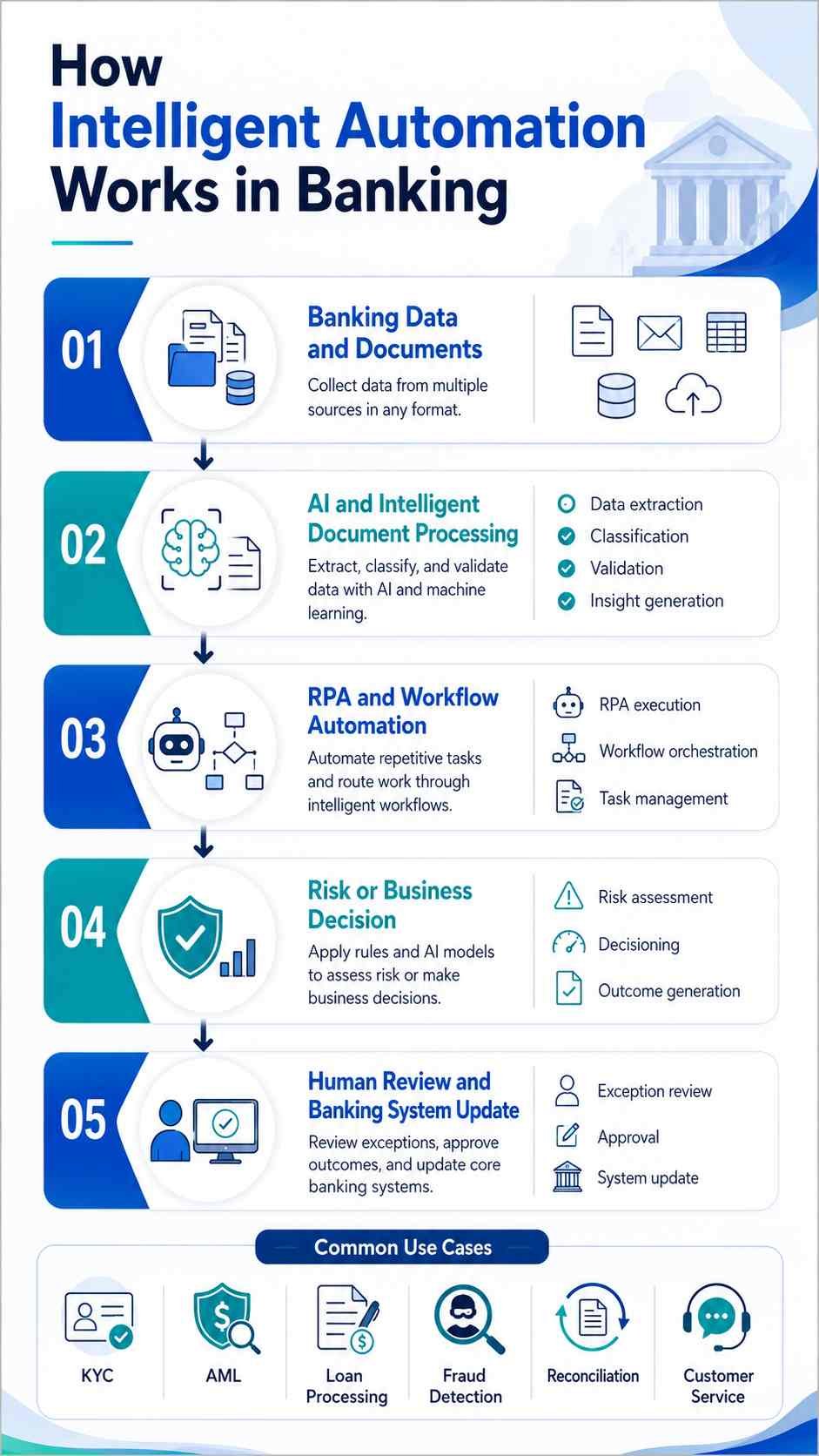
How Is Automation Used in Banking?
Automation now appears throughout front-office, middle-office, and back-office banking operations. Customer-facing automation includes chatbots, digital account opening, automated notifications, and self-service requests. Middle-office systems support fraud detection, underwriting, risk analysis, and compliance. Back-office automation handles reconciliation, document processing, reporting, account maintenance, and data movement between systems.
IBM lists account setup, transaction processing, KYC, lending, reconciliation, customer service, and compliance among common banking automation applications. It also notes that intelligent document processing can interpret complex documents such as financial statements and loan applications rather than relying only on fixed form layouts.
The need usually starts with an operational problem.
| Problem | Common Cause | Banking Impact |
|---|---|---|
| Slow onboarding | Manual document verification | Customer delays and abandonment |
| Too many fraud alerts | Basic rules generate false positives | Analysts waste time |
| Loan delays | Multiple systems and manual checks | Slow credit decisions |
| Compliance workload | Large data and documentation volumes | Higher operating cost |
| Reconciliation backlog | Records stored across systems | Delayed reporting |
| Repeated data entry | Legacy applications | Errors and wasted staff time |
| Slow support | High volumes of routine questions | Long customer wait times |
Intelligent automation works best when banks automate these processes end to end instead of automating one isolated click or data-entry step.
10 Important Intelligent Automation Use Cases in Banking
1. Customer Onboarding
Banks can automate document collection, identity verification, account-data entry, screening, and account creation. IDP extracts customer information while workflow systems route questionable cases to employees.
2. KYC Automation
Know Your Customer processes require banks to confirm identities, understand customer risk, maintain records, and periodically update information. AI and automation can collect documents, compare information across databases, conduct screening, and identify cases requiring investigation.
IBM’s July 2026 analysis of agentic KYC describes a model where automation coordinates document validation, screening, customer outreach, and risk assessment while employees remain responsible for exceptions and final decisions. Its illustrative model estimates that automation could reduce a six-hour KYC case to roughly three hours.
3. AML Monitoring
Anti-money-laundering teams investigate unusual customers and transactions. Intelligent automation can collect information from multiple systems, screen customers, prioritize alerts, prepare case files, and create audit records.
The important word is assist. An automated alert does not prove money laundering. Investigators still need evidence, context, and defined escalation procedures.
4. Fraud Detection
Machine learning can analyze transaction patterns and identify behavior that differs from a customer’s normal activity. Workflow automation can then block a defined action, request additional authentication, or send the case to a fraud analyst.
This capability has become more important as criminals adopt AI themselves. The European Banking Authority reported in its December 2025 risk assessment that criminals increasingly use AI for activities including document forgery, deepfake impersonation, and automated laundering schemes.
5. Loan Processing and Underwriting
Loan processing involves application data, financial documents, credit information, policy rules, and risk assessments. RPA can gather information. IDP can extract figures from documents. AI models can support risk assessment. Workflow software can route cases through underwriting and approval.
Deloitte identifies underwriting as a practical banking AI application where RPA, machine learning, automated document scanning, and multiple data sources can shorten information-gathering and risk-assessment processes.
6. Mortgage Processing
Mortgages involve identity records, income evidence, property information, disclosures, approvals, and repeated data validation. Automation can organize documents, check required fields, transfer data between systems, and flag missing information.
Employees can then focus on exceptions instead of manually checking every predictable step.
7. Customer Service
AI assistants can answer routine questions, summarize conversations, retrieve policies, recommend next steps, and transfer complex problems to people.
Deloitte’s 2026 banking contact-center research found that 71% of its 100 surveyed banking customers placed issue-resolution ease among their top three service priorities, while 63% selected response speed. Deloitte recommends AI-led self-service for simple requests but human-led handling for high-stakes matters such as fraud, disputes, hardship, complaints, and complex lending.
8. Payment and Account Reconciliation
RPA and APIs can compare payment records across systems, match transactions, detect differences, and send exceptions for investigation. This approach reduces the amount of routine matching employees perform manually.
9. Regulatory Reporting
Automation can gather required information, validate fields, apply workflow controls, produce audit trails, and prepare reports. Banks still need governance because automated reporting can spread incorrect data faster when source information or business rules contain errors.
10. Collections and Recovery
AI can analyze customer information for early signs of financial difficulty. Automation can prioritize cases and help employees determine appropriate contact strategies. Deloitte notes that banks can use customer data to identify warning signals for delinquency and offer more suitable recovery options.
Real Examples of Intelligent Automation in Banking
Real banking projects show why intelligent automation works best when institutions target specific operational problems.
HBL: Automation at Scale
A UiPath customer case study reports that Pakistan’s HBL has automated 135 processes and saves about 341,000 hours annually. The case study also reports a 98% accuracy rate for sanction-screening checks. These figures come from the automation vendor’s customer study, so they should serve as an example rather than an industry benchmark.
The important lesson is scale. A bank can begin with individual processes but eventually create an automation program covering operations, compliance, and customer services.
State Street: Faster KYC and Onboarding
SS&C Blue Prism reports that State Street used intelligent automation, RPA, machine learning, and analytics across its automation program. Digital workers helped reduce the time between account opening and a customer’s ability to trade by 49%. The vendor also reports 1.5 million hours returned to the business since the program began.
Standard Bank: Automating Customer Onboarding
WorkFusion reports that Standard Bank automated more than 100 processes and reduced some account-opening workflows to about five minutes. Its customer onboarding system combines automated document classification, data extraction, centralized governance, and human handling of exceptions.
Michael Daniels, the bank’s Head of Operational Excellence and Automation, summarized the shift simply: “Intelligent Automation is changing the nature of financial services.”
These cases share a pattern: automation handles volume, while people manage exceptions, governance, and difficult decisions.
Benefits of Intelligent Automation in Banking
The biggest advantage of intelligent automation is not simply speed. It creates a way to redesign work that previously moved slowly between employees, documents, applications, and departments.
Banks can use automation to reduce repetitive data entry, shorten processing times, handle larger transaction volumes, maintain more consistent workflows, and create better audit trails. Customer-facing processes can operate outside normal office hours. Employees can spend more time investigating suspicious cases, resolving complicated customer problems, and making decisions that require professional judgment.
Automation can also improve scalability. A bank experiencing rapid growth does not necessarily need to increase manual processing capacity at the same rate as transaction volume. Software can absorb part of that increase.
However, banks should avoid unrealistic goals such as zero errors or complete removal of human involvement. Automation can execute an incorrect rule perfectly. AI can also produce inaccurate classifications or predictions. Bad input data can create bad outcomes at machine speed.
The better target is controlled straight-through processing. The system automatically completes low-risk cases when information meets clearly defined requirements and sends unusual cases to people.
Risks Banks Cannot Ignore
Banking automation touches money, identities, personal data, credit decisions, and regulatory obligations. That makes governance part of the technology rather than an optional administrative layer.
One major issue involves AI bias. Models trained on historical data can reproduce patterns that disadvantage particular groups. Credit decisions therefore require careful validation, monitoring, explainability, and legal review. In the European Union, AI systems used to evaluate a person’s creditworthiness or establish a credit score fall within the AI Act’s high-risk category, creating additional requirements.
Banks must also manage privacy, cybersecurity, model errors, access permissions, third-party technology, and operational resilience. McKinsey warns that generative AI can create legal and reputational risks while increasing exposure to cyberattacks and fraud if financial institutions fail to strengthen governance.
Agentic systems create another challenge because they can act rather than simply recommend. Deloitte points to access controls, privacy, model risk, regulatory concerns, ethical issues, and bias as major barriers to wider agentic AI adoption in banking.
A safe banking automation design therefore needs access limits, activity logs, testing, monitoring, override mechanisms, separation of duties, and clear accountability.

Why Human-in-the-Loop Banking Still Matters
The most practical model for intelligent automation divides work according to risk.
A system can process a predictable address update with little human involvement. It can answer a simple question about branch hours automatically. It can reconcile transactions that match perfectly according to established rules.
A suspected fraud case requires more caution. A customer experiencing financial hardship may need empathy and judgment. A complex credit decision may have legal consequences. An AML investigation may depend on information that software cannot interpret confidently.
Deloitte’s 2026 contact-center research recommends keeping high-stakes situations human-led while using AI to provide context and assistance. Seventy percent of surveyed banking executives expected AI to move agents toward higher-value roles rather than simply remove them.
This gives banks a useful operating principle:
Automate certainty. Assist judgment. Escalate exceptions.
Human oversight also creates accountability. Employees need to know when they can override automation, why an AI system recommended an action, and who owns the final decision.
How to Implement Intelligent Automation in a Bank
A successful banking automation project should follow a controlled sequence:
Discover → Map → Redesign → Automate → Test → Govern → Measure → Scale
Step 1: Find the Right Process
Start with work that has high transaction volume, repetitive actions, clear rules, measurable delays, or significant manual effort.
Step 2: Map the Current Workflow
Record every application, document, decision, approval, handoff, exception, and data source. Process mapping often exposes unnecessary steps before automation starts.
Step 3: Fix the Process First
Do not automate a broken workflow. Remove duplicate approvals and unnecessary data entry before adding technology.
Step 4: Classify Risk
Separate low-risk routine work from decisions involving credit, fraud, customer harm, regulatory obligations, or large financial transactions.
Step 5: Choose the Right Technology
Use APIs when systems can exchange information directly. Use RPA when employees must work through legacy interfaces. Use IDP for documents. Use AI when pattern recognition or interpretation adds value.
Step 6: Define Human Checkpoints
Decide which outcomes require review and what conditions trigger escalation.
Step 7: Run a Limited Pilot
Test normal cases and difficult exceptions. Include incomplete documents, system downtime, incorrect information, duplicates, and unusual customer behavior.
Step 8: Measure Results
Compare the automated process against the previous baseline.
Step 9: Monitor Continuously
Watch error rates, model performance, security, compliance, exceptions, and employee overrides.
Step 10: Scale Proven Workflows
Expand only after the process delivers measurable benefits without creating unacceptable risk.
Deloitte’s 2026 banking outlook makes the infrastructure point especially clear: AI cannot operate reliably on fragmented, poorly governed data. Banks need traceable, organized, AI-ready information before advanced automation can scale safely.
How Should Banks Measure Automation Performance?
Useful banking automation metrics include:
- Processing time per case
- Straight-through processing rate
- Number of manual touches
- Exception rate
- Cost per transaction
- Customer response time
- Fraud-alert false-positive rate
- Compliance exceptions
- Automation failure rate
- Human override rate
- System availability
- Backlog size
- Employee hours redirected to higher-value work
Banks should measure more than cost savings. An automation that saves money but increases customer complaints or compliance risk does not represent a successful implementation.
[Visual suggestion: Banking automation dashboard displaying throughput, exceptions, processing time, human escalations, and workflow status.]
Intelligent Automation Tools Used in Banking
Banks can choose from platforms such as UiPath, SS&C Blue Prism, Automation Anywhere, IBM automation technologies, Microsoft Power Automate, and Tungsten Automation, along with specialized fraud, KYC, document-processing, workflow, and process-mining platforms.
The better question is not, “Which intelligent automation tool is best?” It is, “Which technology matches this process?”
A bank may need RPA for an old core system, intelligent document processing for statements, an API for a modern cloud platform, machine learning for risk scoring, and BPM software to coordinate the entire workflow.
Architecture also matters. Adding hundreds of isolated bots can create another layer of technical debt. Banks need centralized security, credentials management, logging, version control, monitoring, and governance as automation scales.
Intelligent Automation vs Hyperautomation
Intelligent automation and hyperautomation overlap, but they describe different ideas.
Intelligent automation focuses on combining technologies such as RPA, AI, machine learning, and workflow management so a system can perform more sophisticated tasks.
Hyperautomation takes a wider organizational approach. It seeks to identify, prioritize, automate, measure, and continuously improve as many suitable business processes as practical.
IBM explains that intelligent automation often acts as one component within a wider hyperautomation strategy.
For a bank, automating one KYC workflow represents intelligent automation. Creating an enterprise program that discovers automation opportunities across KYC, lending, payments, finance, customer service, and compliance moves closer to hyperautomation.
Is Agentic AI the Next Stage of Banking Automation?
Agentic AI represents one of the most important developments in banking automation in 2026.
Traditional RPA follows predetermined instructions. Generative AI creates or analyzes information in response to prompts. An AI agent can potentially pursue a goal, determine intermediate steps, use approved tools, collect additional information, and change its actions as conditions change.
Imagine a loan application with a missing income statement. A traditional workflow might stop and create an employee task. An AI agent could identify what is missing, send an approved request to the customer, receive the document, validate it, update the case, and continue the workflow.
Banks are exploring similar approaches for underwriting, treasury, fraud detection, KYC, AML, customer service, and payments. Deloitte calls agentic AI a natural progression from machine learning, traditional AI, and generative AI, but it also stresses that real-world banking deployments remain relatively uncommon.
That caution matters. In March 2026, Deloitte reported that roughly one in three financial institutions were allocating budgets to agentic AI, while banks including Wells Fargo, PNC, Goldman Sachs, JPMorgan Chase, Citi, and BNY were exploring or developing agent-based applications.
The future is therefore moving toward greater autonomy, but banks still need permissioned autonomy: clearly defined actions, restricted system access, continuous monitoring, human overrides, and documented accountability.
What Are the 7 Ps of Banking?
The 7 Ps of banking do not describe seven types of banking automation. They come from the service-marketing mix.
They are:
- Product: Accounts, loans, cards, investments, and other banking services.
- Price: Interest rates, fees, charges, and pricing structures.
- Place: Branches, websites, apps, ATMs, and other service channels.
- Promotion: Advertising, communication, offers, and customer education.
- People: Employees, advisers, support teams, and customer relationships.
- Process: How customers receive and use banking services.
- Physical Evidence: Tangible signals of service quality, including branches, cards, documents, and digital interfaces.
Academic research applying the 7 Ps to banking uses the same service-marketing framework.
Intelligent automation relates most closely to Process and People because it changes how services move through the bank and how employees interact with customers.
Frequently Asked Questions About Intelligent Automation in Banking
What is intelligent automation?
Intelligent automation combines technologies such as AI, RPA, machine learning, and workflow management to automate tasks that require both predictable actions and some level of data interpretation or decision support.
How is automation used in banking?
Banks use automation for customer onboarding, KYC, AML investigations, fraud monitoring, loan processing, document handling, payments, reconciliation, regulatory reporting, customer service, and internal operations.
What are examples of intelligent automation?
Examples include automatically reading an identity document during account opening, detecting unusual transactions, extracting information from loan documents, preparing AML cases, reconciling payments, and answering routine customer requests.
Is RPA the same as intelligent automation?
No. RPA mainly follows predefined rules and performs repetitive computer actions. Intelligent automation combines RPA with technologies such as AI and workflow management so the system can handle more complex information and processes.
Can intelligent automation approve loans?
Automation can collect information, validate documents, calculate rules, and support credit decisions. Whether software can make a final decision depends on the bank’s policies, jurisdiction, risk level, model governance, and applicable regulations. High-risk decisions may require additional controls or human review.
Will intelligent automation replace bank employees?
It can eliminate parts of some jobs, especially repetitive administrative tasks, but current banking strategies increasingly focus on moving people toward exceptions, customer relationships, investigation, oversight, and complex decisions.
What is intelligent automation in KYC?
It combines document processing, customer-data collection, screening, risk analysis, workflow orchestration, and human review to reduce repetitive KYC work while maintaining compliance controls.
What is the difference between intelligent automation and agentic AI?
Intelligent automation connects AI with automated workflows. Agentic AI goes further by allowing software to plan and execute multiple approved actions toward a goal with less step-by-step human direction.
Practical Intelligent Automation Checklist for Banks
Before putting a banking process into production:
- Define the business problem.
- Map the entire existing workflow.
- Remove unnecessary process steps.
- Identify every data source.
- Determine whether APIs can replace screen automation.
- Classify regulatory and customer risk.
- Define what the automation may access.
- Establish human approval points.
- Test normal and abnormal cases.
- Create complete audit logs.
- Establish cybersecurity controls.
- Test model bias where AI affects decisions.
- Measure false positives and exceptions.
- Define an employee override process.
- Monitor automation after deployment.
- Review third-party vendor risk.
- Set measurable business KPIs.
- Scale only after the pilot meets those targets.
Further Reading and Research
For deeper technical and management research, useful starting points include IBM’s guides to intelligent automation and banking automation, Deloitte’s 2026 research on AI-assisted banking service and agentic AI, McKinsey’s work on AI governance in financial services, the European Banking Authority’s AI and operational-risk publications, and documented banking automation case studies from UiPath, SS&C Blue Prism, and WorkFusion.
Readers evaluating vendor case studies should distinguish between independently validated research and figures published by technology providers. Vendor examples can show what particular implementations achieved, but another bank may see very different results because its data, systems, regulations, processes, and customer volumes differ.
What Intelligent Automation Means for Banking Next
Intelligent automation in banking has moved beyond the simple idea of software robots copying data from one application to another. Modern systems combine RPA, artificial intelligence, document understanding, APIs, machine learning, workflow orchestration, and human oversight.
The practical opportunity is substantial. Banks can process documents faster, improve customer onboarding, investigate fraud more efficiently, accelerate lending workflows, automate reconciliation, and reduce the repetitive work that consumes employee time.
The next shift will involve AI agents that can coordinate more of these activities themselves. IBM and Deloitte’s 2026 research already points toward agent-based KYC, customer service, underwriting, fraud, and other multistep workflows. At the same time, both emphasize governance and human oversight as automation becomes more autonomous.
Banks should therefore avoid treating intelligent automation as a race to remove people from every process. The stronger strategy assigns each kind of work to the right participant. Software handles repetitive execution and large-scale data analysis. AI helps interpret information and recommend actions. Employees provide judgment, accountability, empathy, and control where the consequences matter.
That combination is likely to define successful intelligent automation in banking: machines handling more of the process without removing human responsibility for the outcome.

Digital innovation analyst with a focus on AI, IoT, and connectivity. Maria’s articles combine data-driven research, industry statistics, and tested solutions, helping global readers stay informed, confident, and future-ready in technology.