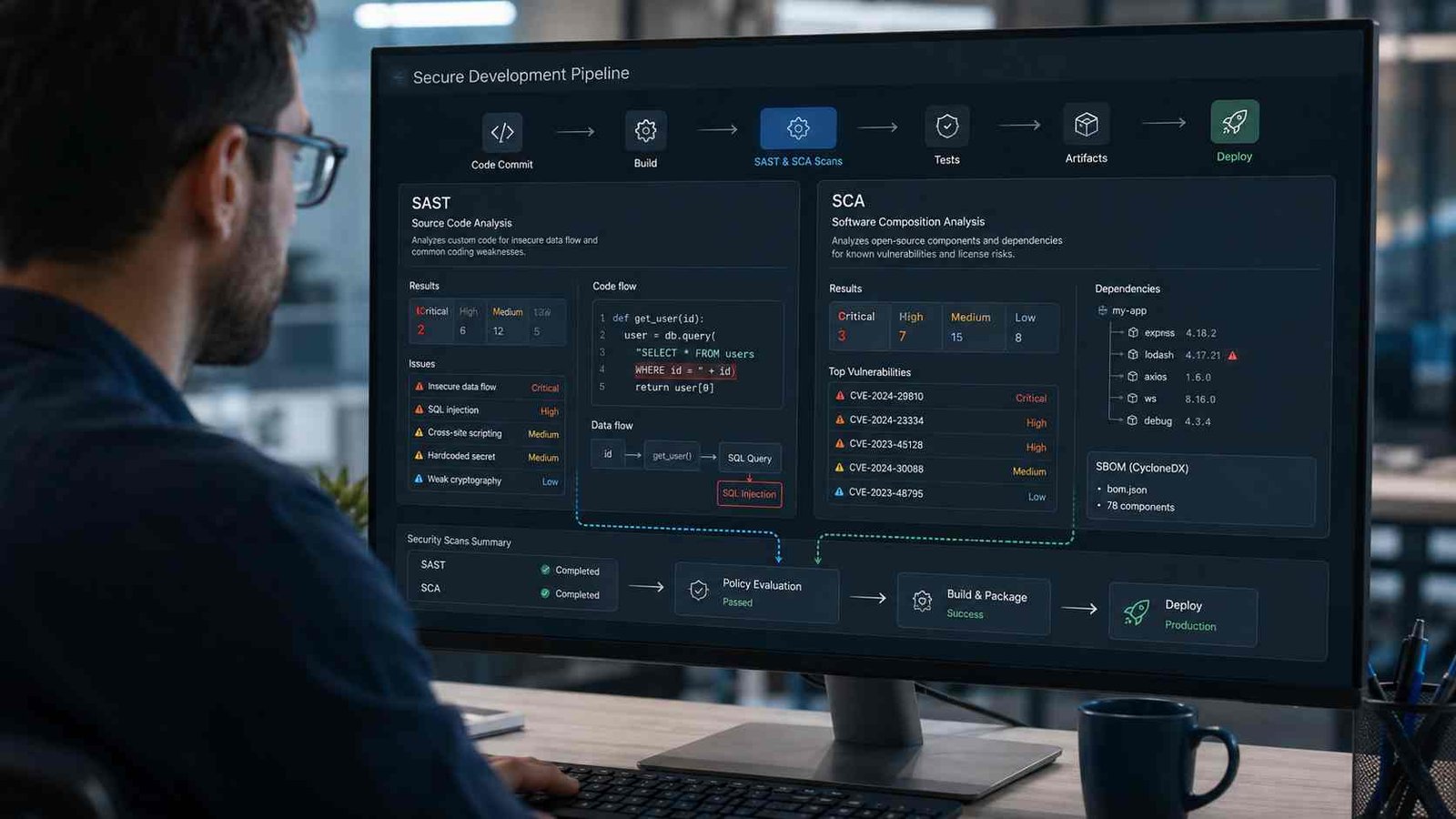
SAST, or Static Application Security Testing, examines first-party application code without running the application. It looks for security weaknesses such as unsafe data flows, injection flaws, risky functions, and insecure coding patterns. SCA, or Software Composition Analysis, focuses on open-source and third-party components. It identifies vulnerable dependency versions, license concerns, transitive dependencies, and other software supply chain risks. OWASP describes SAST tools as systems that analyze source code or compiled code to help identify security flaws. Sonatype makes the distinction even clearer: SAST focuses on proprietary source code, while SCA identifies risks associated with open-source dependencies.
That distinction matters more in 2026 because software dependency risk continues to grow. Black Duck’s 2026 Open Source Security and Risk Analysis report studied 947 commercial codebases across 17 industries. It found that 87% contained at least one open-source vulnerability, 78% contained high-risk vulnerabilities, and 44% contained critical-risk issues. The average number of open-source vulnerabilities per codebase rose 107% year over year to 581.
The practical answer is simple: SAST protects the code your developers create. SCA helps protect the external code your applications depend on. Most development teams need both.
What Are SAST and SCA Tools?
SAST stands for Static Application Security Testing. A SAST scanner examines source code, bytecode, or sometimes compiled binaries without executing the application in the way a normal user would. Modern SAST engines can use pattern matching, control-flow analysis, data-flow analysis, and taint analysis to follow information through an application. For example, a scanner may trace untrusted data from a web form to a database query and warn developers if the application uses that data without suitable validation. OWASP notes that static analysis normally forms part of the implementation stage of a secure development lifecycle and commonly uses techniques such as taint and data-flow analysis.
SCA stands for Software Composition Analysis. Instead of concentrating on code written by your team, it maps the software components your project imports. That can include direct packages listed in files such as package.json, requirements.txt, pom.xml, or similar manifests, as well as packages pulled indirectly through those dependencies. SCA platforms compare identified components with vulnerability intelligence and may also report outdated versions, license obligations, malicious packages, package health, and Software Bill of Materials data. Snyk describes its Open Source product as an SCA solution for finding vulnerabilities and license issues in open-source libraries, including problems buried inside indirect dependencies. Checkmarx likewise describes SCA as a way to identify security vulnerabilities, license requirements, and outdated open-source packages.
This means SAST and SCA answer different questions. SAST asks, What security mistakes exist in the code we wrote? SCA asks, What risks entered the project through software components we imported?
What Is the Difference Between SCA and SAST?
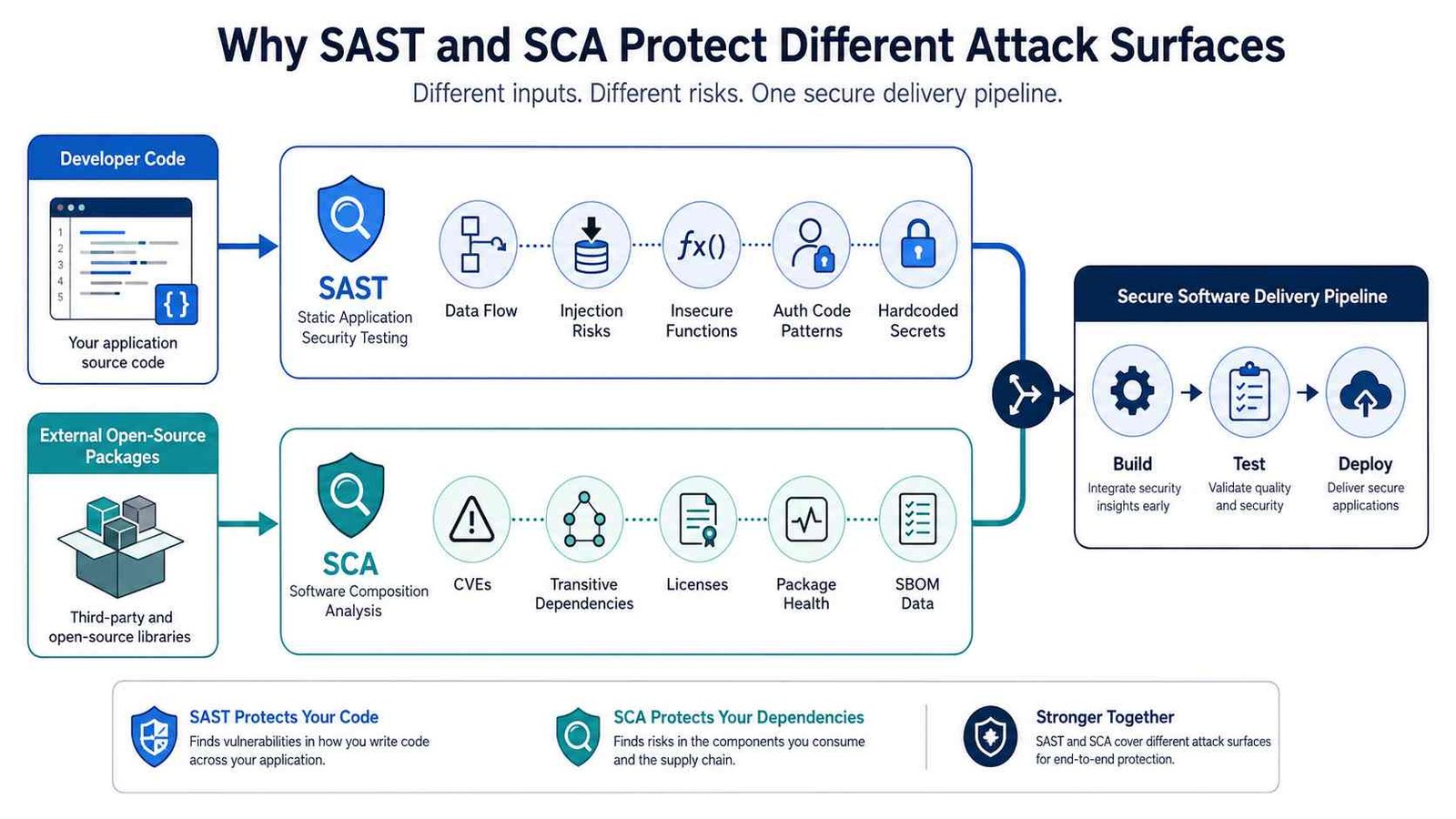
The biggest difference between SAST and SCA is the attack surface each one examines. Imagine a small online store. Its developers write a checkout API, authentication logic, and account-management code. They also install dozens of packages for database access, logging, HTTP requests, authentication, payment integration, and front-end development. If a developer writes an unsafe SQL query, SAST may find it. If one imported library contains a published vulnerability, SCA is better suited to detect it.
Neither scanner provides a complete picture by itself. SAST may know that application data reaches a dangerous function, but it does not primarily maintain an inventory of every open-source component. SCA can tell you that version 3.2 of a dependency contains a known vulnerability, but it usually does not analyze all of your application’s proprietary business logic. This separation explains why security platforms increasingly offer both technologies in the same product suite.
| Problem | Typical Cause | Potential Impact | Best Tool |
|---|---|---|---|
| SQL injection | Unsafe query construction | Database compromise | SAST |
| Cross-site scripting | Unsanitized user input | Session or data theft | SAST |
| Command injection | User input reaches system command | Server compromise | SAST |
| Vulnerable package | Known flaw in dependency version | Application compromise | SCA |
| Risky transitive dependency | Dependency imports another vulnerable package | Hidden supply chain exposure | SCA |
| License conflict | Incompatible open-source license | Legal or distribution problems | SCA |
| Outdated component | Dependency remains unpatched | Known vulnerabilities remain exploitable | SCA |
| Insecure data flow | Poor validation or sanitization | Sensitive data exposure | SAST |
SAST often maps findings to weakness classifications such as CWE entries. SCA often works heavily with package versions, vulnerability advisories, CVEs, dependency graphs, and remediation versions. Some modern platforms combine these data sources and add reachability analysis so security teams can understand whether vulnerable dependency code appears reachable from the application.
Is SCA the Same as SAST?
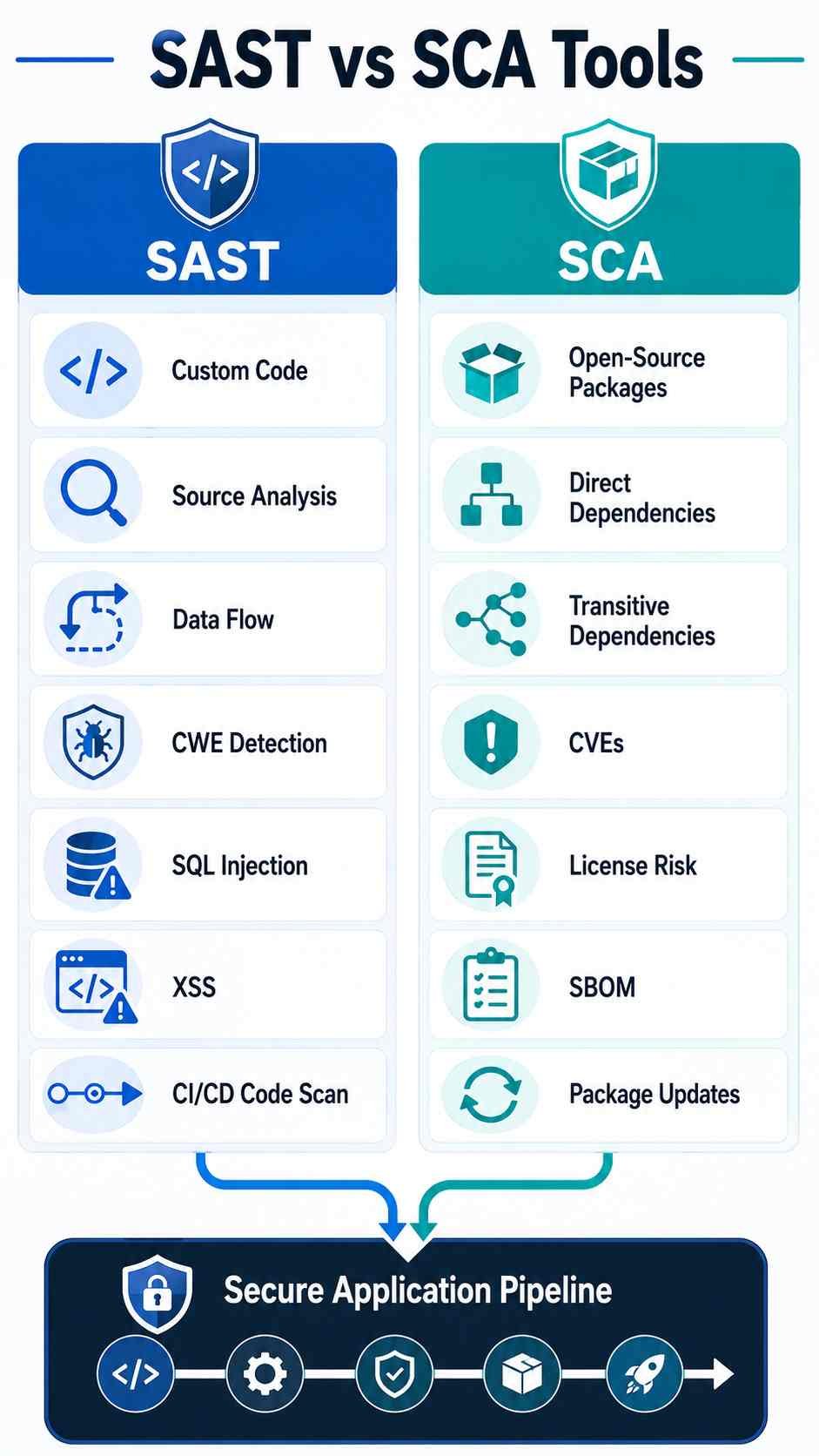
No. SCA is not the same as SAST. They overlap in workflow, but they analyze different sources of security risk. Both can run automatically when developers commit code. Both can produce security alerts in pull requests. Both can integrate into CI/CD pipelines. Both can send findings into a central application-security dashboard. That operational similarity sometimes makes them look interchangeable.
The underlying analysis remains different. SAST examines the structure and behavior of first-party code. SCA inventories external components and compares them against vulnerability and licensing information. FOSSA summarizes the difference in practical terms: SAST focuses on proprietary code, while SCA focuses on open-source dependencies and the risks connected to them. Sonatype similarly treats SAST, SCA, and DAST as separate application-security testing approaches that work together across the software development lifecycle.
This distinction matters when teams choose security coverage. Buying a capable SAST product does not automatically solve open-source dependency management. Adding an SCA scanner does not mean your developers can stop checking custom code for injection problems or insecure logic. A mature DevSecOps program normally treats them as layers.
Consider a Node.js application that contains perfectly safe custom code but imports a vulnerable package through another library. A SAST scan might show no critical problem in the application’s own code. SCA can reveal the dependency chain and the affected version. Reverse the situation and imagine that every third-party component is fully patched, but a developer directly concatenates user input into a database query. SCA may report a clean dependency inventory while SAST flags the risky data flow.
Which Tools Are Used for SAST Analysis?
There is no single SAST tool that fits every development team. Programming languages, repository platforms, deployment requirements, scan speed, security policies, budget, and false-positive tolerance all affect the decision. OWASP’s SAST directory lists a wide range of commercial and open-source options and recommends checking language support, vulnerability detection capability, accuracy, framework support, IDE integration, CI/CD compatibility, ease of use, and cost.
Several current platforms stand out. GitHub CodeQL performs semantic code analysis through queries and integrates with GitHub code scanning. GitHub currently documents built-in CodeQL query suites for languages including C/C++, C#, Go, Java/Kotlin, JavaScript/TypeScript, Python, Ruby, Rust, and Swift. Semgrep Code provides SAST with rule-based analysis, data-flow capabilities, pull-request integration, and developer-focused remediation workflows. Snyk Code scans application code through IDEs, repositories, CI/CD, CLI, APIs, and pull-request checks. SonarQube uses security rules and taint analysis to detect problems such as SQL injection, cross-site scripting, command injection, and risky security configurations.
Enterprise teams may also evaluate Checkmarx SAST, Veracode Static Analysis, Fortify, and Coverity. The important point is not to choose a product because it appears on a popular tools list. Test it against your actual languages and frameworks.
| SAST Tool | Strong Fit | Notable Approach |
|---|---|---|
| GitHub CodeQL | GitHub-centered development | Query-based semantic code analysis |
| Semgrep Code | Developer-focused teams | Rules plus data-flow analysis |
| Snyk Code | Integrated DevSecOps workflows | IDE, repository and CI/CD scanning |
| SonarQube | Code quality plus security | Rules, security hotspots and taint analysis |
| Checkmarx SAST | Enterprise AppSec | Centralized static security testing |
| Veracode Static Analysis | Enterprise application portfolios | Centralized application security scanning |
| Fortify | Large or regulated environments | Broad enterprise static analysis |
| Coverity | Complex software and compiled languages | Deep static code analysis |
A useful proof-of-concept should scan several real applications, not a tiny demonstration repository. Measure how many useful findings developers receive, how long scans take, how easily developers understand remediation advice, and how much tuning the security team must perform.
What Tools Are Used for SCA?
Popular SCA tools include Snyk Open Source, Black Duck SCA, Checkmarx SCA, Mend, GitHub’s dependency-security features, Semgrep Supply Chain, and OSV-Scanner. They share the general goal of finding dependency risk, but their depth, advisory databases, policy engines, license management, SBOM capabilities, remediation workflows, and deployment models differ.
Snyk Open Source identifies vulnerable open-source dependencies and license issues throughout the software development lifecycle. Checkmarx SCA examines direct and transitive dependencies and can create automated remediation pull requests in supported repository workflows. GitHub takes a repository-native approach. Its dependency graph records project dependencies, Dependency Review shows dependency changes in pull requests, and Dependabot checks dependency data against the GitHub Advisory Database. Dependabot security updates can then create pull requests that move vulnerable components to patched versions. GitHub also introduced malware alerts for known malicious dependencies, although its current documentation notes limitations and ecosystem-specific availability.
For teams that prefer an open-source command-line option, Google’s OSV-Scanner connects project dependencies to the OSV vulnerability database. It can run locally or inside CI/CD pipelines and supports many common manifest and lockfile formats. Its current version also supports features including SBOM scanning and selected transitive-dependency analysis.
| SCA Tool | Good Fit | Typical Capabilities |
|---|---|---|
| Snyk Open Source | Developer-first security | Vulnerabilities, licenses, dependencies |
| Black Duck SCA | Enterprise governance | Component inventory, risk and licensing |
| Checkmarx SCA | Existing Checkmarx users | Dependencies, vulnerabilities, remediation |
| Mend | Enterprise DevSecOps | Open-source risk and dependency management |
| GitHub Dependabot | GitHub repositories | Alerts and dependency update PRs |
| Semgrep Supply Chain | Semgrep users | SCA with reachability context |
| OSV-Scanner | Open-source and CLI workflows | Dependency vulnerability scanning |
How SAST and SCA Work Together in DevSecOps
The strongest implementation puts both scanners inside the development workflow instead of waiting for a security review immediately before release. A practical flow looks like this: developer writes code → local or IDE security checks → pull request → SAST scan → SCA scan → security policy evaluation → remediation → build → test → deployment → continuous monitoring.
SAST can begin while a developer writes code. IDE integrations can identify risky patterns before the developer commits them. A deeper scan can then run during a pull request or CI build. SCA should operate at similar points because dependency changes often happen through the same commits. When a developer adds a new package, Dependency Review or another SCA system can examine that package before the team merges it. Continuous SCA monitoring remains valuable after deployment because a library considered safe today may receive a vulnerability disclosure next month.
GitHub’s dependency-security model demonstrates this continuous approach. The dependency graph records components, Dependency Review examines changes, Dependabot alerts react when known vulnerabilities affect those dependencies, and security updates can propose patched versions. Semgrep also supports workflows triggered by pull requests, scheduled scans, or APIs that can combine static analysis, software composition analysis, secrets detection, and additional security logic.
This approach also prevents a common mistake: treating security scanners as audit tools owned only by a security department. Developers create and update the software every day, so useful findings need to reach them while the relevant code is still fresh.
What SAST Finds That SCA Cannot
Suppose a student development team creates a simple course-registration application. They use current and vulnerability-free packages, so their SCA dashboard looks clean. One developer nevertheless writes a search function that takes raw text from a request and inserts it into a SQL query without proper parameterization. The problem lives in their custom code, not an imported package. SAST is designed for this type of weakness.
Static analysis can identify problems involving user-controlled data, dangerous functions, injection paths, security-sensitive APIs, and certain insecure coding patterns. SonarQube, for example, documents taint analysis for vulnerabilities including SQL injection, cross-site scripting, code injection, deserialization issues, and command injection. OWASP also lists SQL injection and buffer overflows among weaknesses that SAST tools can identify.
SAST still has limitations. OWASP warns that automated static analysis can produce false positives and may struggle with some authentication, access-control, configuration, or cryptographic problems. A finding therefore needs context. Security teams should avoid treating every scanner alert as proof that an attacker can exploit the application.
OWASP notes that SAST tools can analyze source or compiled code to help find security flaws.
This is one reason modern platforms increasingly add contextual analysis, framework awareness, prioritization, and developer feedback instead of simply producing long vulnerability lists.
What SCA Finds That SAST Cannot
Now imagine the same course-registration application uses a package that imports another library several levels down the dependency tree. Developers never selected that lower-level package directly, but their application still ships it. A vulnerability advisory later identifies a critical flaw in that transitive dependency.
This is where SCA becomes essential. It builds an inventory of components, identifies affected package versions, maps dependencies, and connects them to security advisories. It may also identify compatible fixed versions, licensing restrictions, package age, or policy violations. GitHub’s dependency graph and Dependabot provide one example of this model, while Snyk, Checkmarx, Black Duck, Mend, Semgrep, and OSV-Scanner provide their own approaches.
The supply chain problem extends beyond ordinary vulnerabilities. Sonatype reported that it identified more than 454,600 new malicious open-source packages during 2025, raising its cumulative total of known and blocked malware to more than 1.233 million packages across ecosystems including npm, PyPI, Maven Central, NuGet, and Hugging Face. The report describes tactics such as typosquatting, namespace confusion, credential theft, malicious installation scripts, and attacks against developer environments.
Sonatype’s 2026 research describes open-source registries as an increasingly important delivery channel for software supply chain attacks.
SAST remains important here, but dependency intelligence requires capabilities beyond traditional source-code analysis.
Do You Need Both SAST and SCA?
For most organizations developing modern applications, the answer is yes. The exact products can vary, and a small team does not need the same platform as a multinational enterprise. The security coverage, however, should address both first-party code and third-party components.
A small startup can begin with repository-native features and open-source scanners. GitHub-hosted projects, for example, can combine CodeQL where available with dependency graph features and Dependabot. Teams using other platforms can pair a lightweight SAST option such as Semgrep with an appropriate dependency scanner. The goal is to establish useful coverage without drowning developers in alerts.
A growing SaaS company usually needs stronger policy controls. It may want scans on every pull request, scheduled full scans, centralized dashboards, security ownership, dependency update automation, and ticketing integration. Enterprise organizations may add on-premises deployment, regulatory reporting, SBOM management, portfolio-level risk views, custom security rules, access controls, and integration with Application Security Posture Management systems.
Consider a 20-person software company releasing updates several times each week. Blocking every build whenever any scanner reports a medium-severity issue would quickly frustrate developers. A more useful policy might block newly introduced critical SAST findings and critical vulnerable dependencies while routing lower-risk findings into remediation workflows. The right implementation combines coverage with prioritization.
How to Choose SAST and SCA Tools
Start with your technology stack. A SAST engine that does not understand your main language or framework cannot provide meaningful coverage. An SCA platform that cannot resolve your package managers or private registries creates similar blind spots. Then test developer experience. Developers should be able to see where the problem occurs, why it matters, and what they can change. OWASP specifically recommends evaluating programming-language support, vulnerability detection, accuracy, false-positive and false-negative rates, library and framework understanding, IDE support, CI/CD integration, setup requirements, and cost when selecting static-analysis tools.
Next, evaluate context and prioritization. A vulnerability database may identify hundreds of CVEs across a large dependency graph. That does not mean every alert represents equal real-world risk. Newer SCA platforms increasingly add reachability or usage analysis to determine whether vulnerable functionality appears relevant to the application. Semgrep, for example, currently positions reachability analysis as part of its Supply Chain product and uses it to prioritize dependency findings.
Finally, test the complete workflow. Run each candidate against real repositories. Review the findings with developers. Add it to a test CI/CD pipeline. Measure scan duration, useful findings, noise, remediation quality, dashboard usability, and policy flexibility. A technically advanced scanner that developers constantly bypass provides less security than a well-integrated tool they actually use.
Common Mistakes When Deploying SAST and SCA
The first mistake is assuming that purchasing both technologies automatically creates a secure development lifecycle. Scanners generate information. Teams still need ownership, remediation rules, exception processes, and follow-up. The second mistake is turning on every rule and immediately blocking builds. That can produce alert fatigue, especially when teams have large existing vulnerability backlogs.
Another mistake is scanning only at release time. By then, developers may have moved on to other features, and fixing architectural problems becomes harder. Running targeted checks earlier gives developers faster feedback. Teams also need to remember that SCA is not a one-time inventory exercise. A package that contains no known vulnerability when you release an application can receive a CVE later, so continued monitoring matters.
Transitive dependencies deserve special attention. A project may directly declare only 40 packages while those packages introduce hundreds of additional components. Snyk specifically highlights vulnerabilities that can exist inside indirect dependencies, and Sonatype attributes part of persistent vulnerable-component usage to transitive dependency blind spots and upgrade friction.
Finally, avoid using severity scores alone. A critical CVE in unused functionality may deserve different treatment from an easily reachable high-severity vulnerability exposed through an internet-facing service. Context, exploitability, exposure, asset importance, and available fixes should influence remediation priority.
SAST vs. SCA vs. DAST: Where Does DAST Fit?
SAST and SCA still do not cover the entire application-security landscape. Dynamic Application Security Testing, or DAST, tests a running application from the outside. A DAST scanner interacts with deployed software and looks for exploitable behavior such as injection flaws, path traversal, insecure configuration, and other web application vulnerabilities. OWASP describes web application vulnerability scanners as automated systems that normally examine applications externally and commonly refers to this category as DAST.
The three technologies therefore provide different views. SAST looks inside custom code before or during the build process. SCA studies the ingredients used to assemble the software. DAST tests how the completed application behaves while running. Sonatype’s current AppSec guidance treats all three as complementary security approaches rather than substitutes.
For a banking application, SAST might find unsafe handling of user input in Java code. SCA might identify an outdated logging library with a known vulnerability. DAST might discover that a running endpoint responds in an unsafe way to a crafted request. Using multiple testing methods reduces the chance that one tool’s blind spot becomes an attacker’s opportunity.
Modern SAST and SCA Trends to Watch
SAST and SCA products increasingly compete on prioritization rather than simply the number of vulnerabilities they can display. Security teams already have more findings than they can fix. Modern platforms therefore add reachability analysis, exploit context, automated triage, developer-specific remediation, and AI-assisted fixes. Semgrep currently combines deterministic static analysis with AI-assisted analysis and offers SAST, SCA, and secrets detection within the same platform. SonarQube’s 2026.1 documentation similarly describes advanced SAST and SCA as part of its expanded security offering.
SBOMs are another important area. A Software Bill of Materials creates an inventory of components included in software. SBOM support can help organizations answer a crucial question after a major vulnerability announcement: Are we using the affected component, and where? Open-source tools such as OSV-Scanner can also scan supported SBOM formats for known vulnerabilities.
Software supply chain security will keep expanding beyond ordinary package vulnerabilities. Sonatype’s 2026 research describes malicious packages, compromised maintainers, developer-targeted attacks, AI-assisted dependency decisions, and risks involving model registries and automated development agents. Black Duck also reports that AI-assisted development has increased code and component volume across audited applications.
The direction is clear: future application-security platforms will need to understand code, components, context, provenance, runtime exposure, and developer workflows together.
Frequently Asked Questions About SAST and SCA Tools
What is the difference between SCA and SAST?
SAST analyzes first-party application code for weaknesses such as unsafe data flow and injection patterns. SCA analyzes open-source and third-party components for known vulnerabilities, dependency risks, outdated versions, and license concerns. They solve different parts of the application-security problem.
What tools are used for SCA?
Common SCA options include Snyk Open Source, Black Duck SCA, Checkmarx SCA, Mend, GitHub Dependabot and Dependency Review, Semgrep Supply Chain, and OSV-Scanner. The best choice depends on package-manager support, vulnerability intelligence, CI/CD integration, licensing requirements, SBOM support, and budget.
Is SCA the same as SAST?
No. SCA and SAST are separate security-testing methods. SCA focuses mainly on software components and dependencies. SAST focuses mainly on application code written or maintained by developers.
Which tool is used for SAST analysis?
There is no single standard tool. GitHub CodeQL, Semgrep Code, Snyk Code, SonarQube, Checkmarx SAST, Veracode Static Analysis, Fortify, and Coverity are examples. OWASP maintains a broader directory of current SAST products and open-source options.
Can one platform provide both SAST and SCA?
Yes. Several modern application-security platforms provide both technologies. Checkmarx, Snyk, Semgrep, Sonar, and other vendors offer combinations of source-code analysis and software composition capabilities.
Does SAST detect vulnerable open-source libraries?
A SAST engine may discover security-relevant behavior involving library calls, and some platforms combine SAST with dependency intelligence. Traditional SAST, however, is not a replacement for dedicated SCA because maintaining dependency inventories and mapping package versions to vulnerability advisories is SCA’s primary role.
Should SAST and SCA run on every pull request?
Fast incremental scans work well at the pull-request stage because they catch newly introduced risks before merging. Teams can supplement those checks with scheduled deeper scans and continuous monitoring. The exact policy should consider scan speed, application risk, and development workflow.
Practical SAST and SCA Security Checklist
- Confirm that your SAST tool supports every important programming language and framework.
- Confirm that your SCA tool supports your package managers, lockfiles, and private registries.
- Run security checks in developer workflows instead of only before release.
- Scan new code during pull requests.
- Review newly added dependencies before merging them.
- Track direct and transitive dependencies.
- Keep dependency monitoring active after deployment.
- Prioritize findings using severity, reachability, exposure, and business impact.
- Tune SAST rules to reduce recurring false positives.
- Define which findings should block a build.
- Give developers clear remediation guidance.
- Keep vulnerability exceptions documented and time-limited.
- Generate and maintain an SBOM where customers, regulations, or internal policy require one.
- Review open-source license risks alongside security vulnerabilities.
- Test automated dependency upgrades before merging them.
- Reassess scanner coverage when languages, frameworks, or build systems change.
- Combine SAST and SCA with other controls such as secrets scanning, DAST, code review, and runtime monitoring.
Resources for Further Reading
OWASP’s Source Code Analysis Tools guide is a useful neutral starting point for understanding SAST strengths, weaknesses, selection criteria, and available tools. GitHub’s current Supply Chain Security documentation explains dependency graphs, Dependency Review, Dependabot alerts, and security updates. Snyk’s documentation provides practical examples of how its separate Snyk Code and Snyk Open Source products approach SAST and SCA. Google’s OSV-Scanner documentation is useful for teams looking for an open-source dependency scanner that works with the OSV database.
For broader industry context, Black Duck’s 2026 OSSRA report documents current open-source vulnerability and licensing trends across commercial codebases. Sonatype’s 2026 State of the Software Supply Chain provides additional research on malicious packages, dependency management, AI development agents, and software supply chain attacks.
Final Thoughts Before Choosing Your Security Tools
The simplest way to understand SAST and SCA tools is to think about ownership. SAST examines security weaknesses in code your organization writes or maintains. SCA examines risk introduced through components your application consumes. One looks closely at your implementation. The other maps the software supply chain around it.
Neither approach can replace the other.
A project can have fully patched dependencies and still contain an SQL injection vulnerability written by its own developer. Another project can contain carefully reviewed proprietary code but still ship a critical vulnerability through an indirect open-source dependency. Those are different problems, and they require different forms of visibility.
For most modern development teams, the best approach is therefore not SAST vs. SCA. It is SAST plus SCA, integrated early enough that developers can act on the results. Add the scanners to pull requests and CI/CD workflows. Continue monitoring dependencies after deployment. Tune policies so developers see important findings instead of endless noise. Then add DAST, secrets scanning, manual review, and runtime controls where the application’s risk level requires them.
The tools will continue to change. The security principle will not: understand the code you write, understand the components you reuse, and make both visible before attackers find the gaps first.

Technology journalist with 12+ years in networking and cybersecurity. Known for simplifying complex tech into everyday solutions, Alex combines research, industry insight, and hands-on testing to guide readers with authority and clarity.